%20%20--%3E%0A%3Csvg%20version%3D%221.1%22%20id%3D%22Layer_1%22%20xmlns%3D%22http%3A%2F%2Fwww.w3.org%2F2000%2Fsvg%22%20xmlns%3Axlink%3D%22http%3A%2F%2Fwww.w3.org%2F1999%2Fxlink%22%20x%3D%220px%22%20y%3D%220px%22%0A%09%20width%3D%2239px%22%20height%3D%2240px%22%20viewBox%3D%220%200%2039%2040%22%20enable-background%3D%22new%200%200%2039%2040%22%20xml%3Aspace%3D%22preserve%22%3E%0A%3Cpath%20fill%3D%22%23FFFFFF%22%20d%3D%22M38.5%2C7H28.2v26h10.3V7z%22%2F%3E%0A%3Cpath%20fill-rule%3D%22evenodd%22%20clip-rule%3D%22evenodd%22%20fill%3D%22%23FFFFFF%22%20d%3D%22M26.1%2C25.5c0%2C5.8-4.1%2C7.5-12.9%2C7.5C3.9%2C33%2C0%2C31.2%2C0%2C25.2v-1.1h11.6%0A%09v2.4c0%2C0.7%2C0.1%2C1.4%2C1.2%2C1.4c1%2C0%2C1.2-0.4%2C1.2-1.3v-0.9c0-1.6-0.9-1.6-3.5-2.2C2.2%2C21.7%2C0%2C19.7%2C0%2C15.3v-0.9C0%2C9.3%2C5.5%2C7%2C12.9%2C7%0A%09c10.2%2C0%2C12.8%2C2.6%2C12.8%2C7.4v1.8h-11v-2.9c0-0.6-0.4-1.1-1.2-1.1c-0.6%2C0-1.2%2C0.4-1.2%2C1.1v0.9c0%2C1.5%2C0.9%2C2%2C3.3%2C2.5%0A%09c8%2C1.6%2C10.5%2C3.3%2C10.5%2C7.5V25.5z%22%2F%3E%0A%3C%2Fsvg%3E%0A)
The Ultimate USMNT World Cup Performance: 2002
As the U.S. men’s national team chases a historic run on home soil in this summer’s World Cup, it’s worth flipping back through the history books first.
The FIFA World Cup began in 1930 in Uruguay, and it was during that inaugural edition that the USMNT had their best finish in tournament history: third place.
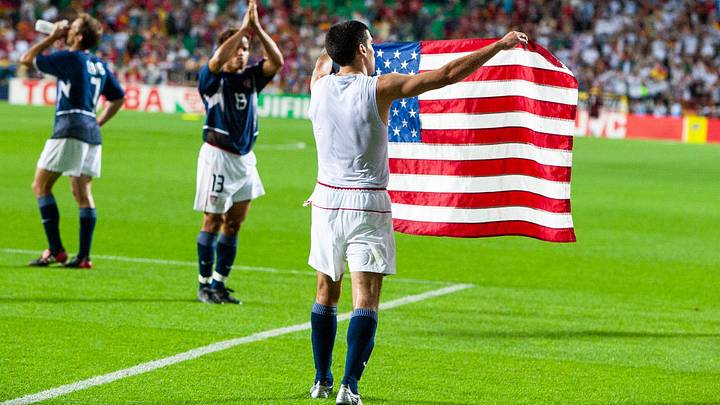
Since that inaugural year, the Stars and Stripes have competed in 11 total World Cups, including 2026. Across its 10 completed campaigns, the U.S. has advanced to the round of 16 six times, however, across those six occasions, the USMNT has achieved victory just once. It was on June 17, 2002, a pleasant, sunny day in South Korea’s Jeonju Stadium when the U.S. gloriously defeated North American rivals Mexico to advance to the quarterfinals and rewrite its history in the modern era of the tournament.
While the USMNT seeks another rewrite this summer, and this time in front of home supporters all across the nation, here’s a breakdown of the U.S.’s unprecedented run at the 2002 World Cup in Japan and South Korea, the team’s ultimate World Cup performance to date.
Qualification

When the USMNT took the pitch against Jamaica in its final 2002 World Cup qualifying opportunity, the Americans carried the weight of more than just the slimmest of odds of clinching a tournament spot.
It was Oct. 7, 2001 at the old Foxboro Stadium just outside of Boston. It was the first time a U.S. national team, of any sport, represented the country following the September 11 attacks, marking a deeply patriotic affair for a nation still grieving.

After three consecutive qualifier losses, the Stars and Stripes not only needed a victory against Jamaica, but also a tie in the match between Costa Rica and Mexico and a miracle win for minnows Trinidad & Tobago against Honduras.
Compounding the intensity of the day was the U.S.’s invasion of Afghanistan, which happened just hours before kickoff and marked the beginning of a 20-year war. The military operation knocked the U.S.’s match off of live broadcast, leaving the players and the stadium’s 40,483 fans in a world of their own.
The gritty battle was locked at 1–1 in the 81st minute, when 19-year-old Landon Donovan was taken down in the box. Moore volunteered for the penalty kick and nailed it into the lower right-hand corner to give the USMNT the lead. The team dug deep for the remaining minutes and walked away with the imperative win.

The U.S. had achieved the resulted it needed, and the players waited in suspense on the pitch to hear the results of the other two games. The stadium’s announcer soon revealed that Costa Rica and Mexico had ended in a 0–0 draw and, minutes later, that Trinidad & Tobago had miraculously upset Honduras, 1–0, punching the U.S.’s ticket to the 2002 World Cup.
USMNT’s 2002 World Cup Campaign
A memorable run with some of the most notable wins in our history.
— U.S. Soccer Men's National Team (@USMNT) June 1, 2026
This is 26 USMNT Moments: Past to Present.
Ep. 16 - 2002 FIFA World Cup 🎬 https://t.co/ZSD5XPvM0a pic.twitter.com/FmFBF2k9RY
Nobody gave much thought to the U.S. It was placed in Group D against European powerhouse Portugal, co-host South Korea and Poland and entered the tournament on a 1–8–1 record in World Cup play since 1990, which was the team’s first World Cup back after its long drought.
The USMNT was given 300-1 odds of winning the tournament.
Group D

With nothing to lose and the thrill of unexpected World Cup qualification still top of mind, the USMNT threw everything it had at Portugal in the opening match. Its high press caught the European giants off guard. Within the first 35 minutes, the Stars and Stripes were up 3–0, leaving the crowd too stunned to speak.
Donovan said: “At halftime, it was basically hold on for dear life because we know the onslaught is coming.”
Portugal closed the gap to 3–2 by the 71st minute; however the U.S. still managed to walk away with the win, a victory that set to the tone for the underdogs for the rest of the tournament.
The team secured a 1–1 draw against South Korea in front of a stadium of 60,778 home supporters five days later, and although the U.S. subsequently lost 3–1 to Poland, it still advanced to the round of 16 after the Koreans upset Portugal 1–0 to send the heavyweights packing.
Group D
Pos. | Nation | Played | Won | Drawn | Lost | Points |
|---|---|---|---|---|---|---|
1. | Korea | 3 | 2 | 1 | 0 | 7 |
2. | U.S. | 3 | 1 | 1 | 1 | 4 |
3. | Portugal | 3 | 1 | 0 | 2 | 3 |
4. | Poland | 3 | 1 | 0 | 2 | 3 |
Knockout Stages

Once again, it was a miracle that the U.S. advanced. With every ounce of luck, the team grew hungrier and hungrier.
Just three days after the loss to Poland, the U.S. entered the round of 16 bruised and beaten. It was brought head-to-head with familiar foe Mexico, who had topped Group G against Italy, Croatia and Ecuador.
“That was the best that we possibly get in the entire World Cup,” Pope said about drawing Mexico. “We knew them...It wasn't because they were an easy team to beat. It was just that we felt like we could beat them. It was the opportunity to beat Mexico in a World Cup. Forget all the other matches. This was the ultimate.”
“It was not on anybody's mind that we were going home,” forward Earnest Stewart added.
As if the Americans needed any more fire in their bellies, President George W. Bush phoned into the locker room just before kickoff. “The country is really proud of the team,” the President said. “A lot of people that don't know anything about soccer, like me, are all excited and pulling for you.”
The U.S. walked away with a 2–0 win over its Concacaf rivals, despite the increasing physicality Mexico played with, culminating in Rafa Marquez head-butting Cobi Jones in the 88th minute.

The U.S. now found itself in unfamiliar terrain: the quarterfinals, and face-to-face with a mighty foe: Germany.
“You always know Germany's going to be extremely good,” forward Brian McBride said. “But we went into that game with the same mentality. We have to believe that we win the match. We didn't sit back. We were very organized. We had to try and hit them on the counter and really be direct going forward as possible.”
The European heavyweights found the back of the net late in the first half to take the lead; however, the U.S. had a brilliant chance to respond just minutes into the second half off a corner kick from Reyna. Gregg Berhalter volleyed a goal-bound shot, before it rebounded and hit the hand of German player Torsten Frings. Although the U.S. shouted for a hand ball, the Scottish referee Hugh Dallas did not see it, and this was well before the introduction of Video Assistant Referee (VAR).
The USMNT's stellar 2002 World Cup run ended in controversy after THAT missed handball vs Germany.
— FOX Soccer (@FOXSoccer) March 24, 2018
82 days away from the FIFA World Cup, it's Moment No. 8️⃣2️⃣ in our #100Moments countdown. pic.twitter.com/ycQXVShUCo
That play could have resulted in a penalty kick for the U.S. and changed the entire outcome of the game. Instead, Germany walked away with the victory and a spot in the semifinals.
“It was a 100 percent penalty,” then-USMNT manager Bruce Arena said. “I hate to say we were cheated out of it. ... We had the momentum in the game. We controlled the game. We would have beaten Germany and gone on to the semifinals. One of my conclusions out of that is that we still as a country had not earned the respect of the world."
Legacy
🇺🇸 104 years ago today the @USMNT's official story began. It has gone on to include reaching the semi-finals at the 1st #WorldCup, producing 'The Miracle of Belo Horizonte', beating Mexico to make the 2002 quarter-finals, THAT victory over Spain & 6 @GoldCup conquests ❤️🤍💙 pic.twitter.com/1bnb5JxjzS
— FIFA (@FIFAcom) August 20, 2020
Despite its heartbreaking and controversial end, the U.S.’s 2002 World Cup run put the nation firmly on the map in the world of soccer.
“It gave everybody a good sense of hope of the future of the national team,” Reyna said. “If we could play against someone like Germany, I think everybody felt we were moving in a good direction...It was just such a positive way to go out of a tournament. Sometimes you go out in a really bad way, unsportsmanlike behavior. We went out with our heads held high.”
Donovan added: “The irony is [that Germany match] was the best game we played in the whole tournament. We were really good that day...There was an immense sense of pride from our guys.”
A deep run for the U.S. at this summer’s World Cup would be more expected than in 2002. The team boasts a group of players more talented than ever before. Showing the same hunger as in 2002 will be key to glory and another ultimate performance.
READ THE LATEST WORLD CUP NEWS, ANALYSIS AND INSIGHT FROM SI FC
 Add us as a preferred source on Google
Sophia Vesely is a writer, reporter and editor for SI FC, with an emphasis on North American coverage. Her experience comes from regional journalism as a former sports reporter for the Orlando Sentinel, Dallas Morning News and Seattle Times. Vesely graduated from Swarthmore College, where she played collegiate soccer as a wingback. She specializes in MLS, NWSL and NCAA soccer.