%20%20--%3E%0A%3Csvg%20version%3D%221.1%22%20id%3D%22Layer_1%22%20xmlns%3D%22http%3A%2F%2Fwww.w3.org%2F2000%2Fsvg%22%20xmlns%3Axlink%3D%22http%3A%2F%2Fwww.w3.org%2F1999%2Fxlink%22%20x%3D%220px%22%20y%3D%220px%22%0A%09%20width%3D%2239px%22%20height%3D%2240px%22%20viewBox%3D%220%200%2039%2040%22%20enable-background%3D%22new%200%200%2039%2040%22%20xml%3Aspace%3D%22preserve%22%3E%0A%3Cpath%20fill%3D%22%23FFFFFF%22%20d%3D%22M38.5%2C7H28.2v26h10.3V7z%22%2F%3E%0A%3Cpath%20fill-rule%3D%22evenodd%22%20clip-rule%3D%22evenodd%22%20fill%3D%22%23FFFFFF%22%20d%3D%22M26.1%2C25.5c0%2C5.8-4.1%2C7.5-12.9%2C7.5C3.9%2C33%2C0%2C31.2%2C0%2C25.2v-1.1h11.6%0A%09v2.4c0%2C0.7%2C0.1%2C1.4%2C1.2%2C1.4c1%2C0%2C1.2-0.4%2C1.2-1.3v-0.9c0-1.6-0.9-1.6-3.5-2.2C2.2%2C21.7%2C0%2C19.7%2C0%2C15.3v-0.9C0%2C9.3%2C5.5%2C7%2C12.9%2C7%0A%09c10.2%2C0%2C12.8%2C2.6%2C12.8%2C7.4v1.8h-11v-2.9c0-0.6-0.4-1.1-1.2-1.1c-0.6%2C0-1.2%2C0.4-1.2%2C1.1v0.9c0%2C1.5%2C0.9%2C2%2C3.3%2C2.5%0A%09c8%2C1.6%2C10.5%2C3.3%2C10.5%2C7.5V25.5z%22%2F%3E%0A%3C%2Fsvg%3E%0A)
USMNT’s Predicted World Cup Lineup Following Roster Reveal
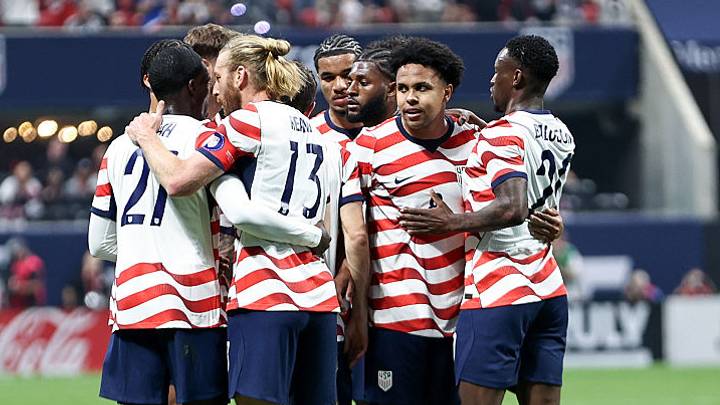
U.S. national team manager Mauricio Pochettino said he had many sleepless nights in the lead up to naming his official 26-player roster for the World Cup this summer, receiving just “three, four hours every night” while mulling over his final decisions ahead of Tuesday’s unveiling.
Well, unfortunately for Pochettino, the sleepless nights might continue. Even though he now has his group, the Argentine boss must determine not only which assembly of 11 should comprise the starting lineup, but also which formation they should set up in. The ability to down global powerhouses en route to a historic run at the tournament rests upon his correct decision-making.
In the past six international friendlies alone, dating back to the October international window, Pochettino has experimented with 28 different players in the USMNT’s starting lineup and four different formations, making it nearly impossible to predict who and what Pochettino will choose.
The upcoming pre-tournament friendlies against Senegal and Germany will be the most enlightening as to Pochettino’s thought process and who he anticipates relying on most. With World Cup kick off just over two weeks away, the 54-year-old will likely not concern himself with further experimentation, instead honing in on the knowledge that he already has. His focus during the final camp will solely be to determine the most synchronized groupings of players.
Nevertheless, here is how Pochettino could choose to line up the Stars and Stripes in the upcoming friendlies and in the World Cup next month.
4-2-3-1 Formation

Pochettino most recently relied upon the 4-2-3-1 formation in the March international window against Belgium, a match that ended in a 5–2 loss. Although Weston McKennie actually featured as a right winger in that friendly, opening the game’s scoring in the 38th minute, transitioning the Juventus star to the central midfield, where he can form a double pivot with Bournemouth defensive midfielder Tyler Adams, is a strong option. The two create a dynamic partnership in the center of the pitch, something Adams even spoke to on Tuesday.
“I am confident if I play by myself or if I play double pivot with someone like Weston, who I have chemistry with,” Adams said in a press conference.
With Sergiño Dest back from his two-month injury and quickly returning to full form, there is no doubt that Pochettino will rely upon the PSV Eindhoven star at right back in his starting lineup. The American is elite at beating defenders with a few silky moves, kickstarting an attack in transition that leaves opponents chasing ghosts on the right flank.
Pochettino is also likely to turn to Malik Tillman at the attacking midfield position; however, the Bayer Leverkusen star is also strong on the wing, meaning he could easily slide over to the right and take the place of Tim Weah, leaving the likes of Sebastian Berhalter, Brenden Aaronson or Gio Reyna to replace him at the No. 10 role. Regardless of who slides into that No. 10 position, though, they will have enough support behind them in the pairing of Adams and McKennie.
3-4-2-1 Formation

Pochettino experimented with the 3-4-2-1 formation in both of the November friendlies, a 5–1 win over Uruguay and 2–1 win over Paraguay. It is a formation that is innately defense-minded, especially against teams whose attacks run predominantly through the center of the pitch, given the additional midfield support the back three has in front of them.
Once again, Pochettino could rely on the prowess of Adams and McKennie in central midfield, both of whom are comfortable showing off their defensive skillsets.
Regardless of the formation, Crystal Palace’s Chris Richards will be tasked with holding down the U.S.’s backline. He is the strongest defender the Stars and Stripes have, led by his tactical fluidity, poise on the ball and aerial capabilities. If Richards is flanked by veteran captain Tim Ream and Mark McKenzie, the backline will prove especially defense-minded, as all three are true center backs.
McKenzie and Ream are not as keen to get forward as Pochettino’s fullback options, such as Alex Freeman, an important consideration against a global powerhouse that requires a defense-first mentality.
3-4-3 Formation

Pochettino trialed the 3-4-3 formation in the October window, crucially in a 2–1 win over Australia, who the U.S. will face again in Group D play this summer.
This formation feels a bit more balanced compared to the 3-4-2-1 as well as attack-minded, given the use of three forwards. Coventry City striker Haji Wright earned the start in that match against Australia, netting a brace for the win. Pochettino could easily choose to rely on him again on the frontline, flanked by superstar Christian Pulisic and McKennie.
Pochettino could also place Berhalter alongside Adams in the midfield, as Berhalter has the tactical versatility of playing as both a traditional central midfielder and attacking midfielder for the U.S., meaning he could bring vertical fluidity to the relatively flat midfield line. Arfsten is a solid option at left wing-back, clocking 90 minutes in that position against Ecuador, a friendly that ended in a 1–1 draw.
READ THE LATEST USMNT NEWS, ANALYSIS AND INSIGHT FROM SI FC
 Add us as a preferred source on Google
Sophia Vesely is a writer, reporter and editor for SI FC, with an emphasis on North American coverage. Her experience comes from regional journalism as a former sports reporter for the Orlando Sentinel, Dallas Morning News and Seattle Times. Vesely graduated from Swarthmore College, where she played collegiate soccer as a wingback. She specializes in MLS, NWSL and NCAA soccer.