%20%20--%3E%0A%3Csvg%20version%3D%221.1%22%20id%3D%22Layer_1%22%20xmlns%3D%22http%3A%2F%2Fwww.w3.org%2F2000%2Fsvg%22%20xmlns%3Axlink%3D%22http%3A%2F%2Fwww.w3.org%2F1999%2Fxlink%22%20x%3D%220px%22%20y%3D%220px%22%0A%09%20width%3D%2239px%22%20height%3D%2240px%22%20viewBox%3D%220%200%2039%2040%22%20enable-background%3D%22new%200%200%2039%2040%22%20xml%3Aspace%3D%22preserve%22%3E%0A%3Cpath%20fill%3D%22%23FFFFFF%22%20d%3D%22M38.5%2C7H28.2v26h10.3V7z%22%2F%3E%0A%3Cpath%20fill-rule%3D%22evenodd%22%20clip-rule%3D%22evenodd%22%20fill%3D%22%23FFFFFF%22%20d%3D%22M26.1%2C25.5c0%2C5.8-4.1%2C7.5-12.9%2C7.5C3.9%2C33%2C0%2C31.2%2C0%2C25.2v-1.1h11.6%0A%09v2.4c0%2C0.7%2C0.1%2C1.4%2C1.2%2C1.4c1%2C0%2C1.2-0.4%2C1.2-1.3v-0.9c0-1.6-0.9-1.6-3.5-2.2C2.2%2C21.7%2C0%2C19.7%2C0%2C15.3v-0.9C0%2C9.3%2C5.5%2C7%2C12.9%2C7%0A%09c10.2%2C0%2C12.8%2C2.6%2C12.8%2C7.4v1.8h-11v-2.9c0-0.6-0.4-1.1-1.2-1.1c-0.6%2C0-1.2%2C0.4-1.2%2C1.1v0.9c0%2C1.5%2C0.9%2C2%2C3.3%2C2.5%0A%09c8%2C1.6%2C10.5%2C3.3%2C10.5%2C7.5V25.5z%22%2F%3E%0A%3C%2Fsvg%3E%0A)
Why Gabriel Is Arsenal’s Perfect Fall Guy for Champions League Heartbreak
At the end of the film The Commitments, when the band that so nearly cracked it disintegrates, the conclusion drawn is: “Sure, we could have been famous and made albums and stuff, but that would have been predictable. This way it’s poetry.”
After 22 years of angst and agony, Arsenal had the chance to erase all that pain in the space of 11 days. Capturing the Premier League title brought an end to the domestic suffering (albeit a very elitist type of suffering where the nadir is eighth place) and Champions League glory less than two weeks later would have crowned the greatest campaign in the club’s history. But where’s the narrative arc in that?
The celebrations in north London and beyond were so joyous and enduring largely because those fans had been forced to wait two decades to celebrate being the best team in England. To then be crowned champions of Europe in Mikel Arteta’s first final could have felt a bit hurried. There is more poetic suffering to be had.
Not that this will be a popular opinion. As the reply in The Commitments points out: “It’s a pisser is what it is, Joey.”
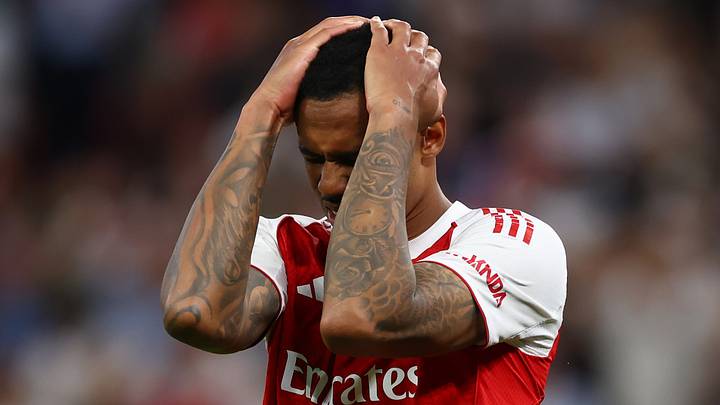
No one felt that more than Gabriel, the player who missed the decisive spot kick in Arsenal’s penalty shootout defeat to Paris Saint-Germain. Yet, no other member of the Gunners’ roster is better equipped to not only endure that pain but channel it into some positive.
What Happened Before Gabriel’s Penalty Is More Telling Than His Miss

“I always say, ‘When you go and take the penalty I will always have respect for you,’” Arsenal icon Thierry Henry reflected after the spot kicks. Yet, the club’s record scorer was still bemused as to why Gabriel, a center back who had never before taken a penalty for the Gunners under any competitive setting, was given the nod at such a decisive point of the shootout.
“I don’t know why he went,” Henry admitted, “I don’t know how he arrived to be the fifth guy. But he went.”
Gabriel took on the responsibility because he had asked for it. “He wanted to take number five,” Arteta confirmed postgame. Could you blame him?
On the back of an individual campaign which saw him rightly nominated for the Premier League Player of the Season award, Gabriel once again rose to the occasion in Budapest. After finding themselves 1–0 up with 84 minutes of the final to play, Arsenal were condemned to sit back and defend the best attacking team on the planet. It was not Arteta’s plan—“They force you to do that,” he explained—but Gabriel undoubtedly relished the task.
The “King of Brazil,” as he has been christened by Arsenal fans, leapt off his throne to continually thwart the princely pitter-patter of PSG’s frontline. There were last-ditch blocks, desperate lunges and wild celebrations for all of the above.
Shootouts are a question of confidence as much as technique when it comes to the elite level of a Champions League final. Few could have been feeling as high as Gabriel after limiting this glittering iteration of PSG to a non-penalty xG of 0.93. The fates didn’t fall his way on this occasion, but Arsenal’s resilient leader has proven capable of responding to plenty of setbacks in the past.
Gabriel’s History of Bouncing Back

During his second season as an Arsenal player, Gabriel was asked by the club to name his favorite atmosphere from any game across his opening 18 months in north London. It was telling that his mind went straight to a comeback victory over Wolverhampton Wanderers, a match defined—in Gabriel’s mind, at least—by his blunder for the game’s opening goal.
“Only if you’re on the inside can you know what it feels like to make that type of mistake,” Gabriel recalled. “That’s something you can watch back and learn from.”
That capacity to learn and correct his errors is one which has played out in real time over the subsequent years.
After again giving up a goal against Fulham in August 2022, Gabriel raced to the other end of the pitch to score. “After I lose the ball, my head is down,” the Brazilian explained at the time. “But I look at my brothers, they say, ‘Gabi, let’s go, let’s go!’, and I put my head up.”

This season alone, Gabriel was at fault for opening goals gobbled up by Newcastle United and Bournemouth. On each occasion, he would singlehandedly rectify his mistake with a goal. As Arteta pointed out: “It’s not a coincidence with Gabi.”
It can be forgotten that Arteta briefly lost faith in his defensive totem. After a summer littered with links of a lucrative move away to Saudi Arabia, Gabriel was dropped for three league games in the 2023–24 season.
“Sometimes you just need to sit down on the bench and realize things,” Arteta pointedly noted. Gabriel accepted his punishment and has scarcely been left out since, becoming, in the words of his manager, “a much better player.”
This capacity to respond to setbacks is one which has been prevalent throughout Gabriel’s professional career.
Arsenal’s Very Own Mentality Monster

Homesickness got the better of Gabriel when he first move 300 miles across Brazil to play for Avaí FC in Florianópolis. He only lasted a week. After some reflection, the teenager was convinced to once again leave the safety of São Paulo, this time sticking it out for five years before getting his break in Europe with Lille.
“It was a period when I learned a lot and it made a big difference in terms of helping me become the player I am,” Gabriel later explained. “When I’m on the pitch now, I think back to those difficult times and use them to help me.”
The towering center back suffered another setback when he made it to Lille, failing to break into the first team and getting sent on loan to Dinamo Zagreb. Satisfied with life in Croatia, Gabriel was keen to stay only to be strong-armed into a return to France by Luís Campos.
The revered sporting director—who just so happens to have masterminded PSG’s transformation under Luis Enrique—was not going to let Gabriel’s talent go to waste. Campos judges a player on his mentality as much as his technical capacity—and few stand out as clearly as Gabriel.
— Luis Campos (@luiscamposFoot) November 12, 2025
Campos revealed the question he asks himself when judging “adversity capacity.” When a mistake happens, is it fixed fast? In the case of Gabriel, the answer is often a resounding yes.
The cruel fate of taking the last penalty ensures that Arsenal’s mentality monster will have to stew on his failure for weeks. This is where a player hailed by his teammates as the squad’s “bodyguard” needs some protection of his own.
Declan Rice was the first to offer that. “Obviously it’s not nice,” the midfielder accepted when reflecting on the misses of Eberechi Eze and Gabriel. “But we love them and we’re with them. It happens in football.”
“Gabriel,” Rice added, “I’ve ran out of words for him as a person, as a player.”
There was also the touching sight of PSG captain Marquinhos being the first to embrace his sobbing compatriot. The experienced international knows Gabriel’s struggles all too well after watching his spot kick clank off the post as Brazil crashed out of the 2022 World Cup to Croatia. Much like Gabriel, that was the first penalty of his senior career.
There will be more tears and nights of torment for Arsenal’s beaten battler, but if there is any player capable of shouldering the burden of this disappointment, it’s Gabriel.
READ THE LATEST ARSENAL NEWS, ANALYSIS AND INSIGHT FROM SI FC
 Add us as a preferred source on Google
Grey Whitebloom is an Associate Editor for SI FC. He has more than half a decade of experience in sports media across all its various guises, from the fast-paced demands of news articles and match reports to in-depth research required for features. Whitebloom graduated with a First Class Honours from University College London and found himself named on the Dean’s List—which, despite his initial fears, was a form of praise rather than a punishment. He specialises in the Premier League and Champions League, while also boasting an extensive track record of La Liga coverage.