%20%20--%3E%0A%3Csvg%20version%3D%221.1%22%20id%3D%22Layer_1%22%20xmlns%3D%22http%3A%2F%2Fwww.w3.org%2F2000%2Fsvg%22%20xmlns%3Axlink%3D%22http%3A%2F%2Fwww.w3.org%2F1999%2Fxlink%22%20x%3D%220px%22%20y%3D%220px%22%0A%09%20width%3D%2239px%22%20height%3D%2240px%22%20viewBox%3D%220%200%2039%2040%22%20enable-background%3D%22new%200%200%2039%2040%22%20xml%3Aspace%3D%22preserve%22%3E%0A%3Cpath%20fill%3D%22%23FFFFFF%22%20d%3D%22M38.5%2C7H28.2v26h10.3V7z%22%2F%3E%0A%3Cpath%20fill-rule%3D%22evenodd%22%20clip-rule%3D%22evenodd%22%20fill%3D%22%23FFFFFF%22%20d%3D%22M26.1%2C25.5c0%2C5.8-4.1%2C7.5-12.9%2C7.5C3.9%2C33%2C0%2C31.2%2C0%2C25.2v-1.1h11.6%0A%09v2.4c0%2C0.7%2C0.1%2C1.4%2C1.2%2C1.4c1%2C0%2C1.2-0.4%2C1.2-1.3v-0.9c0-1.6-0.9-1.6-3.5-2.2C2.2%2C21.7%2C0%2C19.7%2C0%2C15.3v-0.9C0%2C9.3%2C5.5%2C7%2C12.9%2C7%0A%09c10.2%2C0%2C12.8%2C2.6%2C12.8%2C7.4v1.8h-11v-2.9c0-0.6-0.4-1.1-1.2-1.1c-0.6%2C0-1.2%2C0.4-1.2%2C1.1v0.9c0%2C1.5%2C0.9%2C2%2C3.3%2C2.5%0A%09c8%2C1.6%2C10.5%2C3.3%2C10.5%2C7.5V25.5z%22%2F%3E%0A%3C%2Fsvg%3E%0A)
How Novak Djokovic Defied Time—And Himself—to Win Longest Wimbledon Quarterfinal Ever
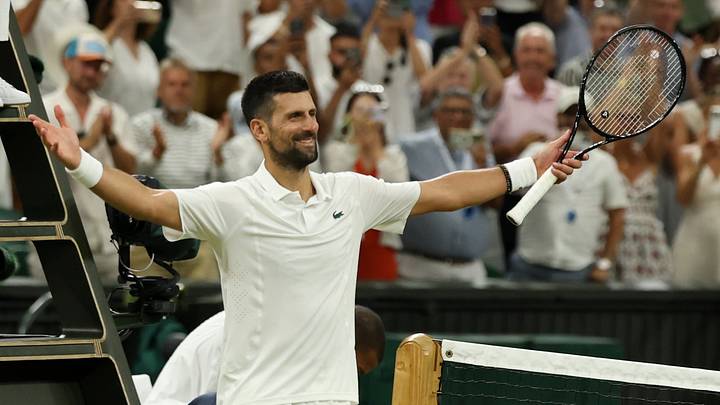
Novak Djokovic has done it again.
Tennis’s Benjamin Button, at 39 years young, outlasted 25-year-old Felix Auger-Aliassime in five hours and 15 minutes, the longest Wimbledon quarterfinal ever, to advance to the semifinal and a date with world No. 1 Jannik Sinner.
Give credit where credit is due to Aliassime, who came as close to besting Djokovic on Center Court as anyone has. The Canadian fired more winners than Djokovic, converted the oh-so-crucial break points at a better rate, and joined Roger Federer as the only players to push the Serbian to a fifth-set tiebreak at Wimbledon. In the end, it wasn’t enough.
Djokovic on Tuesday did what he has done his entire life and pro tennis career: he overcame. A boy hardened by a childhood spent in a war-torn Serbia bombed by NATO, a young man who conquered his troubles with physical fitness, a veteran who battled disapproval from tennis fans as a Roger Federer-Rafael Nadal party crasher partly by exceeding the career achievements of both men.
Djokovic is built on resilience. That was on full display on Center Court against Aliassime.
Father Time perhaps came knocking on Djokovic’s door in the first set with the Serbian on serve at 4-all. Djokovic, who had spent 11 hours and 17 minutes on the court before Tuesday’s match, gripped at his left calf after a backhand. He went on to hold serve to go up 5-4, but grimaced in pain and stretched out his leg before calling for the physiotherapist and a medical timeout.
The 39-year-old, still seemingly hindered by his leg, staved off a break point at 5-all to take a 6-5 lead. Then, in a marathon first-set tiebreak that was a precursor to the match as a whole, Djokovic gritted his teeth and fought off three Aliassime set points to claim the first set 7-6 (10). Not even his own body, nor a big-serving, powerful baseliner 14 years his junior could stop a teflon-strong Djokovic from victory in the first-set tiebreak.
Throughout points of the match, Djokovic seemed to battle himself, his focus wavering. The greatest returner of serve in tennis history, with an ironclad focus in such situations, only won 33% of receiving points and converted just two of 13 break points.
At one point, he even continued the fight off the court.
After Aliassime claimed the second set, a vexed Djokovic, succumbing to his own frustrations, took Wimbledon tournament referee Denise Parnell to task when the decision was made to close the Center Court roof at 7:40 p.m.
“We can play a whole another set outdoors. We're an outdoor tournament," Djokovic said. "You remember the first round? You didn't close it until like 8:20, 8:30 and now you want to close it at 7:40. Where's the consistency? You're so proud of your rules and you're not sticking to any kind of rules.”
Djokovic quickly put his irritation in the rearview and won the third set 6-3 on the strength of a clinical serving performance in which he connected on 81% of his first serves.
When Aliassime went big on the baseline, the Serbian, stretching left and right like his body was made of elastic to defend the court, had the answer. The fifth-set super tiebreak was Djokovic at his best. Having navigated so many nerve-filled moments in his career, Djokovic simply kept making shot after shot, forcing a suddenly error-prone Aliassime to play one more ball.
The strategy paid off—Aliassime made six unforced errors in the tiebreak—and Djokovic was the last man standing in the marathon match. How did he pull it off?
“With racket and a lot of heart and management of the nerves," Djokovic said on court after the win. “These are the kind of moments that I still play tennis for.”
39-year-olds aren’t supposed to be this good at tennis, especially for five hours and 15 minutes of grueling tennis. But this 39-year-old is the oldest semifinalist at a major since 42-year-old Ken Rosewall at the 1977 Australian Open.
In a way, it was fitting that Djokovic, six minutes before the 11 p.m. curfew time at the All-England Club, emerged victorious. Time, both literal and Father, would have to wait.
More from Sports Illustrated
 Add us as a preferred source on Google
Tim Capurso is a staff writer for Sports Illustrated, primarily covering MLB, college football and college basketball. Before joining SI in November 2023, Capurso worked at RotoBaller and ClutchPoints and is a graduate of Assumption University. When he's not working, he can be found at the gym, reading a book or enjoying a good hike. A resident of New York, Capurso openly wonders if the Giants will ever be a winning football team again.
Follow TimCapurso