%20%20--%3E%0A%3Csvg%20version%3D%221.1%22%20id%3D%22Layer_1%22%20xmlns%3D%22http%3A%2F%2Fwww.w3.org%2F2000%2Fsvg%22%20xmlns%3Axlink%3D%22http%3A%2F%2Fwww.w3.org%2F1999%2Fxlink%22%20x%3D%220px%22%20y%3D%220px%22%0A%09%20width%3D%2239px%22%20height%3D%2240px%22%20viewBox%3D%220%200%2039%2040%22%20enable-background%3D%22new%200%200%2039%2040%22%20xml%3Aspace%3D%22preserve%22%3E%0A%3Cpath%20fill%3D%22%23FFFFFF%22%20d%3D%22M38.5%2C7H28.2v26h10.3V7z%22%2F%3E%0A%3Cpath%20fill-rule%3D%22evenodd%22%20clip-rule%3D%22evenodd%22%20fill%3D%22%23FFFFFF%22%20d%3D%22M26.1%2C25.5c0%2C5.8-4.1%2C7.5-12.9%2C7.5C3.9%2C33%2C0%2C31.2%2C0%2C25.2v-1.1h11.6%0A%09v2.4c0%2C0.7%2C0.1%2C1.4%2C1.2%2C1.4c1%2C0%2C1.2-0.4%2C1.2-1.3v-0.9c0-1.6-0.9-1.6-3.5-2.2C2.2%2C21.7%2C0%2C19.7%2C0%2C15.3v-0.9C0%2C9.3%2C5.5%2C7%2C12.9%2C7%0A%09c10.2%2C0%2C12.8%2C2.6%2C12.8%2C7.4v1.8h-11v-2.9c0-0.6-0.4-1.1-1.2-1.1c-0.6%2C0-1.2%2C0.4-1.2%2C1.1v0.9c0%2C1.5%2C0.9%2C2%2C3.3%2C2.5%0A%09c8%2C1.6%2C10.5%2C3.3%2C10.5%2C7.5V25.5z%22%2F%3E%0A%3C%2Fsvg%3E%0A)
Cathy Engelbert’s Reign Is Over. The WNBA’s Next Leader Must Learn From Her Mistakes.
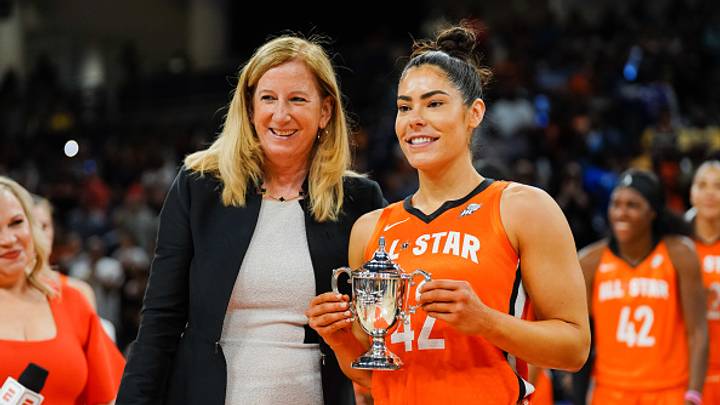
A notable person’s legacy is a fickle thing. Usually it requires some time and years removed for a legacy to really take hold or cement in the public eye, for the crowds to step back and gaze with wonder or awe at someone’s glittering list of accomplishments. But in the case of soon-to-be retired WNBA commissioner Cathy Engelbert, her legacy is already clear, and arguably fraught with more missteps than right decisions.
Engelbert, 61, announced Friday that she will retire at the end of the year, ending her seven-year tenure as head of the WNBA.
“When I first came to the league I intended to do this for 3 1/2 years,” she said, via The Associated Press. “The 7 1/2 years exceeded that time. This is a really good time given the financial transformation journey we’ve been on. Getting the collective bargaining agreement done, getting a long-term media rights deal done, getting expansion done.”
Engelbert, who will end her reign as the second-longest tenured WNBA leader, added that her decision to leave was her own, and she didn’t feel any pressure to step down from stakeholders. Moreover, she has reportedly been mulling over a potential retirement for months.
During one of the most transformative eras of the W, Engelbert can claim a handful of wins, as she briefly pointed out: the new CBA, which resulted in the league’s first-ever million-dollar salaries, and the historic $2.2 billion media rights deal that will continue to help the WNBA grow financially and structurally (the league is set to expand to 18 teams by the end of the decade).
Back in May 2019, Engelbert was brought in to the WNBA as its fifth leader and became the first to be named commissioner. It was, at the time, a fitting job for someone who was the first female CEO at Deloitte. Engelbert wasted no time putting her business acumen, leadership and diplomacy to good use as she helped save the WNBA’s COVID-19–impacted 2020 season with the now-iconic “Wubble.”

Yet, the era Engelbert helped usher in the W has been as transformative as it has been tumultuous in recent years. Sure, it’s easy to brush off the smaller-potato, nitpicky moments, like when she mispronounced Valkyries coach Natalie Nakase’s name before presenting her with the Coach of the Year award in 2025—a very professionally embarrassing move, but by no means a fatal one.
Other missteps are more difficult to forget and have left lasting scars. When Engelbert decided to sell a 16% equity stake in the league for $75 million in 2022, for example, in a desperate move to raise money that was, in retrospect, an egregious undervaluation on Engelbert’s part. Four years ago, Engelbert mathematically valued the entire WNBA at roughly $470 million; today, that’s around the average price of a single franchise.
Cathy Englebert announces that she will retire as WNBA commissioner at the end of the year. She took over in 2019, and next 2 team sales in 2021 were for $2-3M (Las Vegas) and $5M (Atlanta). W average value is now $427M, and No. 1 based on avg revenue multiple. pic.twitter.com/Mf3CmaqgNl
— Kurt Badenhausen (@kbadenhausen) September 4, 2026
Engelbert’s poor foresight has trickled into other areas of her leadership over the years as well. The WNBA’s officiating problem still hasn’t gone away, nor has the residual effects that players were allegedly left to deal with. Earlier this season after Alyssa Thomas’s flagrant foul on Caitlin Clark, the Mercury star said she received death threats and called out Engelbert for staying silent online.
“Time and time again, players are going through this, and the league remains silent. I’m sick and tired of it. It’s time for them to step up and have our backs in these instances,” Thomas told reporters.
For decades, the WNBA existed on the fringe of professional sports as a majority-Black league that included a sizable, openly queer community. Now that the W is receiving more mainstream visibility and popularity, the discourse surrounding the league is too often getting co-opted by non-basketball fans who are only interested in pushing their own agendas and narratives. It’s why Adam Silver called Caitlin Clark a “political football,” as off-putting as that sounds. In this extremely divisive time, Engelbert, for her part, has arguably been too slow to address the broader cultural and controversial issues, or has fumbled too many of her responses.
She made off-the-mark comments on the Caitlin Clark–Angel Reese rivalry back when the two jointly entered the league in 2024 and significantly increased the WNBA’s exposure, attendance and television ratings. In her answer to a question about racialized and toxic online narratives stemming from Clark and Reese’s on-court matchups, Engelbert maintained that the W needed the competition.
“But the one thing I know about sports, you need rivalry,” Engelbert said. “That’s what makes people watch. They want to watch games of consequence between rivals. They don’t want everybody being nice to one another.”
WNBPA executive director Terri Jackson later did some damage control, condemning Engelbert’s comments: “This is not about rivalries or iconic personalities fueling a business model. This kind of toxic fandom should never be tolerated or left unchecked. It demands immediate action, and frankly, should have been addressed long ago.”
Engelbert also dragged her feet addressing Enes Kanter Freedom’s feud with the WNBA, which emerged after Sophie Cunningham spoke about her opposition to transgender participation in women’s sports in an ESPN profile.
And, who could forget the months of icy discord over WNBA labor negotiations, which saw Napheesa Collier slam-dunk on Engelbert in the rant heard ‘round the league at the end of the Lynx’s season.
Here’s a snippet of Collier’s war-waging statement during the peak of CBA tensions:
“We have the best players in the world. We have the best fans in the world. But, right now, we have the worst leadership in the world. If I didn’t know exactly what the job entailed, maybe I wouldn’t feel this way. But unfortunately for them, I do. We serve a league that has shown they think championship coaches and Hall of Fame players are dispensable. And that’s fine, it’s professional sports. But I will not stand quietly by and allow different standards to be applied at the league level.”

Collier added that Engelbert told her: “Players should be on their knees, thanking their lucky stars for the media rights deal that I got them,” and that “only the losers complain about the refs.” Engelbert said she was “disheartened” by how Collier characterized their conversations, but left it at that.
Though the league undeniably thrived and grew at an exponential rate under Engelbert, one could say she did not grow with it. Her mistake-prone, years-long tenure as WNBA head is ultimately one marked by too many instances of poor communication, fractured relationships shaped by mistrust and wavering leadership. Players like Thomas and Collier publicly speaking out against Engelbert year after year would suggest she wasn’t doing a good enough job listening to the people who matter most in the league, the diverse individuals who make up the whole marketable product and whose concerns deserve to be heard, no matter how big or small.
“It’s a good time to hand it off to the next leader to take the ‘W’ into a better phase,” Engelbert said Friday of her retirement decision. “I’m proud of the team we built and everything we accomplished. A leader knows when it’s time to drop the mic and move on after building a powerhouse team in the league office. ... Hopefully I can help this next leader transition in especially considering the elevation of this league.”
If the W’s next leader, whomever he or she might be, can learn from Engelbert’s mistakes and embrace the league for what it has always stood for, the players and the future of the WNBA will be in much better hands.
 Add us as a preferred source on Google
Kristen Wong is a staff writer on the Breaking and Trending News team at Sports Illustrated. She has been a sports journalist since 2020 and has a bachelor’s in English and linguistics from Columbia University. Before joining SI in November 2023, Wong covered four NFL teams as an associate editor with the FanSided NFL network and worked as a staff writer for the brand’s flagship site. She is a lifelong Liverpool fan who enjoys solving crossword puzzles and hanging out at her neighborhood dive bar in NYC.
Follow kriscwong