%20%20--%3E%0A%3Csvg%20version%3D%221.1%22%20id%3D%22Layer_1%22%20xmlns%3D%22http%3A%2F%2Fwww.w3.org%2F2000%2Fsvg%22%20xmlns%3Axlink%3D%22http%3A%2F%2Fwww.w3.org%2F1999%2Fxlink%22%20x%3D%220px%22%20y%3D%220px%22%0A%09%20width%3D%2239px%22%20height%3D%2240px%22%20viewBox%3D%220%200%2039%2040%22%20enable-background%3D%22new%200%200%2039%2040%22%20xml%3Aspace%3D%22preserve%22%3E%0A%3Cpath%20fill%3D%22%23FFFFFF%22%20d%3D%22M38.5%2C7H28.2v26h10.3V7z%22%2F%3E%0A%3Cpath%20fill-rule%3D%22evenodd%22%20clip-rule%3D%22evenodd%22%20fill%3D%22%23FFFFFF%22%20d%3D%22M26.1%2C25.5c0%2C5.8-4.1%2C7.5-12.9%2C7.5C3.9%2C33%2C0%2C31.2%2C0%2C25.2v-1.1h11.6%0A%09v2.4c0%2C0.7%2C0.1%2C1.4%2C1.2%2C1.4c1%2C0%2C1.2-0.4%2C1.2-1.3v-0.9c0-1.6-0.9-1.6-3.5-2.2C2.2%2C21.7%2C0%2C19.7%2C0%2C15.3v-0.9C0%2C9.3%2C5.5%2C7%2C12.9%2C7%0A%09c10.2%2C0%2C12.8%2C2.6%2C12.8%2C7.4v1.8h-11v-2.9c0-0.6-0.4-1.1-1.2-1.1c-0.6%2C0-1.2%2C0.4-1.2%2C1.1v0.9c0%2C1.5%2C0.9%2C2%2C3.3%2C2.5%0A%09c8%2C1.6%2C10.5%2C3.3%2C10.5%2C7.5V25.5z%22%2F%3E%0A%3C%2Fsvg%3E%0A)
Can Miami (Ohio)'s Audacious ACC Plan Actually Work?
In this story:
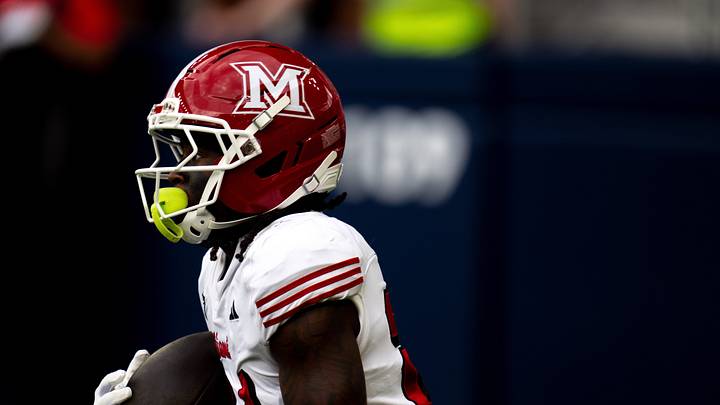
The Mid-American Conference has been in the football business since 1946, and with the exception of the league’s very first season, Miami (Ohio) has been there for every one of them. Since the conference’s first year as a major league by College Football Reference’s standards—1962—only Toledo has won more MAC games than the RedHawks.
It’s a cushy arrangement—and one Miami (Ohio) is starting to talk about dissolving.
“Could I see a reshaped ACC one day where we somehow play a role in that? Yeah, maybe,” athletic director David Sayler told Cameron Teague Robinson of The Athletic in August. That quote’s publication came on the heels of reporting from multiple outlets that connected the RedHawks to the American (in a statement, Sayler said “we don’t focus on hypotheticals”).
What is Miami (Ohio) thinking? Could the RedHawks’ long game actually work? Let’s break down two reasons Sayler’s plan could succeed, and two reasons it could fail.
Point for: The ACC could need new members soon
The final text of the Protect College Sports Act—should it become law—includes language capping the size of Power 4 conferences at 20 schools. However, as Sports Illustrated’s Pat Forde pointed out back on Sept. 18, that provision sunsets in 2031—which could theoretically allow the Big Ten and SEC to merge into a singular superleague, or raid other conferences. Should the latter come to pass, the ACC is swimming in schools that (on paper) could attract either league: Clemson, Duke, Florida State, Miami, North Carolina and others. If the ACC winds up in a retooling mood, it makes sense for Miami (Ohio) to get its house in order to show off to suitors.
Point against: Miami (Ohio) is overestimating its football history
The RedHawks have a .559 winning percentage all-time per College Football Reference, which is a healthy number (North Carolina, Iowa and Stanford aren’t far behind them). They’re the Cradle of Coaches, a legacy that buys them clout in the upper echelons of football. And yet—Miami (Ohio) has finished in the AP Top 25 just four times ever, and just once in the 21st century. Coach Chuck Martin, for all his success over the past 13 years, has just two MAC titles to his name. Is the MAC holding the RedHawks back, or is the program just not the football capital-N Name it thinks it is? The fact we have to ask this question shows Miami (Ohio) should look before it leaps.

Point for: Miami (Ohio) fits in academically with the ACC
“We are very much like Virginia Tech, Syracuse, Georgia Tech, Wake Forest or Duke, in terms of the size and the kinds of things that we offer academically,” Sayler said. He’s right: The school of a little over 16,000 frequently lands on lists of “Public Ivies” and has a sterling regional reputation, particularly in the business world.
“The most beautiful campus that ever there was” (poet Robert Frost’s famous words) is a bit of an outlier in a MAC dominated by ex-normal schools. Where the university has plenty of regional friends in its current home, it would make fast cultural friends in its new one.
Point against: There are so many quality college athletic programs within striking distance of Cincinnati and Dayton that Miami (Ohio) will get lost
If you can name a power-conference (or high-mid-major) school near the Indiana-Kentucky-Ohio point of intersection, it’s probably near Miami (Ohio). Cincinnati, a longtime rival, is 37 miles away (Xavier is 35). Dayton, where the RedHawks opened their NCAA men’s tournament campaign in 2026, is 44. Ohio State is 120; Indiana is 131; Kentucky is 121; Louisville is 141. Does this corridor really need another power-conference sports team? Market saturation has been the death of many a college sports team, so for the time being it might behoove Miami (Ohio) to continue to hide.
PODCAST: Listen to Sports Illustrated’s college sports podcast, Others Receiving Votes, hosted by Pat Forde, on Apple and Spotify. Watch the show on SI’s college YouTube channel or on SI TV.
 Add us as a preferred source on Google
Patrick Andres is a staff writer on the Breaking and Trending News team at Sports Illustrated. He joined SI in December 2022, having worked for The Blade, Athlon Sports, Fear the Sword and Diamond Digest. Andres has covered everything from zero-attendance Big Ten basketball to a seven-overtime college football game. He is a graduate of Northwestern University's Medill School of Journalism with a double major in history .
Follow PAndres2001