%20%20--%3E%0A%3Csvg%20version%3D%221.1%22%20id%3D%22Layer_1%22%20xmlns%3D%22http%3A%2F%2Fwww.w3.org%2F2000%2Fsvg%22%20xmlns%3Axlink%3D%22http%3A%2F%2Fwww.w3.org%2F1999%2Fxlink%22%20x%3D%220px%22%20y%3D%220px%22%0A%09%20width%3D%2239px%22%20height%3D%2240px%22%20viewBox%3D%220%200%2039%2040%22%20enable-background%3D%22new%200%200%2039%2040%22%20xml%3Aspace%3D%22preserve%22%3E%0A%3Cpath%20fill%3D%22%23FFFFFF%22%20d%3D%22M38.5%2C7H28.2v26h10.3V7z%22%2F%3E%0A%3Cpath%20fill-rule%3D%22evenodd%22%20clip-rule%3D%22evenodd%22%20fill%3D%22%23FFFFFF%22%20d%3D%22M26.1%2C25.5c0%2C5.8-4.1%2C7.5-12.9%2C7.5C3.9%2C33%2C0%2C31.2%2C0%2C25.2v-1.1h11.6%0A%09v2.4c0%2C0.7%2C0.1%2C1.4%2C1.2%2C1.4c1%2C0%2C1.2-0.4%2C1.2-1.3v-0.9c0-1.6-0.9-1.6-3.5-2.2C2.2%2C21.7%2C0%2C19.7%2C0%2C15.3v-0.9C0%2C9.3%2C5.5%2C7%2C12.9%2C7%0A%09c10.2%2C0%2C12.8%2C2.6%2C12.8%2C7.4v1.8h-11v-2.9c0-0.6-0.4-1.1-1.2-1.1c-0.6%2C0-1.2%2C0.4-1.2%2C1.1v0.9c0%2C1.5%2C0.9%2C2%2C3.3%2C2.5%0A%09c8%2C1.6%2C10.5%2C3.3%2C10.5%2C7.5V25.5z%22%2F%3E%0A%3C%2Fsvg%3E%0A)
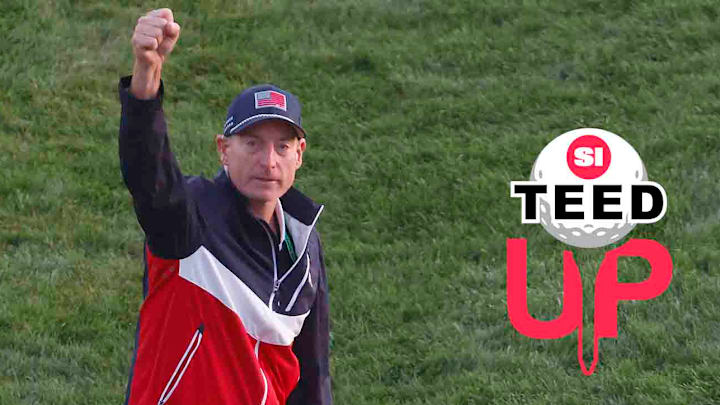
Why Jim Furyk Was the Only Option for the U.S. Ryder Cup Team
The PGA of America was behind in its announcement of its next U.S. Ryder Cup captain, delayed by Tiger Woods’s indecision prior to deciding to pull his name from consideration following his March 27 arrest on suspicion of DUI in the aftermath of a crash near his Florida home.
Much like two years ago, Woods was the PGA of America’s No. 1 choice, but then they pivoted to the “outside-the-box” pick of Keegan Bradley.
This time, the decision was to go to a former captain who lost by a wide margin and has one of the worst playing records in U.S. Ryder Cup history.
MORE FROM BOB HARIG: Bottomless Money in Pro Golf Is Over
Perhaps the lack of fanfare on Friday was due to the negativity that was sure to follow. The Associated Press reported that Jim Furyk was getting the job, and it was later in the day that the PGA of America sent out a news release confirming the decision.
If there is to be a big news conference to celebrate the occasion, it has yet to be announced.
After consecutive losses, including in September at Bethpage—the first U.S. home defeat since 2012—there was a sense that the leadership needed to forge a new path, get new blood, blow things up.
Instead, it went to a captain who lost 17½ to 10½ in Paris in 2018 and featured bickering among a few of his players. The same guy who went 10–20–4 across nine Ryder Cup appearances and played on only two winning teams.
So, yeah, there’s going to be some consternation over the choice of Furyk.
Then there’s this: who else?
Without Tiger or Phil, the candidate pool is shallow
Certainly circumstances have changed since the seemingly lock choices of Phil Mickelson and Woods, both of whom were destined for the captain’s role but have yet—and may never—serve. But if you’re going to call out playing records, Mickelson has the most losses of any player with an 18–22–7 record across 12 Ryder Cups. Only three were U.S. wins. Woods went 13–21–3 in eight Ryder Cups, playing on just one winning team.
The U.S. doesn’t have a lot of success to draw upon over the past 30 years.
Justin Leonard? He played on winning teams in 1999 and 2008 and holed the big birdie putt to help the U.S. overcome a huge deficit at the Country Club. He’s not been part of a U.S. team as a player or captain since 2008 at Valhalla. (He was a 2024 Presidents Cup assistant.) Perhaps that is a mistake of leadership over the years, but Leonard is just as much of a reach as Bradley was last time.
Stewart Cink? He had hoped to get the job when Woods turned it down the first time and played on five teams. He was also an assistant captain to Zach Johnson in 2023, the only time he’d been part of the Ryder Cup since he played in 2010. (He also assisted at the 2024 Presidents Cup.) Now, it appears that Cink is having a great time cleaning up on PGA Tour Champions.
Who else? Bradley again? Steve Stricker, the last winning captain? Both might have been possibilities.
What Furyk does bring is continuity. Say what you want about that, but the goal of the Ryder Cup Task Force which launched in 2014 in the aftermath of three straight losses was to develop assistant captains and captains through both the Presidents Cup and Ryder Cup.
It was borrowing heavily from the European handbook and the idea makes sense and was being followed. Develop camaraderie, a system, a way of doing things that allows for players to play. And then hope that they come through over those three days.
The U.S. had big wins under Davis Love III (who got a second captaincy) and Stricker but lost on the road under Furyk and Johnson. Considering the Americans have not won in Europe since 1993 when most of the current players were not even born, that is hardly a surprise.
Where the Americans went off-script was with Bradley. Although the view from here remains that he is undeserving of blame for the U.S. defeat—the play of Scottie Scheffler (1–4), Bryson DeChambeau (1–3–1) and Patrick Cantlay (1–3–1) were far bigger factors—his captaincy broke with a decade of building a system.

Bradley had not been part of a Ryder Cup since 2014. He had never been an assistant at either the Ryder Cup or Presidents Cup. Two of his assistants, Gary Woodland and Kevin Kisner, had never played in a Ryder Cup. And the previous captain, Johnson, was not involved.
That had not been the formula for a decade, and while it is fair to argue that success was limited in that period, there was enough to build on.
Furyk, 55, for his part, has been part of every U.S. Ryder Cup team dating to 1997 as both a player and assistant. He also was the winning Presidents Cup captain in 2024.
He’s been an easy mark in retrospect for a deflating 2018 defeat that saw Patrick Reed complain that his partnership with Jordan Spieth was sabotaged. Truth is, Reed was terrible that week and Spieth went 3–1 with Justin Thomas.
Furyk’s captain’s picks were also chided, but it’s easy to forget that almost nobody had a problem with DeChambeau, Mickelson, Woods and Tony Finau in real time. When selected, DeChambeau, Mickelson and Woods were ninth, 10th and 11th in points and Finau was 15th.
DeChambeau had won two of the four FedEx playoff events. Woods had contended in two major championships. Both he and Mickelson were top-25 players in the world and Mickelson had won that year in Mexico.
And Finau was hardly a problem. He went 2–1 that week when the combined records of the captain’s picks was 2–10.
It’s tough to pin that on Furyk.
So sure, this is an easy pick to pan. And winning next year at Adare Manor will be incredibly difficult.
But Furyk has a lot of experience to draw upon. He can use it to start grooming others for the future and has seen how this has evolved. And he’s admitted he would do things differently if given the chance.
Now he has it.
More Golf from Sports Illustrated
 Add us as a preferred source on Google
Bob Harig was a senior writer covering golf for Sports Illustrated. He has more than 25 years experience on the beat, including 15 at ESPN. Harig is a regular guest on Sirius XM PGA Tour Radio and has written two books, “DRIVE: The Lasting Legacy of Tiger Woods” and “Tiger and Phil: Golf’s Most Fascinating Rivalry.” He graduated from Indiana University where he earned an Evans Scholarship, named in honor of the great amateur golfer Charles (Chick) Evans Jr. Harig, a former president of the Golf Writers Association of America, lives in Clearwater, Fla.
Follow bobharig