
Should Houston Astros Renew Their Interest in Trevor Larnach?
In this story:
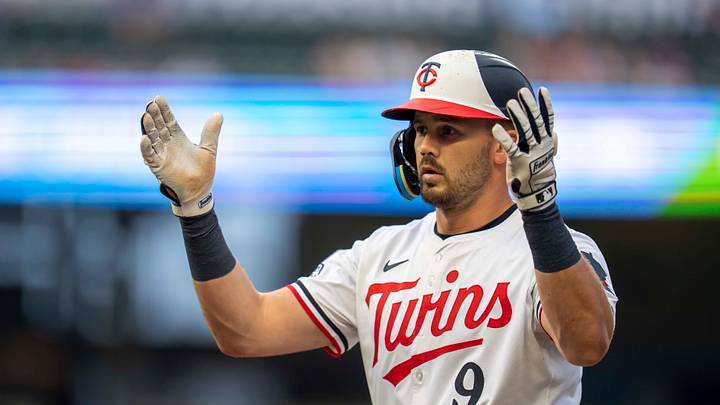
Outfielder Trevor Larnach was non-tendered by the Minnesota Twins before the contract deadline for 2027, making him available again, this time as a free agent.
That means there will be teams like the Houston Astros that could have a second opportunity to decide whether they should take another chance on Larnach, due to their needs to improve the outfield.
The possibility of Larnach ending up in Houston was on the table during last summer, as the Astros wanted to strengthen their outfield and find a left-handed hitter who could add power to the lineup. Larnach, 29, was on his way to completing what became the best first half of a season of his career, after producing career-high marks across his entire offensive line with .289/.379/.451, along with an .830 OPS, .337 BABIP, a 136 wRC+ and the lowest strikeout rate of his career, at 17.2%.
In 2026, Larnach combined power and improved several areas of his production and, although he fell off during the second half of the season, when he saw his wRC+ drop from 136 to 96, his .451 slugging percentage only dropped to .408, so he finished with single-season career highs by posting an overall offensive line of .269/.352/.436, with his lowest strikeout rate (18.2%) and the highest wRC+ (123) and fWAR (2.2) values of his career.

The negotiations seemed to have progressed, as the Astros and Twins had agreed to a deal that would send the outfielder to Houston in exchange for reliever Bryan Abreu. However, owner Jim Crane intervened and blocked the move because the organization was not willing to part with an established member of its bullpen. Although the conversations resumed before the trade deadline, both teams failed to finalize an agreement.
In the end, Minnesota addressed its needs by bringing in relievers Jeff Hoffman from the Blue Jays and A.J. Minter from the New York Mets, while the Astros’ left fielders ended up seeing their wRC+ drop from 105 and their slugging percentage from .408, recorded between April and July, to a puzzling 67 and .347 during the final two months of the season, respectively.
According to MLB Trade Rumors, Larnach had projected a salary of $4.7 million for 2026, but that figure does not correspond to the next arbitration cycle. For 2027, other estimates placed his possible salary around $6.3 million, with models bringing it closer to $6.66 million.
Why Could He Fit in Houston?

The Astros’ main need remains, obviously, improving left field, since they have not had a player who has been able to take ownership of the position and add both stability and positive value. Houston increasingly used Yordan Alvarez as a designated hitter, which remains reasonable to keep him away from the possibility of getting injured.
That said, Larnach’s left-handed bat makes sense to a certain extent. While he is not the type of hitter profile that would ideally fit in Houston’s left field, since the ideal profile would be a right-handed hitter who could hit fly balls frequently and take advantage of the park effect at Daikin Park, Larnach would bring much more contact and stability to the lineup than the usual contribution from left fielders over the last two seasons.

So the most notable improvements in 2026 were in his ability to limit strikeouts, take better advantage of contact and become a more useful hitter as his on-base percentage improved. Those adjustments led him to finish in the 69th percentile in xBA and K%, and in the 67th percentile in BB%, combining both placements for the first time in his career, despite dropping from the 62nd to the 32nd percentile in Hard Hit%.

Likewise, it is fair to highlight an important detail, which was that Larnach also became a better baserunner, another interesting addition. In 2025, his profile had leaned more toward tendencies to try to generate power, when he finished with an offensive line of .250/.323/.404, with 17 home runs and a .727 OPS, but home runs were the only figure that really made a difference.
Overall, Larnach’s season this year has been his most complete, finishing in the 73rd percentile in Batting and in the 51st percentile in Base Running, within the Top 50 for the first time in his career, since in previous years his baserunning had ranked in the 28th and 37th percentiles, respectively. Where have the biggest problems been?

Agreed, they have definitely been on defense, a point that could be contradictory for the Astros. Larnach recorded -5 OAA (Outs Above Average) and -8 DRS in left field during 2026 and finished in the 12th percentile in Statcast’s defensive range component. In contrast, his arm was a strength, with a value ranked in the 84th percentile which, although it does not compensate for his range problems in the outfield, remains a valuable tool. That is why it cannot be ruled out that Larnach could work to improve his negative Fielding Run Value of -9 as a left fielder, after recording -2 and -3 in the last two campaigns, respectively.
 Add us as a preferred source on Google

Yirsandy is a baseball writer specializing in MLB coverage with experience across multiple teams and storylines. He currently writes for Diamond Centric, where he covers the New York Mets, San Diego Padres, Chicago Cubs, Milwaukee Brewers, and Kansas City Royals. My work focuses on game coverage, player analysis, and storytelling that connects performance with context. My Substack has also been an important part of my writing development, where I’ve built much of my baseball coverage and storytelling voice over time. I’m passionate about combining reporting, research, and thoughtful analysis to produce engaging baseball content for readers.
Follow Yirsandy