
Michael King Could Be a More Valuable Bet Than He Seems for the Astros
In this story:
The lack of stability and consistency were two of the major problems that defined the chaos of the Houston Astros’ starting rotation during the 2026 season. This situation will not change enough if the team does not get reinforcements capable of completely changing the current projections.
Houston used 19 pitchers as starters in 2026, a franchise record, and only three teams finished with a worse collective ERA in their rotation, while only six pitched fewer innings from their starters. Pitchers such as Mike Burrows and Tatsuya Imai, from whom the Astros projected a greater contribution, ended up combining for 0.1 fWAR and 30 home runs allowed (21 of them by Burrows).
Houston’s starters ranked 27th in Baseball-Reference WAR and 28th in FanGraphs. Peter Lambert led the team with 155⅔ innings, while Hunter Brown made 20 starts and finished with a 3.19 ERA, but missed two and a half months because of a shoulder injury.
Why He Should Be in Houston’s Plans

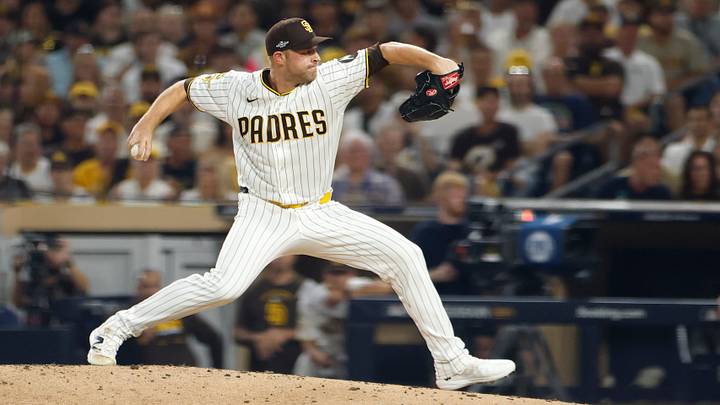
The best scenario for the Astros would be the possibility of acquiring a top-level pitcher, but also another arm that would not be so expensive for the starting rotation. My first choice would obviously be between Freddy Peralta and Michael King, but King is likely more attainable for Houston. Several projections have him seeking a possible three-year contract worth between $85-100 million. The biggest appeal here is that King returned to leading the San Diego Padres’ rotation after a 2025 campaign in which he was limited to just 15 starts.
After recovering this season, King posted a 12-10 record and a 3.21 ERA, with 185 innings pitched in 32 starts. He finished in the 93rd percentile in Pitching Run Value, thanks to the impact of his changeup, which ranked in the 98th percentile, and his breaking pitches, in the 89th percentile. However, the drop in strikeouts could be the most concerning point looking ahead. King finished with the lowest K/9 rate of his career, at 7.74.

Of course, that does not mean he cannot achieve dominance without striking out hitters, as King showed exactly the opposite in his actual results, despite finishing in the 33rd percentile in xERA.
A key point here is that this year King recorded a 44.6% ground-ball rate, the highest since he became a full-time starter when he arrived in San Diego in 2024. His impact in controlling hard contact was also consistent: he finished in the 89th percentile in Hard Hit% and combined his high ground-ball rate with his lowest HR/FB% mark, allowing just 10.2%.
For the stability of Houston’s starting rotation, another piece of good news is that King secured at least five innings in 28 of his 32 starts and six or more in 22. He had only four starts in which he did not manage to complete five innings, but just one from July 3 onward, when he finished with a 7-3 record and a 2.84 ERA in his final 15 starts. That lone short start was precisely his last one of the regular season, when he pitched four innings and allowed five runs against the Los Angeles Dodgers on Sept. 22 at Dodger Stadium.

A week later, King got his revenge by throwing a seven-inning pitching gem, allowing one hit and striking out eight, to lead the Padres to an 8-0 win over the Chicago Cubs in Game 1 of the National League Wild Card Series. His next two outings were also very dominant, as he allowed just one run over seven innings against the Milwaukee Brewers in the NLDS. King finished the postseason with a 1-0 record, one save in Game 3 of the NLDS against Milwaukee (in the Padres’ only win) and a 0.64 ERA.
FINAL: #Padres 4, #Brewers 3 (Brewers lead NLDS 2-1)
— Yirsandy Rodríguez (@Yirsandy) October 7, 2026
The San Diego Padres did everything they could to survive. They jumped ahead on the scoreboard again, survived a tie, took the lead with a key home run by Jake Cronenworth—his first in the postseason since the 2022 NLDS… pic.twitter.com/7Ei9U86nv7
By standing out among the few pitchers who managed to control the Brewers’ offense throughout the postseason, King’s performance further improved his track record of dominance in the playoffs. He finished with a 3-0 record, one save and a 1.86 ERA in 29 innings. The Astros have lost their last six consecutive postseason games, so the investment in pursuing a pitcher with King’s pedigree would represent something more than a bet on stability throughout the regular season.
 Add us as a preferred source on Google

Yirsandy is a baseball writer specializing in MLB coverage with experience across multiple teams and storylines. He currently writes for Diamond Centric, where he covers the New York Mets, San Diego Padres, Chicago Cubs, Milwaukee Brewers, and Kansas City Royals. My work focuses on game coverage, player analysis, and storytelling that connects performance with context. My Substack has also been an important part of my writing development, where I’ve built much of my baseball coverage and storytelling voice over time. I’m passionate about combining reporting, research, and thoughtful analysis to produce engaging baseball content for readers.
Follow Yirsandy