
Trevor Rogers Has the Potential to Help Houston, but Is He Worth a Long-Term Bet?
In this story:
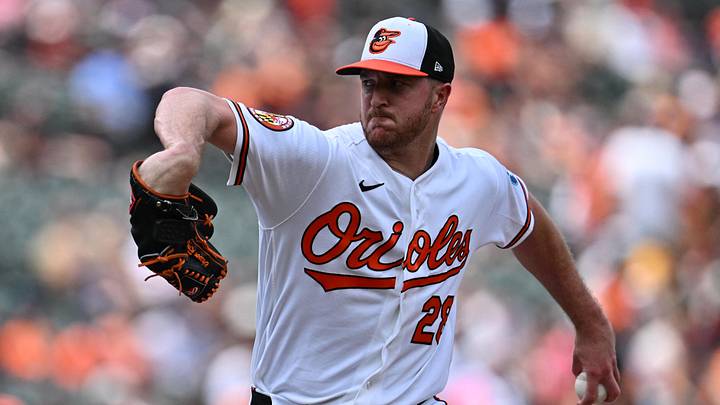
When you analyze the career of left-hander Trevor Rogers, currently one of the most dominant pitchers available on the free-agent market and the most coveted left-hander after Tarik Skubal, the 2025 season with the Baltimore Orioles is usually the main reference. Rogers finished with a great year, posting a 1.81 ERA in 109 ⅔ innings over 18 starts and recording 3.3 fWAR at 27 years old.
If we compare his fWAR, the 4.0 mark this season is better, as Rogers was able to extend part of his best dominance and made two more starts, completing 20, the highest total of his career since the 25 he recorded in 2024 during his last season with the Miami Marlins, before moving to the Orioles. Therefore, he also pitched many innings and, after recovering from a difficult start to his first three months of the campaign, his xFIP did not go above 3.59 again, so there was a big difference between the versions of Rogers we saw in the two halves of the season.
After the All-Star break, he raised his strikeout rate from 6.87 to 9.98 K/9 and reduced walks from 3.09 to 0.91 BB/9, which led to an adjustment in his K-BB%, which rose from 9.9% to 25.2%. By returning to his dominance standards, regaining control of at-bats with more strikeouts and fewer walks, Rogers finished the year with a solid 3.05 xFIP.
Would a long-term investment in Rogers be worthwhile for Houston?

Rogers will pitch at 29 years old next season, and his impact as a left-hander has been on the rise in each period over the last three seasons. In the period between 2024 and 2026, Rogers ranked with the tenth-best fWAR among left-handed pitchers, but he has climbed to seventh place over the last two seasons. In 2026, he ranks behind Skubal (5.2 fWAR), with 4.0 fWAR in the ranking of pitchers currently available in free agency. That obviously means Rogers will seek a multi-year contract — preferably four years — and it will be very expensive.
Ben Clemens, of FanGraphs, has projected his contract at an AAV of $26 million over four years, which amounts to a total of $104 million. This is where the conversation begins: asking ourselves whether the Astros would really be capable of entering the bidding for Rogers and whether, obviously, an investment of this magnitude would be feasible. When it comes to Rogers’ quality and dominance, there are aspects we should analyze in detail, starting with some of the problems the left-hander went through to stabilize his performance this year.
Rogers dropped considerably from the 98th to the 53rd percentile in Pitching, largely because of the collapse of his offspeed, which fell dramatically from the 93rd to the 1st percentile. However, there were also interesting aspects that would fit perfectly with a possible arrival in Houston, such as his improvements in control by reaching the 92nd percentile in BB%, reaffirming his jump from 23rd to 69th place last year. Rogers is also generating more chases and still getting good results at controlling hard-hit balls.

However, the point that raises the most concern is not only the decline in his dominance with the offspeed, since Rogers remained above the 90th percentile in Fastball (97 in 2025 and 91 this year) and at the 62nd percentile in Breaking (68 last season), but also how he has stopped inducing ground balls at his usual rate. Rogers had averaged a 42.7 GB% over the first six seasons of his career, with an improvement to 43.2% since 2023, which more than compensated for his limitations in generating whiffs at a high level.
Instead, this year his ground-ball rate fell to 38.3%, the lowest point of his career, and that reduction gave way to him being more exposed to contact, as his strikeout rate also dropped slightly from 8.45 to 8.33 K/9, with the influence of his inconsistencies between April and June. Much of this situation is what has marked the most notable difference between the 2025 Rogers and the version we saw in 2026, when his HR/FB rate jumped from 5.5% to 8.8%.
One might think this has more to do with Rogers’ inability to induce ground balls, but when he recorded his highest percentage, a 46.5% GB rate between 2023 and 2025, his HR/FB rate was 8.4%. I think you already understand where I want to go with this, and that, in reality, the 2025 Rogers has not been the average pitcher, but rather the best version he has shown in the first 132 starts.

There are also two unavoidable details regarding the home runs he allowed:
1. Rogers’ problems were predominantly against right-handed hitters, who hit 18 of the 19 home runs he allowed in 2026 and have accounted for 24 of the 25 he has allowed over the last two seasons.
2. His most vulnerable pitches were fastballs, which ended up allowing 11 of the 19 home runs, a figure Rogers has allowed for the second time in his career. The first was in 2022, when he went through a similar situation.
There are probably two situations that raise doubts about Rogers’ future, and that is reasonable, since the explosion in home runs allowed to right-handed hitters is not a situation exclusive to this year.

Rogers allowed 12 home runs in 2024 and 14 in 2022, and the .449 slugging percentage allowed this season is only a little above his .413 career mark, after facing 2,233 right-handed hitters between 2020 and 2026. As for the effect of this situation, do not lose hope, since if the 19 home runs allowed by Rogers had been evaluated according to Daikin Park’s dimensions, he would have allowed three fewer.
 Add us as a preferred source on Google

Yirsandy is a baseball writer specializing in MLB coverage with experience across multiple teams and storylines. He currently writes for Diamond Centric, where he covers the New York Mets, San Diego Padres, Chicago Cubs, Milwaukee Brewers, and Kansas City Royals. My work focuses on game coverage, player analysis, and storytelling that connects performance with context. My Substack has also been an important part of my writing development, where I’ve built much of my baseball coverage and storytelling voice over time. I’m passionate about combining reporting, research, and thoughtful analysis to produce engaging baseball content for readers.
Follow Yirsandy