
Andres Gimenez’s Elite Defense Isn’t Enough for Blue Jays
In this story:
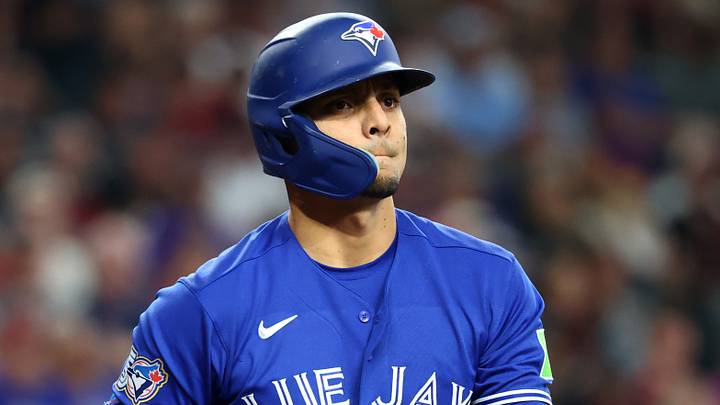
There is nothing to argue about here regarding Andres Gimenez’s defense, as he is one of the best shortstops in baseball. In 2026, in his second year with the Toronto Blue Jays, his defense was once again wonderful, posting a 16 Fielding Run Value, the seventh-best mark among all qualified fielders at any position, tied with center fielder Ceddanne Rafaela.
The only shortstops who can be considered above Gimenez’s level have been Bobby Witt Jr. (17 FRV) of the Kansas City Royals and the young prospect Masyn Winn (17 FRV) of the St. Louis Cardinals.
That is the strong point of Gimenez’s game, and it once again helped him maintain his balance as a player to post 2.8 fWAR. Even so, his offensive performance has suffered a considerable decline.
He dropped to the 3rd percentile in Batting, and it is hard to believe that at his best, he ranked 81st in 2022.

Although he is still a good base stealer—he has recorded at least 20 stolen bases in four of the last five seasons—he just finished with the lowest walk rate of his career (only 3.3 BB%), and the occasional power he showed during his best period with the Cleveland Guardians has not been present with the same frequency over the last three campaigns.
But the fact that Gimenez represents high defensive value for the Jays does not eliminate the need to recognize that his declining offense could become a problem for the future.
Do you remember that streak of 41 consecutive games without hitting a home run, from June 17 through August 16?
I think it could be the perfect sample to illustrate Gimenez’s problem. During that stretch, when his production did not depend on home runs, he continued to be, in many ways, the same hitter. He posted just a .298 on-base percentage during the streak, with 20 strikeouts and only four walks in 122 plate appearances.
Do you know what his OBP has been over the last three seasons?
In a much larger sample of 1,510 plate appearances, he has averaged just .293, even worse than during what could be considered his most puzzling streak of 2026, when he recorded a .298 OBP.
That said, it is clear that Gimenez’s problem is not expanding his power, although if he does, it would obviously solve a large number of game situations in the lower part of Toronto’s lineup. But beyond that, everything indicates that he needs to be more consistent at getting on base.
Where Could the Bigger Problem Be?

The Blue Jays’ list is long. When it comes to plate discipline, the problems were very frequent among several hitters. The Jays have a skill that the entire league knows about: the frequency with which they put the ball in play and, until before this season, the success several hitters had in combining their high batting averages with home run production.
Things changed considerably in 2026, with an offense that finished with only two hitters capable of hitting at least 15 home runs, the Japanese third baseman Kazuma Okamoto, who hit 33 to set a franchise rookie record, and George Springer with 15.
Two hitters finished with 10, Alejandro Kirk and Nathan Lukes, and Gimenez was among the four who hit nine. However, the big problem for several hitters was not just the decline in power, since the Jays continued to record the same percentage of runs scored via home runs as in 2024, at 36.8%, and only slightly below 2026 (38.6%).
However, the decline that hurt several hitters the most was their poor performance when they fell behind in two-strike counts. While attacking the first pitches and trying to put the ball in play prevented a large number of strikeouts, two-strike counts limited their production even further.
Gimenez could not escape that abyss and was among the team’s worst hitters with a negative wRC+ in that situation, alongside Brandon Valenzuela, Davis Schneider, Ernie Clement, Josh Smith, and Myles Straw. All of them fell into what I classified as “Bad,” basically the group of hitters who were very inconsistent in two-strike counts and also in counts before reaching two strikes.
Two Strikes | BB% | K% | OPS | wRC+ |
|---|---|---|---|---|
Two Strikes | 2.1% | 33.2% | .505 | 41 |
Before | 3.7% | 20.6% | .604 | 68 |
As you can see here, Gimenez fell from producing a 68 wRC+ to 41 in two-strike counts, his OPS dropped .099 points, and he struck out in 33.2% of his plate appearances. To a certain extent, you can accept a decline like that from a hitter who has a different role in the lineup.
But that is not the case with Gimenez, and the warning sign he left in 2026 should be a good starting point for Toronto to work on improving his inconsistencies.
 Add us as a preferred source on Google
Yirsandy is a baseball writer specializing in MLB coverage with experience across multiple teams and storylines. He currently writes for Diamond Centric, where he covers the New York Mets, San Diego Padres, Chicago Cubs, Milwaukee Brewers, and Kansas City Royals. My work focuses on game coverage, player analysis, and storytelling that connects performance with context. My Substack has also been an important part of my writing development, where I’ve built much of my baseball coverage and storytelling voice over time. I’m passionate about combining reporting, research, and thoughtful analysis to produce engaging baseball content for readers.
Follow Yirsandy