
Three Trade Targets Who Could Address Blue Jays' Biggest Problem
In this story:
The Blue Jays finished last in baseball in home runs, isolated power (SLG% - BA), average exit velocity, and hard hit %. The offense is their biggest problem, specifically the lack of power.
Unlike last year's free agent class, which included sluggers like Kyle Schwarber and Pete Alonso, both of whom topped 40 home runs this year, the free agent market isn't stocked with sluggers.
Three names have been floated as potential free-agent sources of power for the Blue Jays are left fielder Randy Arozarena and right fielder Seiya Suzuki, and the Japanese slugger Teruaki Sato.
Even assuming the Blue Jays sign one of those three as a free agent, they would still need more pop. An outfield bat is a particular need, as Toronto outfielders finished last in baseball with just 41 homers, but the middle infield and DH could also be areas where the Blue Jays look to upgrade.
There were 133 MLB players hit more than 15 home runs.
Kazuma Okamoto was the only Blue Jay on that list.

So let's look for three trade candidates that could upgrade Toronto's lineup, especially in the power department, why their current team might be open to trading them, and what Toronto might need to give up.
We will also put these into three categories of players Toronto might acquire: a star, a small-market player about to get expensive, and a blocked prospect. Even if they don't trade for the listed player, we will also share others of the same archetype.
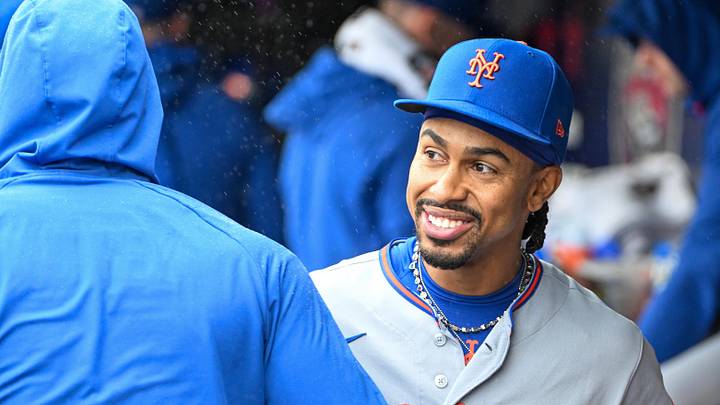
The Expensive Star - Francisco Lindor
Lindor was hampered by a hamate bone injury in 2026, but still hit 21 home runs in 105 games after topping 30 home runs and 100 RBI the previous three seasons. Over the past four seasons combined, he is tied with Manny Machado for 10th in baseball with 116 home runs. In late September, he hit his 300th career home run.
In the first half of the 2026 season, Lindor hit just five home runs and had an 89 wRC+. The hamate injury had zapped his power.
Sam-I-Am in the car from Flushing did not like Laid Eggs and Hamates.
Mets fans thought the 32-year-old was washed.
It turns out he was just recovering from an injury that often causes short-term power outages.
In the second half, Lindor tied for 7th in baseball with 16 HR, besting 40-home-run sluggers Kyle Schwarber, Junior Caminero, and Hunter Goodman.
His full-season numbers were also hurt by a .242 BABIP, while his career average before this season was about 50 points higher.
So why would the Mets trade him? Simple: money.

Lindor will be 33 in 2027 and is still owed $185M. He is signed at $27M per season through 2031 and will then collect $5M each year of Uncle Steve's Monopoly money from 2032 to 2041, even if he never passes Go.
The Mets are still paying Bobby Bonilla just over $1M every July through 2035, and baseball fans call it Bobby Bonilla Day. Through 2041, November 30th will be Francisco Lindor Day.
The question teams often ask when thinking about trades is: will this player be part of our next championship team? That is a legitimate question for the Mets with Lindor, though Lindor insists they are not rebuilding and still have a strong core.
Lindor has a full no-trade clause and has said he wants to stay in New York.
Lindor, though, is very familiar with the Blue Jays' President and CEO, Mark Shapiro, and General Manager, Ross Atkins, from their time together in Cleveland. Shapiro and Atkins were in Cleveland when the Indians drafted and developed Lindor before Chris Antonetti later traded him to the Mets.
The Blue Jays would pay for Lindor's age-33-through-37 seasons, similar to the deal they signed with George Springer. Lindor hit the ball harder and increased his bat speed from 2025 to 2026, though he sacrificed some contact to do so.

The bigger drop-offs with Lindor that could signal Father Time creeping up on him are the drop from 31 stolen bases in 2025 to 3 in 2026 and a significant decrease in his above-average outs at shortstop.
Toronto would be weaker defensively with Lindor at short than with Andres Gimenez, who could slide to second, moving Ernie Clement back into a utility role or onto the trade block. But they would be a lot stronger offensively.
Thirty-two is pretty young for that type of decline, which could signal he was playing through an injury, though he also may have lost a step, as his sprint speed went from the 49th percentile to the 43rd.
The prospect cost on Lindor will be heavily dependent on how much of Lindor's contract Toronto takes on. If the Blue Jays pay all of it, the prospect cost could be light. If not, it might take a Nolan Perry or Johnny King.
Other Expensive Stars: Bryce Harper
The Small Market Player About to Get Expensive - Oneil Cruz
One hallmark of small-market teams like the Tampa Bay Rays is that they unload players as they become progressively more expensive in their arbitration years and get closer to free agency.
A broad rule of thumb is that players will make around 40% of their open market value in the first year of arbitration, 60% in year 2, and 80% in year 3.
These are trade waters Toronto should go fishing in to take advantage of its ability to take on payroll.
One such player is the Pirates' Oneil Cruz.

Nobody in baseball has louder tools. Cruz holds the Statcast record for the hardest hit ball of the Statcast era, pummeling a Logan Henderson fastball at 122.9 mph out of PNC and into the Allegheny River 432 feet away. Cruz holds the Home Run Derby record with a 513 foot home run and has smashed several home runs over 460 feet in regular season play.
He also has the 2nd hardest hit ball in the Statcast era.
But this offseason will mark his second year of arbitration eligibility. The Pirates are coupon clippers, having consistently ranked in the Bottom 5 in payroll.
Cruz had his best season yet in 2026 with an .854 OPS. His biggest improvement came against lefties. He hit .102 against lefties in 2025 (yes, you read that right, and I double-checked it) and .326 against lefties in 2026.

He still has just a .212 BA against lefties for his career, and even if his BA see-saws back down to that level and he needs to be platooned, he still offers the Blue Jays a potential 30/30 threat. Cruz has also stolen at least thirty bases in the past two seasons.
So why would Pittsburgh trade Cruz, aside from his increasing price tag? They have the pitching staff to be contenders, assuming Paul Skenes is healthy.
Cruz has some serious flaws in his game.
The first is health. He was limited to 97 games this past season and has averaged exactly that number over the past four seasons.
The second is that the power comes with a ton of swing-and-miss. Cruz was in the 2nd percentile in whiffs and the first percentile in strikeouts. His .280 average was inflated by a .397 BABIP, so don't expect him to hit .280 again (his expected batting average was .251).
The third is defense. Cruz was a horrible shortstop defensively and is miscast as a center fielder despite his high-end speed. His cannon of an arm, though, would play right where the Blue Jays desperately need more thump and enable them to keep Brett Bateman in center.
The fourth is that he has sometimes been viewed as lacking maturity, effort, and energy. In 2025, he was pulled from a game for lollygagging for the second time in a week. In 2026, there were no such incidents, so these may be in the past.

Finally, he hits a ton of ground balls. His GB% is 48.8%, even higher than Vladdy's 48.3% career mark.
The Pirates would likely want prospects in return, particularly position players.
A package of two of Toronto's #5 prospect, 18-year-old C Will Brick, #6 prospect SS/3B Juan Sanchez, or #7 prospect Daisan Hill, acquired in the Jeff Hoffman trade with Minnesota, might get it done. Catcher, shortstop, and third are also areas where the Blue Jays have talent at either the Major League level or a stud prospect (Parker at SS).
Other options: Spencer Torkelson, JJ Bleday, Kody Clemens
The Blocked Prospect - James Tibbs III
Speaking of blocked prospects, we turn to the Dodgers' James Tibbs III. His name makes him sound like a commodities trader, but he is actually a Dodgers outfield prospect, and for the Dodgers, that is a commodity.
He is blocked by a Major League outfield that includes Andy Pages, Kyle Tucker, Teoscar Hernandez, and elite prospect Josue DePaula.
The Dodgers traded away outfielder Zyhir Hope as the headliner in the Tarik Skubal trade and could do the same with Tibbs.
A first-round selection out of Florida State Tibbs has already been traded twice — from the Giants to the Red Sox as part of the Rafael Devers trade before the Red Sox flipped him to the Dodgers for Dustin May at the 2025 deadline.

In 2026, he crushed 30 home runs and drove in 107 runs with Oklahoma City. While those stats may be somewhat inflated by hitting in the Pacific Coast League, OKC's ballpark consistently grades out as a pitcher's park. Tibbs' average exit velocity of 91.7 mph was in the 91st percentile in Triple-A, and his 13,9% barrel rate was in the 93rd.
Tibbs did most of his damage against fastballs and struggles more with spin, so he could adjust to the Major Leagues and may be a long-term solution.
The Dodgers' weakest spot is probably their bullpen, while the Blue Jays are strong there, so trading away either Tyler Rogers or Mason Fluharty could address a Dodgers need.
Other options: Andrew Fischer (MIL), Kevin Alcantara (CHC)
The Blue Jays' ceiling will ultimately hinge on reacquiring one more source of power: Vladimir Guerrero Jr., These acquisitions could certainly help the cause.
 Add us as a preferred source on Google
Adam Steinmetz writes about the Toronto Blue Jays for On SI. Adam is also the editor and publisher of the Boston Sunday Sports Section, a weekly digital publication covering the Patriots, Red Sox, Celtics, and Bruins. A two-time winner of the Best Collegiate Sports Writer award in Philadelphia, he began his career with freelance work for The Philadelphia Daily News and The Palm Beach Post before building a successful career outside of journalism. He returned to sports writing last year, contributing to Pitcher List—including coverage of the Toronto Blue Jays—before launching Authorenticity on Substack, where he explores the human stories within baseball. The Boston Sunday Sports Section is his most ambitious project — the thinking fan’s modern Sunday Sports Section focused on the Patriots, Red Sox, Celtics, and Bruins.