
4 Trade Targets Who Could Solve the Mariners’ Biggest Problem
In this story:
The Mariners don’t need to build another offseason around collecting options. They should be in an aggressive pursuit of a position player who makes the lineup harder to pitch against. Whether it’s a player that tightens up the infield or corner outfield, it’s something they need if they want to be successful in 2027.
That sounds simple. But it never is when it comes to Seattle.
Any useful trade board has to survive a couple of questions: Why would the other team move the player, and what would the Mariners have to surrender? Once we apply those tests, these four names land in four very different places. One is a natural target. Another is a financial gamble. The last two require us to stretch our imagination and may not be remotely realistic until we hear more.
How These Four Trade Targets Could Solve the Mariners’ Biggest Problem
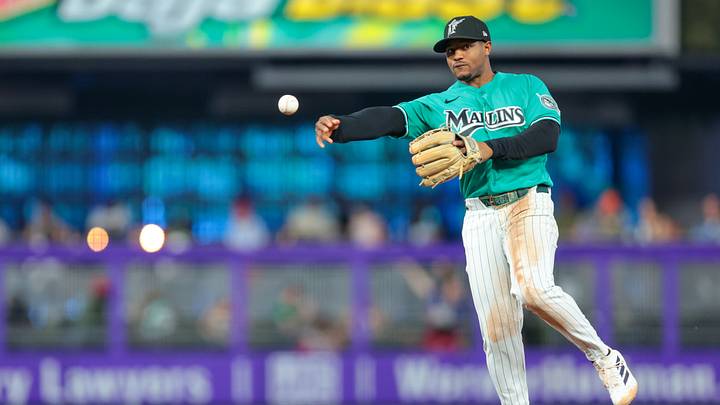
Xavier Edwards
Edwards slashed .280/.360/.371 while stealing 21 bases. He doesn’t bring the pop needed in the middle-of-the-order, but that’s not the only way to improve the M’s offense. He’s another bat that controls the strike zone, puts the ball in play and creates pressure after reaching base.
He fits what the Mariners need at the plate. Finding him a permanent defensive home is more complicated.
Cole Young should remain at second base, where he can continue where he left off after his Gold Glove campaign in 2026. Colt Emerson is Seattle’s shortstop of the future. The Mariners shouldn’t disrupt either player simply because Edwards has spent most of his recent time at second.
That means Seattle would need to believe Edwards can handle another infield position, or use him frequently enough across the diamond to justify the acquisition cost. His contact skills, speed and ability to reach base would still improve the lineup, but the Mariners cannot trade a premium prospect package without knowing exactly where he will play.
Miami has at least given teams a reason to call. The Marlins reportedly listened to offers for Edwards before the 2026 trade deadline and ultimately kept him, which suggests he was available at a price, not untouchable.
That price would sting because Edwards is just 27, inexpensive and under club control. Seattle would probably have to surrender meaningful prospect capital. A deep farm system is supposed to help the major-league roster eventually, but the Mariners shouldn’t spend heavily on a player whose arrival creates another positional puzzle.
Edwards remains one of the most attainable players on this list. Calling him the cleanest roster fit, however, would ignore the infield Seattle has already committed to building around Young and Emerson.
Matt Chapman
Chapman is the kind of player who can tempt a front office into talking itself past several obvious warning signs.
The attraction is obvious. He’s an established third baseman whose defense and track record would bring certainty to the left side of Seattle’s infield. The Giants also made Chapman and other expensive veterans available during the 2026 season, so this is not a random trade scenario pulled from thin air.
The contract is what changes everything.
Chapman is owed $100 million over the next four seasons, holds a full no-trade clause and is coming off a year in which he batted .235 with a career-low .692 OPS before undergoing season-ending core-muscle surgery.
If the Mariners take most of the money, the baseball return to San Francisco should be modest. If the Giants want real young talent, they need to cover a substantial portion of the contract.
Chapman could improve the Mariners. That doesn’t make every version of the trade intelligent.
Joey Ortiz
Ortiz has been a popular name circulating recently. That’s different from being the right trade target. He has handled both shortstop and third base for Milwaukee, giving Seattle the kind of defensive flexibility teams value. But the premise that he’s an elite, obvious solution needs scrutiny. Ortiz’s offensive production has been very hot and cold, and the Mariners already have Emerson established as their long-term shortstop after signing him to an extension through 2033.
Then we get to what would motivate Milwaukee to actually move him. The Brewers are a contender, currently ahead in the NLCS over the Dodgers and controllable infielders are exactly the players an organization like that usually keeps. Seattle would have to overpay simply to make Milwaukee reconsider.
George Kirby would probably be the asking price. That would end the conversation immediately. Trading a foundational starting pitcher for Ortiz would create a larger problem than it solves. He slashed .270/.328/.402 with 9 home runs and 47 RBIs. Wouldn’t expect much more production if he spent half his games hitting in T-Mobile Park. But defensively, he would still be an upgrade at third base.
If Milwaukee becomes surprisingly motivated and the cost drops, listen. Until then, Ortiz belongs closer to the fantasy section of the board.
Ronald Acuña Jr.
Of course the Mariners should want Acuña. Every team should. And after the way the boo birds rained down in Atlanta to end the season, they could begin answering the phone to listen. But wanting him doesn’t produce a trade market.
Atlanta controls Acuña through two $17 million club options for 2027 and 2028. MLB.com recently described exercising the first option as one of the easiest decisions of the offseason.
That contract is enormously valuable even after a merely good season(.255/.345/.451 with 20 home runs, 55 RBIs, and 21 stolen bases in 107 games). Instagram changes and frustrated speculation following a postseason exit aren’t evidence that the Braves intend to trade the face of their franchise.
If Atlanta somehow entertained offers, the Mariners would be bidding against the sport for a former MVP. The conversation would begin with multiple elite prospects, continue with young major-league talent and probably reach a point where Seattle should walk away. And let’s be honest, Acuña hasn’t played a full season since his MVP-winning season in 2023.
A healthy Acuña would transform the lineup. He’s also not a realistic offseason target. We can admire the idea without pretending it belongs on Jerry Dipoto’s working trade board.
The Mariners should concentrate their energy where ambition and reality overlap. That means calling Miami about Edwards first and determining exactly how desperate San Francisco is to move Chapman’s contract. Everything else is noise.
 Add us as a preferred source on Google
Tremayne Person is the Publisher for Mariners On SI and the Site Expert at Friars on Base, with additional bylines across FanSided’s MLB division. He founded the Keep It Electric podcast in 2023 and covers baseball with a blend of analysis, context, and a little well-timed side-eye just to keep things honest. Tremayne grew up a Mariners fan in Richmond, Va., and that passion ultimately led him to move to Seattle to cover the team closely and become a regular at home games. Through his writing, he connects with fans who want a deeper, more personal understanding of the game. When he’s not at T-Mobile Park, he’s with his dog, gaming, or finding the next storyline worth digging into.
Follow TremaynePerson