
Cal Raleigh’s Vanishing Power Exposed the Mariners’ Biggest Offensive Flaw
In this story:
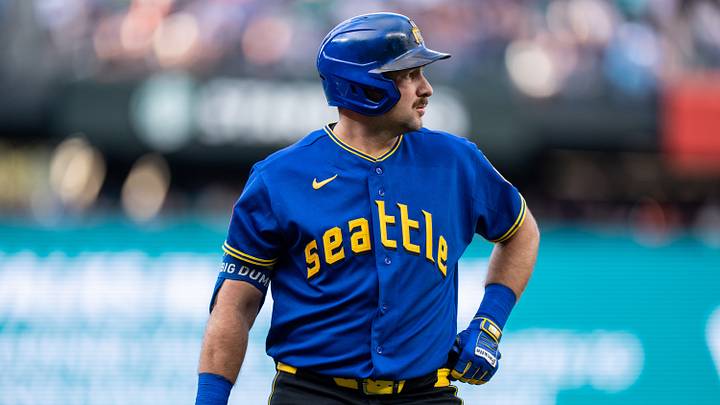
Regression was inevitable. But what has happened to Cal Raleigh in 2026 is something else entirely. Raleigh’s 2025 season was an outlier even by the standards of baseball’s best power hitters. He set a new record for catcher, switch-hitter, and for a Mariner by hitting 60 home runs. He also drove in 125 runs and produced a .247/.359/.589 line. His .948 OPS represented a 200-point improvement over 2024. Nobody reasonably should have expected another 60.
But it seems like Seattle did. They needed something resembling the version of Raleigh they saw in 2025. Instead, through August 20, Raleigh was slashing .156/.271/.296 with 13 home runs, 44 RBIs, and 125 strikeouts in 391 plate appearances. His OPS had fallen from .948 to .567 — a 381-point decline, and nearly 200 points below his .748 mark from 2024.
The most obvious dividing line arrived May 1, when Raleigh injured his right oblique against the Royals. He missed three games, returned May 5 and attempted to play through the discomfort. From the beginning of the injury through his eventual placement on the IL, he endured an 0-for-38 stretch. Raleigh later acknowledged that trying to gut it out was not helping him or the club. The Mariners finally placed him on the IL on May 14, beginning the first injured-list stint of his career.
Cal Raleigh’s 2026 Slump Is More Than Expected Regression
The timing brings the whole thing together. Raleigh had just produced his best stretch of the season, batting .345 with five home runs over seven games from April 20–27. An injury to the muscles responsible for rotating the torso is especially problematic for a switch-hitter whose value depends on generating pull-side power. It also presented a broader question for the organization: Did Raleigh’s reputation for durability and willingness to play hurt delay a decision that should have been made sooner?
But the oblique isn’t a catch-all explanation. Raleigh returned June 16 after missing 29 games and obliterating minor league pitching during his rehabilitation assignment by hitting five home runs in 17 at-bats. More than two months later, his major league production still doesn’t resemble anything we saw over the previous seasons. The injury interrupted his season; it doesn’t fully explain everything that followed.
There’s no shortage of theories about what happened to Raleigh this season. Maybe the World Baseball Classic disrupted his preparation. Maybe the oblique injury threw off his timing. Maybe the increased workload and attention accompanying his rapid rise to stardom took a toll. Those possibilities provide context, not proof. He's always been a measured, focused player, and the off-field explanations are difficult to quantify. The clearest evidence is in the numbers, so that is where the diagnosis should begin.
The underlying numbers suggest that Raleigh hasn’t suddenly lost physical ability to swing a bat. His average bat speed is essentially unchanged. His swing path and attack angle are also the same. Raleigh simply looks like a hitter who is no longer meeting the ball at the right time.
His hard-hit rate has plummeted from 49.6 percent to 35.4 percent. His barrel rate from 19.5 to 12.3., He is getting underneath 44.8 percent of his batted balls, up from 35.8 last season. The result is a steady supply of popups and harmless fly balls where home runs once existed. His strikeout rate has also climbed but strikeouts were always a part of his game.
But the most heavily talked about change has come against the four-seam fastball. And that’s where this actually goes beyond Raleigh. The majority of the team has been snakebitten against the fastball. Raleigh is no outlier in that conversation. But still, he slugged .594 against them in 2025 and generated 16 runs of offensive value. In 2026, he is batting .110 and slugging .189 against the pitch, producing minus-15 runs.
If you’re looking for some poor fortune in his results. His .290 expected weighted on-base average is better than his actual .261 mark. But neither number is flattering.
Raleigh has accepted responsibility. During Seattle’s August skid, he described himself as the worst-performing member of the lineup and said the team’s offensive approach was missing. That accountability is important, but it’s not an invitation to make him responsible for every structural problem around him.
The Mariners were too dependent on Raleigh’s production and opted not to provide enough insulation. It’s odd they couldn’t see how his 2025 season covered weaknesses. Seattle could reasonably expect its franchise catcher to be better than this. It couldn’t reasonably construct an offense that required another historic season from him.
Raleigh’s collapse is both a cause and an exposure. His missing power removed the center of Seattle’s lineup. The damage that followed revealed how little the Mariners had built around it.
 Add us as a preferred source on Google
Tremayne Person is the Publisher for Mariners On SI and the Site Expert at Friars on Base, with additional bylines across FanSided’s MLB division. He founded the Keep It Electric podcast in 2023 and covers baseball with a blend of analysis, context, and a little well-timed side-eye just to keep things honest. Tremayne grew up a Mariners fan in Richmond, Va., and that passion ultimately led him to move to Seattle to cover the team closely and become a regular at home games. Through his writing, he connects with fans who want a deeper, more personal understanding of the game. When he’s not at T-Mobile Park, he’s with his dog, gaming, or finding the next storyline worth digging into.
Follow TremaynePerson