
Mariners’ Lazaro Montes Gives Front Office a 474-Foot T-Mobile Park Blueprint
In this story:
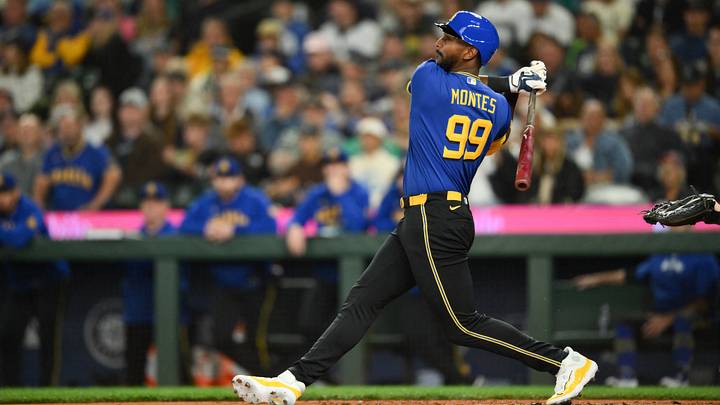
We had a feeling Lazaro Montes was going to hit some home runs. But until you actually see that power show up in the majors, it all feels a little like fantasy. On Sept. 8, Montes made it real with a 474-foot memo addressed directly to the front office.
Cal Quantrill put a 94.7 mph fastball over the middle of the plate in a 2-1 count. Montes launched it at 116.1 mph and deposited it on the right-center-field concourse. It’s hard to recall a ball ever being hit over the J-Rod squad area.
It was the longest home run hit at T-Mobile Park since Statcast began tracking in 2015, clearing Mike Zunino’s previous record by four feet. It also tied Fernando Tatis Jr. for the longest homer in baseball this season. Montes somehow made one of the most difficult ballparks in the league look comically small.
Unfortunately, the Mariners quickly turned the moment into a footnote. Montes’ three-run blast cut a 4-0 deficit to 4-3, proving his ability to flip the score with one swing, only for Texas to score five times in the next half-inning and win 10-5.
That sequence captured Seattle’s entire season. The future gave everyone a reason to look up. The present immediately buried it and brought us back to reality. Still, Montes left the Mariners with something more than another highlight. He showed them exactly what kind of power they should be actively searching for.
474 FOOT BOMB FROM LAZ.
— Seattle Mariners (@Mariners) September 9, 2026
Montes' first home run at @tmobilepark is the longest in ballpark Statcast history and tied for the longest in MLB this season. 🤯 pic.twitter.com/kzCrVyoZDv
Lazaro Montes Proved Elite Power Plays at T-Mobile Park
We’ve heard every explanation for why offense seems to disappear in Seattle. The marine air knocks down fly balls. The dimensions swallow decent contact. The batter’s eye gives hitters fits. T-Mobile Park has earned its reputation, but it can’t be used as an alibi.
Through Tuesday, the Mariners had scored 574 runs, the fewest in baseball. Their .229 batting average and .684 OPS told the same story. T-Mobile Park hosts only half the schedule. It doesn’t follow the lineup around the country.
The front office can’t change the air that tunnels through the park. However, they can change the hitters they ask to cut through it. Montes didn’t hit a wall-scraper over the fence. He hit the ball hard enough to make the dimensions irrelevant. His 116.1 mph exit velocity was Seattle’s highest on any batted ball since a Julio Rodríguez single in 2023 and its highest on a home run since Rodríguez reached 117.2 mph in 2022. You know you’ve crushed one when the center fielder is barely jogging and isn’t even remotely close to the warning track.
That kind of contact travels. Tuesday’s blast was also Montes’ 40th home run of the season between the majors and minors. He hit 38 across Double-A Arkansas and Triple-A Tacoma before adding two in his first six games with Seattle. He didn’t simply run into this one. It was the loudest example yet of the tool that carried him through the farm system. T-Mobile Park never stood a chance.
The Mariners Need to Target Power That Travels
Montes should change how Seattle talks about building an offense for T-Mobile Park. A lineup dependent on sequencing needs three or four things to go right. Someone has to reach base, the next hitter has to move him over and somebody else has to finish the job.
A legitimate home run hitter needs one mistake. Quantrill made one. Montes took care of business. That should be the blueprint when the Mariners evaluate power hitters outside of the organization. Prioritize real exit velocity, consistent barrels and power that holds up away from hitter-friendly environments. Find hitters whose best contact remains dangerous after the marine layer takes its cut.
Positional flexibility is also useful. Contact skills like a healthy Brendan Donovan, or Michael Arroyo’s potential all play a role. A deep bench helps, too. None of those things can carry an offense that needs four singles to produce one run.
Seattle needs more hitters capable of ending an argument with one swing. Montes remains a work in progress. Nine strikeouts through his first 19 major-league plate appearances make that obvious.
The Mariners should be adding power around him and preserving proven production beside him. Turning Montes into the inexpensive replacement for every veteran bat would miss the mark.
He adds to the makings of a legitimate power core. He shouldn’t be the excuse to stop building one. T-Mobile Park isn’t going anywhere. The Mariners’ response should be a lineup strong enough to punish mistakes before the ballpark can interfere. Montes showed them what that looks like in his sixth major-league game.
 Add us as a preferred source on Google
Tremayne Person is the Publisher for Mariners On SI and the Site Expert at Friars on Base, with additional bylines across FanSided’s MLB division. He founded the Keep It Electric podcast in 2023 and covers baseball with a blend of analysis, context, and a little well-timed side-eye just to keep things honest. Tremayne grew up a Mariners fan in Richmond, Va., and that passion ultimately led him to move to Seattle to cover the team closely and become a regular at home games. Through his writing, he connects with fans who want a deeper, more personal understanding of the game. When he’s not at T-Mobile Park, he’s with his dog, gaming, or finding the next storyline worth digging into.
Follow TremaynePerson