
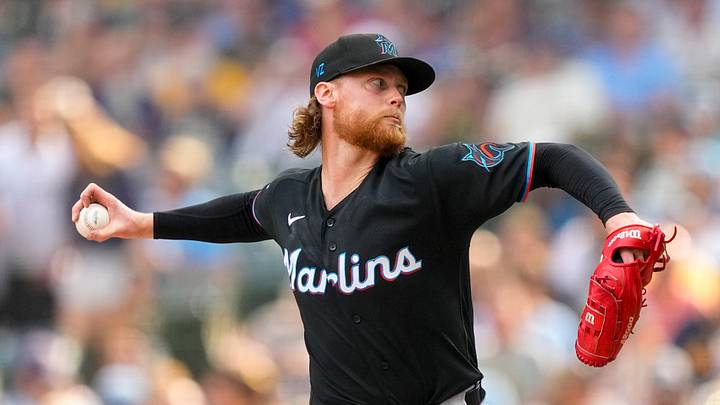
Marlins Are Bucking MLB Trend With Unusual Pitching Approach
In this story:
“We just believe that if you ask hitters what pitch they want to hit, most of them are going to say a fastball,” Is what Miami Marlins pitching coach Daniel Moskos told MLB Network on Friday.
Miami has structured its pitching philosophy around denying hitters the conventional answer. A Statcast graphic shown by MLB Network listed the Marlins with a 51.9% non-fastball usage rate this season, the highest mark in baseball.
Statcast separates those offerings into breaking pitches and true offspeed pitches such as changeups and splitters. The larger philosophy is the same: make hitters adjust to something other than velocity.
The results have been solid. Opponents are hitting .231 against Marlins pitching this season, compared with a .244 MLB average. That does not mean Miami has uncovered some foolproof secret after more than 150 years of baseball, but it provides a fun example of a staff willing to experiment.
Tyler Phillips and Eury Pérez Show Why the Approach Can Work

Tyler Phillips has been a standout in terms of his ability to excel with secondary pitches. He has thrown his splitter 373 times, accounting for 23.7% of his pitches. Opponents are batting just .133 with a .200 slugging percentage and .203 wOBA against it, while missing on 32.8% of their swings. His four-seam fastball, by comparison, has been hit at a .419 clip, albeit in a much smaller sample of 136 pitches.
The speed difference helps explain the challenge. Phillips' four-seamer averages 96.1 mph, while his splitter comes in at 87.2 mph.
Phillips isn't the only Marlins pitcher getting results with offspeed pitches. FanGraphs shows Sandy Alcantara has already thrown his changeup more than 500 times this season. That is nothing new for the 2022 NL Cy Young Award winner, who has thrown the pitch at least 700 times in three different seasons, peaking at 895 during his award-winning 2022 campaign.

Eury Pérez's changeup has held hitters to a .200 average while producing a 42.5% whiff rate, according to Statcast. He also demonstrates why the philosophy is more nuanced than simply avoiding fastballs. His four-seamer averages 98.3 mph and ranks in the 73rd percentile in fastball run value. The contrast between the two pitches allows them to play off one another. With more than eight mph separating them, hitters geared up for Pérez's upper-90s fastball risk getting out in front when the changeup arrives instead.
Fastballs remain the most common pitch in baseball. Miami is simply leveraging that reality and zigging when hitters expect pitchers to zag. Opposing teams will have opportunities to adjust as the league gets a better read on the approach, but the Marlins may also have found a strategy particularly well suited to the strengths of their staff. If so, it could become another reason to believe Miami's surprisingly competent 2026 season is more foundation than fluke.
 Add us as a preferred source on Google
Wesley Dixon is a sports writer focused on thoughtful analysis, roster-building angles, player development and feature-style storytelling. He has covered the Philadelphia 76ers and the NBA, with work centered on breaking down team direction, player fit and the larger stories behind the game. Wesley is a lifelong MLB fan, following multiple teams throughout the league. He is excited to bring that same detail-oriented approach to On SI.