
If the Royals Want to Upgrade the Outfield, a Former Foe is One of the Better Options
In this story:
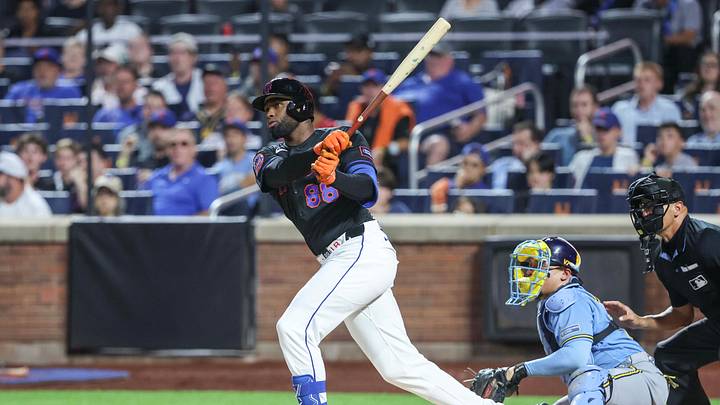
The Royals have already made some smaller moves this offseason, but nothing that has moved the needle on the player front yet, as teams also figure out the plan for 2027 baseball. Either way, one of the bigger needs for the Royals is once again getting an impact bat in the outfield, and former foe Luis Robert Jr. is a prime candidate to fit that role.
This move makes sense if the Royals also move off of Kyle Isbel as the starting outfielder. Moving on to Robert Jr's. numbers: in 2026, he slashed .221/.300/.407 for an OPS of .707 and a wRC+ of 97. It isn't anything special or remotely close to his 2023 form, but his profile fits what the Royals need both at the plate and in the field.
Athletic, Fast Bat, and Solid Fielder
It has been a couple of seasons since Luis Robert Jr. had an elite season, but the framework for that is still there, given that he needs to make some tweaks to his approach. One huge boost to his profile is his elite bat speed, which sat at 77.3 mph. That matters because he keeps improving his bat speed season by season rather than the opposite as he ages.
That means he has a solid baseline for hard contact, as he hasn't dipped below a 40% hard-hit rate since his rookie season in 2020. He also tends to have a solid average exit velocity that sat at 89.7 mph in 2026, which is well in line with his career average. Mix in that he always barrels the ball around 10% of the time (9.9% in 2026) and it shows that he has plenty of power potential still.
The power potential is there for Robert, but he also brings in some good athleticism, which would be a big benefit for the Royals in the outfield. Robert sports an 88th percentile sprint speed of 28.9 ft/sec, which helped him be a solid outfielder in 2026. The only issue with his speed was his inefficiency on the basepaths, as he was worth -1.4 BsR while also only stealing two bases in 2026.
Switching over to the defensive side of the ball, for Robert, it was another solid season in center field as he had 2 DRS, 2 OAA, and 2 FRV. As a rangy center fielder, his athletic profile and instincts make a ton of sense for the Royals to have him patrol center field in a big Kauffman Stadium. Plus, in 2026, he showed in limited innings that he isn't a great LF with 0 DRS, -2 OAA, and -1 FRV in 73.2 innings of work.
So, in short, Robert has a bat with explosive potential still, athleticism that hasn't waned, a walk rate that continues to improve (was 10.4% in 2026) and he still fields CF at a solid to above-average rate. Now, for the downsides with his profile.
Injuries, Batted Ball Issues, Contact Issues

The biggest concern with Robert is, and always will be, the injuries, as he has an extensive history of injuries. The most games he has played in a season is 145 in 2023, and he has crossed the 100-game threshold in three of his six seasons (excluding the shortened 2020 season). In 2026, injuries plagued him as he only played in 61 games due to a lower back disc herniation and a left hamstring strain.
Availability has not been Robert's best ability in his major league career. Moving back over to his bat, there are plenty of issues with it for Robert. For a guy who has power potential with the bat, his batted-ball profile needs some tweaking. In 2026, he had a ground ball rate of 43.0%, the second-highest rate in his career, a 41.1% fly ball rate, and a 15.9% line drive rate. The issue lie more in the fact that his line drive rate was a career low, and that the fly balls for Robert were either infield fly balls (19.4%) or home runs (17.7%).
That is not ideal, because when he hits a fly ball, it is only going over the fence or being an infield fly ball. There isn't a big chance for any of those fly balls to be anything else, result-wise. With a smaller sample size, however, the biggest fix for him is going to be getting the line drives going again as that is where a majority of his contact comes from.
Speaking of contact, Robert struggles with that as well. This has been a problem for the majority of his career, but in 2026, his contact rate was 74.2%, which is his second-best rate. He does swing the bat 50.3% of the time, which is a little bit above league average, so that doesn't help. A positive is that he swings at pitches in the zone a lot at 71.6%, but he doesn't make as much contact on pitches in the zone at 84.0%.
Robert also chases a lot (32.7%) and whiffs a lot (28.1%), meaning he has a very boom-or-bust profile. If he can tweak his swing decisions a little bit and keep that walk rate around 10%, then he would be a more consistent top bat in CF.
Contract Projection
Robert is an FA for the first time in his career after signing a 7-year, $68 million deal with the White Sox in 2020, and the Orioles declined the club option for 2027. In the CF market, he is a top option alongside Trent Grisham and Daulton Varsho. All three will be in similar price ranges, but Robert's is the lowest tally, as he is projected by Spotrac to get a 3-year, $36 million deal. Grisham and Varsho are expected to get at least $13 million, per Spotrac.
Conclusion
One of the best ways for the Royals to upgrade the outfield is to not trot Kyle Isbel out every day, and Luis Robert Jr. is a prime candidate to replace Isbel in CF. He has the defensive chops to play in Kauffman; he has, at a minimum, the potential to be at least a 95 wRC+ batter with the chance to be a 100+ wRC+ batter, and he is still very athletic despite the injury history. Will the Royals be taking a gamble on his health, yes, but it is a gamble that could elevate the lineup so it doesn't have a void in the nine-hole.
Related Articles
 Add us as a preferred source on Google

Trey is no stranger to writing about the Royals as he has done it for 6 years now for various blogs (Kings of Kauffman, Inside The Royals, and Farm to Fountains). He is a graduate of Baker University with a degree in Mass Media with an emphasis in sports media. He enjoys watching and researching sports as well as gaming.
Follow Trey%20Donovan