
John Peck’s Ugly Tigers Numbers Are Hiding a Better Reality
In this story:
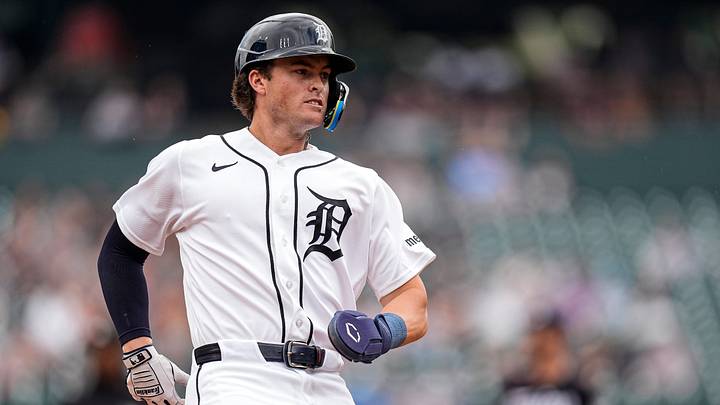
John Peck’s first 59 Major League at-bats produced a difficult offensive line for the Detroit Tigers.
Tuesday’s 0-for-4 performance against the Washington Nationals dropped Peck to a .169/.286/.186 slash line. He remained without a Major League home run and had collected only one extra-base hit.
Those results were impossible to ignore. They also failed to tell the complete story.
Peck repeatedly hit the ball with authority during Detroit’s 3-1 loss, including two outs with exit velocities above 105 mph. Washington’s defenders converted the contact into outs, leaving the rookie without anything to show for several competitive plate appearances.
His broader Statcast profile had produced a similar disconnect between process and results.
Peck’s Expected Numbers Offered Encouragement

Entering Tuesday, Peck had generated a .232 expected batting average and .369 expected slugging percentage, according to his Baseball Savant profile.
Both marks sat comfortably above his actual production.
Peck also had a .330 expected weighted on-base average compared with a .247 actual mark. His 40.5% hard-hit rate and 9.8% barrel rate showed that he had not spent his entire introduction to the Majors producing harmless contact.
Expected statistics did not guarantee that better results would arrive. They measured the quality of contact based on exit velocity and launch angle rather than accounting for every element that determined a hit.
The sample also remained small. Peck had put only 42 balls in play before Tuesday, meaning a handful of hard outs or softly hit singles could create a substantial difference.
His early plate discipline provided another positive sign. Peck entered the game with a 12.1% walk rate and 21.2% strikeout rate, indicating that Major League pitching had not completely overwhelmed him.
Those indicators did not erase the .169 batting average. They suggested the Tigers should resist judging him solely by it.
Detroit Still Needed to Evaluate the Complete Player

Detroit promoted Peck after he produced a .285/.328/.511 slash line with 10 home runs, 17 doubles, and 19 stolen bases in 58 games for Double-A Erie.
His time with Triple-A Toledo was limited by injury, forcing him to make a difficult jump without an extended adjustment period at the highest minor league level.
Manager A.J. Hinch still told Peck that he was “here to stay” after the rookie delivered his first two Major League hits and drove in three runs during an earlier victory, as detailed previously by Tigers On SI.
That commitment gave the Tigers an opportunity to evaluate more than offensive production. Peck started 20 games at shortstop and offered speed that could contribute even when his hits did not fall.
Detroit must determine whether his defense was strong enough for shortstop, whether his contact quality persisted and whether he could adjust once pitchers developed a more detailed plan against him.
Four remaining games would not settle those questions. They could provide more evidence than the basic slash line alone.
Peck’s actual results remained poor, and expected statistics should not become an excuse for every unsuccessful plate appearance. His hard contact nevertheless showed why the Tigers had reason to continue playing him.
Early numbers suggest Peck had struggled. The underlying evidence suggested he had performed better than those numbers indicated.
 Add us as a preferred source on Google