
Improving This Area Will Help Detroit Tigers New First Baseman Become Power Hitter
In this story:
The Detroit Tigers are going to have a new Opening Day first baseman this season.
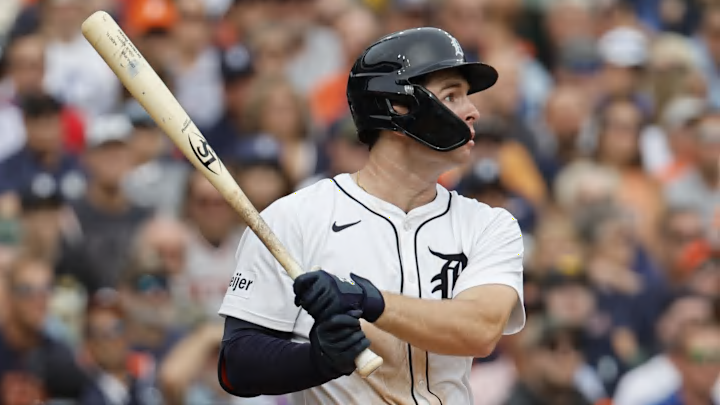
After signing Gleyber Torres to a one-year deal, the decision was made to move Colt Keith out of his spot at second base and over to first, replacing the question mark that is Spencer Torkelson.
It's a gamble.
Keith has never played there during his professional career, getting the majority of his work at the hot corner during his time in the minors and playing in 133 games at second during his first season of Major League Baseball.
But at 23 years old, and with a long-term extension already under his belt, this is the time for the Tigers to make a change that could become permanent if it works.
Outside of the unfamiliarity he has with the position, the other risk that's present is his lack of power numbers.
Keith hit 13 homers last season across his 516 at-bats.
That was a major difference from his 2023 campaign in the minors when he had 27 blasts, 13 of which came at the Triple-A level in 261 at-bats.
Getting his power swing to translate to the Majors will be a must, and Evan Petzold of The Detroit Free Press pointed out an easy area Keith should focus on at the plate this year.
"First baseman Colt Keith is one adjustment away from unlocking a breakthrough sophomore season in 2025 ... Keith is capable of hitting 20-plus homers for the Tigers in 2025, as long as he averages an 89 mph exit velocity," he wrote.
Getting to that point will be the challenge.
Petzold points out the rising star averaged an 88.7 mph exit velocity during his 67 games at Triple-A. Last season in The Show, Keith's exit velocity was an average of 87.8 mph, putting him in the 23rd percentile across Major League Baseball per Baseball Savant.
The advanced stats didn't paint a rosy picture of Keith on the surface, with his hard hit rate sitting in the 22nd percentile and his barrel rate in the 25th.
However, he squared up the baseball 27.2% of the time, good for the 71st percentile in the Majors last year to go along with an expected slugging percentage in the 45th percentile and his bat speed of 71.3 mph in the 39th.
With more time to adjust to pitching at this level, there's a chance Keith will be able to generate the exit velocity needed to hit some power numbers required for a starting first baseman.
While he likely never will reach the home run totals that some of the game's best sluggers hit on an annual basis, Keith also brings a solid approach to the plate with a high batting average and low strikeout rate.
If he's able to add some power to his game, then he could be the first baseman of the future in Detroit.
Recommended Articles
 Add us as a preferred source on Google