
Why a Kyrie Irving Trade Makes Little Sense for the Utah Jazz
In this story:
Despite the NBA trade deadline still sitting a little under three months away from transpiring, it hasn't stopped a few insiders around the league connecting some big names to some potential trade chatter to keep an eye on.
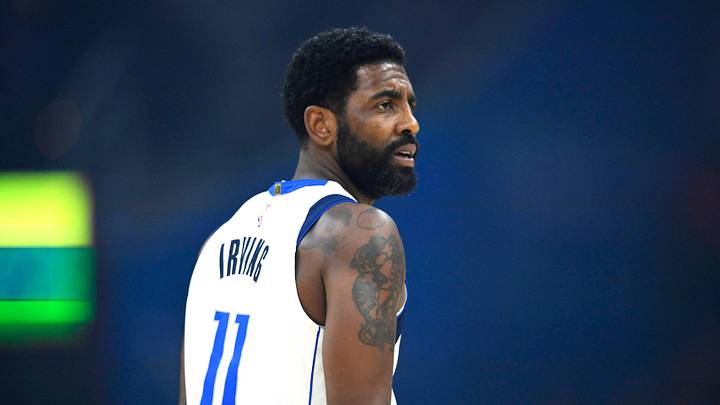
And the latest trade buzz around the league is seemingly centered around Kyrie Irving and none other than the Utah Jazz.
According to SNY's Ian Begley, the Jazz have reportedly given "internal consideration" to the idea of trading for Irving.
"The thing that I've heard recently that kind of piqued my interest was Utah doing so with Kyrie Irving, just internally, kind of going through some things and giving him internal consideration as a potential trade candidate," Begley said on a recent episode of The Putback. "Irving, obviously, with the Mavs, so many teams are waiting to see what Dallas does there at the trade deadline. Do they trade Irving?"
"A lot of trade capital there in Utah, and I think they want to win. And so, it's just interesting to me to hear about that with Utah. Again, teams around the league are doing similar things. But, you're not going to spend a lot of time on a player if you don't have any interest in them. So, the idea that Utah is spending some time internally on Kyrie Irving was interesting."
It's certainly an interesting piece of intel to have surfaced connecting the Jazz and Irving of all players, especially at this point in the season.
Considering how early in the season it is, and free agent signings from this summer still trade restricted until December 15th, it's hard to imagine a move for Irving being imminent for any team––let alone for the Jazz.
But when that time comes for the Jazz and other teams to start seriously poking around the trade market, would a move to go and acquire Irving actually make sense for Utah given their current situation?
Let's break it all down:
Does a Kyrie Irving Trade Make Sense for the Jazz to Consider?
On the surface, adding a guard of Irving's caliber and skillset to the Jazz's lineup does make a bit of sense.
With the current structure of the Jazz's rotation, they have only two reliable guards to roll out as a primary ball-handler on a nightly basis: that's Keyonte George and Darryn Peterson. Based on how Isaiah Collier has started off this season, he can't be factored in as a part of their future plans–– or even short-term plans–– at this point.
So that makes a potential acquisition of a third guard add up for the Jazz to consider. Someone like Irving, for example, seems as if he could be a major lift for Utah's guard rotation, and for their overall offensive ceiling as they've started off the new year ranking 27th in offensive rating.
However, the true logistics behind trading for a player like Irving––including the cost and his long-term fit with the roster––might not make as much sense for the Jazz.

For one, Irving is on a far different timeline than this Jazz roster. He's turns 35 in March, and across Utah's entire roster, there's only one player in the mix who's even over 30 years old. That's Jusuf Nurkic. That factor alone should sound some alarms for Utah's front office when considering a deal.
On top of the age concerns, Irving's contract situation deserves some attention as well. He's got a player option to decide on this coming offseason worth $42 million, and is signed on for this season at a deal just under $40 million.
This season, the Jazz could find a path to afford Irving on the books by sending out the right combination of contracts in a trade package.
Heading into this summer, though, with hefty deals to Lauri Markkanen and Jaren Jackson Jr., on top of Keyonte George's rookie-scale extension, Irving might not be a realistic addition to keep onboard for more than just this year.
If Irving were simply valued as a cheap acquisition on an expiring contract, taking a flier on a possible rental wouldn't be the worst choice for the Jazz to consider. However, Irving's certainly still seen as a valuable player who the Dallas Mavericks most likely aren't giving up for pennies on the dollar.
He's averaging 22.3 points on 47.3% shooting through the 12 games he's played this season, and clearly still has the capabilities of being a starting point guard for a competitive team.
Other front offices would be interested in acquiring him as well, thus raising the price tag for the Jazz if they wanted to bring him onboard themselves. He'd likely require multiple players to match contracts, on top of additional draft capital, and such a move might be too costly for Utah to truly consider.
The Harsh Reality of a Kyrie-to-Utah Trade
So in a vacuum, the Jazz pursuing Irving as a possible trade target would be a fun idea to pursue.
A three-guard rotation of Irving, George, and Darryn Peterson would make for a dangerous offensive combination to stop, and might help Utah find their way to stacking a few more wins than they have early in the season.
Yet, when combining his timeline fit with this current Jazz roster, the cost of acquisition, and an uncertain future beyond this season, the idea of an Irving-to-Utah trade becomes a bit more complicated to work through.
Lots of time still remains between now and the NBA trade deadline, so perhaps things change that make such a move add up more than it does now. At the current moment, though, the Jazz would probably be best to steer clear of the nine-time All-Star and attack their guard needs in a different fashion.
 Add us as a preferred source on Google

Jared Koch is the deputy editor of Utah Jazz On SI. He's covered the NBA and NFL for the past two years, contributing to Denver Broncos On SI, Indianapolis Colts On SI, and Sacramento Kings On SI. He has covered multiple NBA and NFL events on site, and his works have also appeared on Bleacher Report, MSN, and Yahoo.
Follow jjaredkoch