
Pelicans' Best Move Once Dejounte Murray Returns Is Now Clear
In this story:
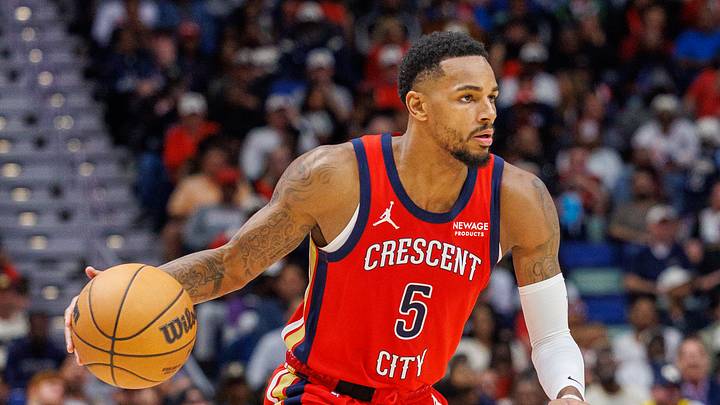
Three games, three wins, and a decision the Pelicans should no longer put off. With Dejounte Murray unavailable, Jeremiah Fears has taken control of the offense, Herb Jones has returned to the starting lineup, and New Orleans has followed a 0-4 start with victories over Sacramento, Atlanta, and previously unbeaten Memphis.
Murray's return should allow the Pelicans to strengthen their already strong bench. Fears has earned the chance to keep running with the starters, and the current combination deserves more time together.
That leaves a meaningful assignment for Murray as a scorer and ball-handler with the reserves. It also gives New Orleans a practical approach while evaluating a trade market that may offer few attractive solutions.
Fears has earned control of the offense
Fears averaged 9.0 points and 1.8 assists in the four games Murray played. Across the three Murray missed, he averaged 18.0 points and 9.0 assists. Whatever the reason for the improvement, Fears has played better without Murray.
The Memphis win strengthened that argument despite his shooting struggles. Fears went 5-for-17 and turned it over four times, yet delivered seven assists, an important late rebound, and the winning free throws.
At this point in his career, his role should be secure enough to withstand an uneven performance. New Orleans needs to learn how effectively he can lead this offense, and that evaluation requires consistent opportunities against starting competition.
Keeping Jones alongside him maintains another benefit of the recent arrangement. The Pelicans have improved with a different backcourt configuration, giving them reason to keep evaluating Fears with Jones' defensive support.
Murray can make the bench better
Murray averaged 17.8 points, 5.8 rebounds, and 6.0 assists in his first four appearances. The Pelicans could put that production to work in minutes when Fears rests, with opportunities to stagger Murray alongside Zion Williamson or Trey Murphy III.
Derik Queen's passing adds another possibility. Murray could share initiation duties with Queen while contributing as a scorer when the center facilitates. That pairing would need time to establish some chemistry, but both players could benefit.
His assignment should come with clear expectations about touches and decision-making. Moving Murray to the bench won't accomplish much if there's still uncertainty about who controls the offense.
Mosley can adjust closing combos according to performance and matchups. Preserving the starting lineup would give the Pelicans continuity without obligating them to finish every game the same way.
Any trade needs to serve a purpose
Murray's contract makes finding a workable role particularly important. Beyond this season, he holds a $30.8 million player option for 2027-28, leaving the decision about that final year in his hands.
At 30 and with an Achilles rupture in his recent injury history, Murray brings considerations that potential buyers will weigh against his production and salary. Those factors could narrow the market; they don't establish that New Orleans must attach assets to move him.
If Murray is unwilling or unable to accept a reserve role, the Pelicans would face a harder decision.
The standard for any move should remain clear. New Orleans should pursue complementary shooting, perimeter defense, or future assets. Financial relief can also have value, provided obtaining it doesn't mean sacrificing useful players or picks without a sufficient return.
The original investment in Murray shouldn't determine his current place in the rotation. It shouldn't push the Pelicans into another costly transaction, either.
Their recent wins have created an opportunity to establish a better fit internally. Keep Fears with the starters, give Murray a defined role off the bench, and demand a worthwhile package before making a larger change.
 Add us as a preferred source on Google
