
Detroit Pistons Are 3-0, and Their Blue Collar Identity Has a New Offensive Dimension
In this story:
There haven’t been any fancy additions or major changes. It’s largely the same group picking up their lunch pails and grinding on both ends of the floor.
And yet, they’ve been widely overlooked across the league. They were projected by many to take a step back. Not enough talent. No secondary creators.

And while some of the statements were grounded in the data, the Pistons have emerged as one of seven NBA teams that remain undefeated to open the season.
Detroit stands atop the Eastern Conference as the only team without a loss on its record.
They’ve defeated the Boston Celtics, Miami Heat and Philadelphia 76ers by a combined 38 points.
And in Sunday’s victory over the Sixers, they were without Ausar Thompson (ankle) and Jalen Duren (hamstring), and still didn’t miss a beat.
After their home opener, they got a road win over Miami, dominating the first and third quarters while holding the Heat to 38 percent shooting from the field.
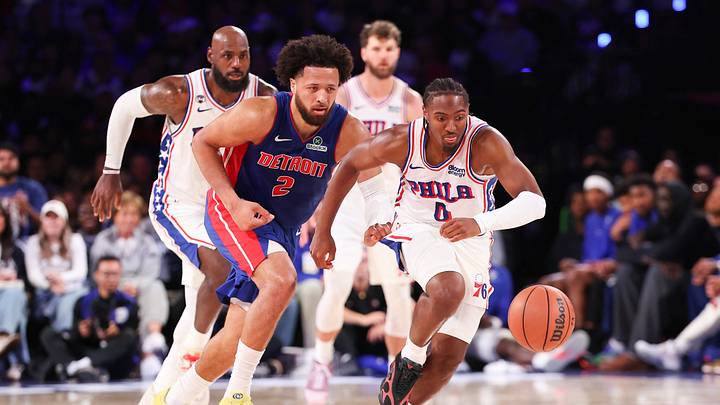
They followed that with another road victory against Philadelphia, holding the Sixers to 93 points while limiting their top offensive threats--LeBron, Jaylen Brown and Tyrese Maxey--to a combined 24-for-59 shooting.
And through three games, the Pistons have shown the familiar aptitude to impose its defensive identity on opposing teams and that’s even without key players in the lineup. But for Detroit, it’s how they’re doing it this season that makes their overall attack more lethal.

Offensively, the Pistons have worked to be more diverse in the halfcourt.
Last season, the offense consisted of Cade Cunningham pick-and-rolls with Jalen Duren or Duncan Robinson flying off of pin-downs or dribble handoffs.
And then when they got in a pickle, the solution was to toss the ball into Tobias Harris at the elbow or low block for a post fade. As the season progressed, it became a predictable brand of basketball.
But this year, the Pistons have incorporated more cutting, more guard-to-guard screening and flare screens. A more nuanced approach has added some spice to their overall half-court gumbo.
They’ve also taken a lot more three-pointers. Last season, Detroit averaged 11 made 3-pointers on 30 attempts per game, ranking near the bottom in both categories.
However, through their first three games this season, the Pistons have attempted 42,38, and 34 3-pointers.
They’ve also made 42 percent of those attempts, which ranks third in the league. New addition John Collins is 7-for-14 from the 3-point range so far. His ability to knock down above-the-break threes and serve as a reliable corner shooter adds a dynamic that the Pistons didn’t have with Tobias Harris last season.
In fact, Harris made five 3-pointers in one game last season. Collins matched that total against the Miami Heat in his second game with Detroit.
The Pistons have also put the ball in Ausar Thompson’s hands to initiate the offense. Before getting hurt in the second game, he had recorded five assists, matching his total from the previous game in just 19 minutes of action.
Overall, It is a super small sample size with 79 more games to go, but these offensive wrinkles are worth monitoring as the season progresses.
And, of course, the Pistons aren’t nearly as talented on paper as many of their Eastern Conference counterparts from a star power standpoint. But this group fits one another. And they dominate the margins.
Last season, they ranked seventh in rebounding. This year, they’re tied for second. They’re second in opponent field goal percentage at 41 percent and 11th in opponent 3-point percentage.
Also, the Pistons have a lot more area for improvement on defense. Last season, they led the league by forcing 16.4 turnovers per game, a central factor in the chaos they created on that end of the floor.
So far this season, they are ranked 24th in the NBA in forced turnovers.
Detroit has a formula now. It’s defense, attention to detail and a community-driven brand of offense centered around their star, Cade Cunningham.
If the Pistons are going to win this season, it won’t be pretty. It won’t always make headlines. And most will doubt this team until it proves it can win three playoff rounds, let alone four. But if anything, this start has proved that the zebra hasn’t changed stripes. Detroit still carries the same DNA that fueled its 60-win mark from last season.
 Add us as a preferred source on Google

Christopher Davis is a UCF Journalism graduate and former Associated Press writer covering the NBA, NFL, and UCF. He later contributed as a narrative writer for EA Sports College Football 25. A Detroit native and lifelong sports fan, he is the author of Master Key, an epic fantasy for young adults that blends anime, comics, sports, and culture—crafted to create the kind of story he always wished existed.
Follow bychrisdavis