%20%20--%3E%0A%3Csvg%20version%3D%221.1%22%20id%3D%22Layer_1%22%20xmlns%3D%22http%3A%2F%2Fwww.w3.org%2F2000%2Fsvg%22%20xmlns%3Axlink%3D%22http%3A%2F%2Fwww.w3.org%2F1999%2Fxlink%22%20x%3D%220px%22%20y%3D%220px%22%0A%09%20width%3D%2239px%22%20height%3D%2240px%22%20viewBox%3D%220%200%2039%2040%22%20enable-background%3D%22new%200%200%2039%2040%22%20xml%3Aspace%3D%22preserve%22%3E%0A%3Cpath%20fill%3D%22%23FFFFFF%22%20d%3D%22M38.5%2C7H28.2v26h10.3V7z%22%2F%3E%0A%3Cpath%20fill-rule%3D%22evenodd%22%20clip-rule%3D%22evenodd%22%20fill%3D%22%23FFFFFF%22%20d%3D%22M26.1%2C25.5c0%2C5.8-4.1%2C7.5-12.9%2C7.5C3.9%2C33%2C0%2C31.2%2C0%2C25.2v-1.1h11.6%0A%09v2.4c0%2C0.7%2C0.1%2C1.4%2C1.2%2C1.4c1%2C0%2C1.2-0.4%2C1.2-1.3v-0.9c0-1.6-0.9-1.6-3.5-2.2C2.2%2C21.7%2C0%2C19.7%2C0%2C15.3v-0.9C0%2C9.3%2C5.5%2C7%2C12.9%2C7%0A%09c10.2%2C0%2C12.8%2C2.6%2C12.8%2C7.4v1.8h-11v-2.9c0-0.6-0.4-1.1-1.2-1.1c-0.6%2C0-1.2%2C0.4-1.2%2C1.1v0.9c0%2C1.5%2C0.9%2C2%2C3.3%2C2.5%0A%09c8%2C1.6%2C10.5%2C3.3%2C10.5%2C7.5V25.5z%22%2F%3E%0A%3C%2Fsvg%3E%0A)
Joel Embiid’s Pretty Statline Hides Biggest Issues With His Return to 76ers
In this story:
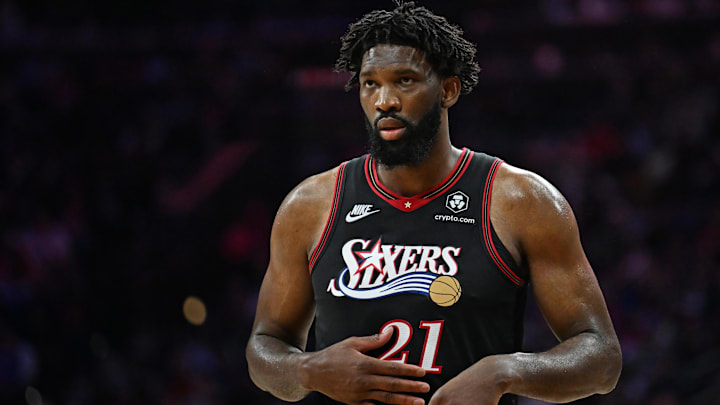
Before the first commercial break of Game 4 between the 76ers and Celtics, Joel Embiid drank in the roars of the Philadelphia crowd. He raised his arms, Gladiator-style, as his teammates walked to the bench and basked in the glory of postseason basketball. For a player who underwent emergency appendix surgery three weeks prior, it was probably the best feeling in the world.
It was fleeting, as these moments are. Little did Embiid know it was also the last such moment he’d enjoy that night.
When the dust settled on Sunday, the scoreboard showed Boston beating Philadelphia, 128–96. It was an annihilation, the sort of game we’d expect to see from a No. 2 v. 7 playoff matchup, but hadn’t happened yet this series. The Sixers kept pace pretty well in the first three games of the series but wound up flattened by the Celtics’ steamroller in Game 4.
In theory, Embiid’s return and performance should represent the lone bright spot of the loss. He was able to get back on the floor and play 34 minutes less than a month after emergency surgery. Moreover he was productive—the former MVP tallied 26 points, 10 rebounds, six assists, a steal and a block. A player of his talent putting up those kinds of numbers despite rust can only help Philadelphia in a series where the Sixers are outgunned. Right?
Wrong, actually. Embiid’s return completely threw Philly off its game and took away the things the team was doing best in their Game 2 win over the C’s. Moreover, it was his return that set the stage for Game 4’s thrashing.
Embiid’s return didn’t help 76ers, it hindered them

Embiid is not the same player he was when he won MVP, which perhaps isn’t shocking to some considering the multiple surgeries he’s been forced to undergo since 2023. But it bears mentioning because he doesn’t play the same way anymore. Instead of a three-level scoring center with elite rim protection and mobility, Embiid’s playstyle is now more akin to that of a 7-foot guard.
He hangs out at the three-point line on most possessions, only posting up a few times per game. He still sets screens on the perimeter but very rarely rolls to the rim to punish defenses that switch a smaller man onto him; Embiid does most of his damage on jumpshots and from the free throw line. Defensively the Sixers still want him anchored to the paint but he doesn’t move nearly as well as he once did.
That version of Embiid doesn’t fit into the best version of the 76ers’ offense. Upon his return Sunday, Philadelphia fed him the ball at the cost of its best player, Tyrese Maxey, who had just three shot attempts in the first half as the Sixers were outscored by 18. He finished with 22 points on 7-for-14 shooting after averaging 27.0 points on 26.3 shots per game before Embiid came back this series. Maxey’s speed and ability to pull up from deep has given the Celtics huge problems all year long; when he catches fire he’s nigh unstoppable.
But he was taken completely out the game on Sunday, not because Boston did anything different but because Embiid needs touches to impact the game. And those touches usually gum up the offense. The star big man doesn’t have a quick enough trigger to be an efficient spot-up shooter and every time he takes on a defender one-on-one the rest of the team just stands around to watch. That worked well enough a few years ago but he needed 20 shots to get to 26 points in Game 4—it clearly doesn’t work anymore.
As a result, the 76ers’ offensive rating for Game 4 was 102.1, a steep drop-off from the 112.4 number they posted in a competitive Game 3 loss and miles from Game 2’s 126.1. It’s not entirely on Embiid, as those numbers reflect a generally poor offensive performance from the whole roster—but given Philly was outscored by 25 in his minutes on the floor, there’s some correlation here.
76ers can’t let Embiid’s presence stop them from being their best selves

This version of Embiid isn’t a bad player by any means. But for this playoff series, giving him minutes comes at a cost. Running the offense through him comes at a cost. And that cost is the 76ers’ ability to be the best version of themselves.
The only chance Philadelphia has to keep up with Boston is to play the way we saw in Game 2. That team ran the offense through Maxey as he flew around screens set by Adem Bona and Andre Drummond. The star scoring guard was able to pull up from three if the Celtics sat back too far in fear of his driving ability. When he did go to the hoop, Boston was forced into two-on-one situations constantly, having to choose between defending Maxey or the center rolling to the hoop. Whatever decision was made resulted in an open man elsewhere as the defense was forced to help off the perimeter. That’s the way to score in the modern NBA and, coincidentally, one of the core tenets of Joe Mazzulla’s Celtics offense.
The play style is fundamentally different with Embiid at the five instead. It has to be. Whether by design or otherwise, he won’t collapse the defense by rolling into the paint after freeing up Maxey with a pick. Embiid’s threat as a shooter is nice as far as opening up the floor but having the center stand out by the three-point line simplifies things for the Boston’s defense. He can’t switch defensively like Bona (who has been excellent on that end all series long) and the team’s focus on ensuring Embiid isn’t left on an island leads to scrambling, which then leads to open passing lanes that smart teams (like the Celtics) will see immediately.
Case in point: the 76ers did everything they could to prevent Embiid from being involved in this Jayson Tatum pick-and-roll. He wound up there anyway, and because Philly didn’t want to leave him on an island against the Celtics’ superstar, he was left sprinting to try to cover the screener, Derrick White. Which made for an easy bucket, even as White goes through the worst shooting stretch of his Celtics career.
Enjoyed this one
— Pull up shoot (@NElGHT_) April 27, 2026
Sixers pre-switch Embiid out of the action, Tatum says nope get over here buddy. pic.twitter.com/A888h30gUl
The 76ers have very little room for error at large. Boston is a very good team and might have dropped 130 points on Sunday without Embiid on the floor. But his presence makes things easier for opponents while making life more complicated for his teammates.
The decent statline doesn’t change that. Embiid’s return is a feel-good story but if Philadelphia wants to survive any longer in the playoffs, changes must be made to ensure his weaknesses don’t take away what the team does best on the floor.
More NBA playoffs from Sports Illustrated
Listen to SI’s NBA podcast, Open Floor, below or on Apple and Spotify. Watch the show on SI’s YouTube channel.
 Add us as a preferred source on Google
Liam McKeone is a senior news writer for the NBA team at Sports Illustrated. He has been in the industry covering the NBA and other sports as a content creator starting in 2017. Prior to joining SI, McKeone worked for NBC Sports Boston and The Big Lead. In addition to his work as a writer, he has hosted the Press Pass Podcast covering sports media and The Big Stream covering pop culture. A graduate of Fordham University, he is always up for a good debate and enjoys loudly arguing about sports, rap music, books and video games. McKeone has been a member of the National Sports Media Association since 2020.
Follow liam_mckeone