
2 Big & 2 Small Takeaways From Timberwolves’ Loss to Knicks
In this story:
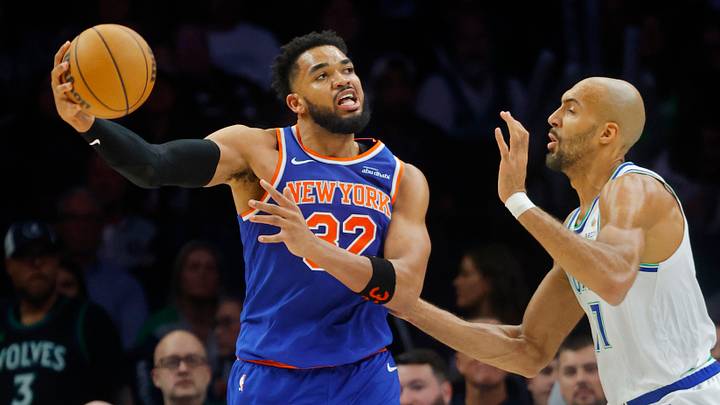
There is, and always will be, a special kind of buzz in Target Center when Karl-Anthony Towns is back in the building where he played the first nine years of his NBA career.
That was especially true Thursday night as Timberwolves fans welcomed back their 2015 first overall pick, who won a title with the team he grew up rooting for last season and paraded the streets of Manhattan.
Never gets old seeing KAT at the Target Center 💚 #RealLoud pic.twitter.com/yvObc5JDcx
— Mikey Torborg (@22MIK3Y) November 20, 2026
The Knicks entered Thursday with a modest 8-6 record, but they were 6-2 in their previous eight games and carried the same championship DNA that will likely stay with the club for a long time. They know what it takes to win at the highest level. They know how to capitalize on their opponents' mistakes and win in the clutch.
That's a big reason they walked out of Target Center with a 102-99 win despite letting go of an 18-point lead. Let’s run through some takeaways, both big and small, for the Wolves coming out of a disappointing loss.
Big — the Rudy Gobert complexity continues to grow
With Gobert on the floor this season, the Wolves have a 97.9 defensive rating, which is 6.2 points better than their NBA-leading season average (104.1). But with Gobert on the bench, Minnesota’s defensive rating drops to 114.6, equivalent to the NBA’s 20th-ranked defense.
Even though Towns scored 22 points Friday and got the better of Gobert, especially in the first half, the Wolves' rim protector is still giving them the same type of impactful and important defense as he has since joining the team. But the offense this season has been so bad that it is overshadowing his defense.
Gobert, who is almost always near the top of the NBA in field goal percentage, is shooting 46.6% from the floor this season. He has had five games with zero field-goal makes, the same total he has had over the previous five seasons.
Against the Knicks, Gobert shot 4-for-9 (44%) and scored nine points in 35 minutes. By his offensive standards this season, that’s not a horrible stat line. He converted some powerful buckets at the rim throughout the game. But of the 14 games last season Gobert took at least nine shot attempts, he scored 12 or more points every time and shot 50% or better all but once.

Gobert’s offensive struggles this season have Chris Finch scratching his head. The Wolves thought this was the year they could unlock Gobert’s scoring, but we have heard that since he got here, and it has never truly happened. LaMelo Ball has yet to develop a two-man game with Gobert. So far this season, Ball has assisted his new big man just seven times.
It is still early. There is still time for Ball to improve his production with Gobert. The Wolves believe they need to get Gobert the ball in more advantageous positions to score. But at the same time, he needs to seal up his offense. Gobert needs to refine his approach and be as airtight as possible because he is so limited on offense right now.
That means cutting out the contested layups, which almost always spur momentous transition opportunities for the opponents. Gobert needs to prioritize dunks at the rim, and when he can’t, he should look to pass. Gobert also can’t afford to make unforced, late-game miscues like the one he committed in the fourth quarter against the Knicks.
There is still time left for Gobert to find some type of groove in Minnesota’s new-look offense. It will be on both him and the team to make that happen. But at this point in time, it is hard to say that his offensive woes—and how they limit the Wolves’ offense—are not concerning for this team’s playoff hopes for as long as he is on the roster.
Big — LaMelo Ball remains in an offensive rut
That isn’t how the game started, though.
Ball scored nine points on 4-for-9 shooting in the first quarter. He went 1-for-4 from deep, but that one make was an impressive one. Ball broke down Josh Hart on the perimeter, stepped back, and laced in the long ball.
oh myyy, Melo. 🕺 pic.twitter.com/6CHuFK9j5B
— Minnesota Timberwolves (@Timberwolves) November 20, 2026
It seemed as if Ball was breaking out of his cold stretch, doing so at a perfect time against a highly capable offense in the Knicks. But over the final three quarters, Ball cooled off back to the chilly version of himself that he has been over the last four games.
Ball shot 2 of 12 over the final three quarters against New York. He scored just six more points in 26 minutes. Collectively, Ball is now shooting 28.9% from the floor over Minnesota’s last four games. The Wolves have certainly felt his misses, and did once against New York. But Ball is finding other ways to positively impact these games.
As Ball struggled to hit shots over the final three quarters, he compensated by creating 18 points off seven assists, pulling in six rebounds, and only committing one turnover.
Ball’s cold stretch is not terribly concerning. He has been dealing with right wrist pain this season, so that explains his poor shooting. But Ball is consistently having a positive impact elsewhere, whether on the glass, in the passing lanes, or by keeping the ball moving. And that is critical.
It is indicative of his buy-in to this team and is keeping them competitive despite lacking considerable offensive firepower (Ball’s shooting slump and Anthony Edwards’ and Donte DiVincenzo’s injuries).
Small — Jonathan Kuminga looked healthy
It was good to see Kuminga have a productive night in his first game back after suffering a shoulder contusion on his shooting arm that kept him out for Tuesday’s contest against Portland.
throw it down, JK. pic.twitter.com/Q1T71yg2GY
— Minnesota Timberwolves (@Timberwolves) November 20, 2026
Kuminga scored a game-high 23 points against the Knicks, his most since April 8. He went 7-for-13 from the floor, 2-for-4 from deep, and 7-for-7 from the free-throw line. Despite committing a season-high five turnovers, the Wolves outscored New York by eight points with Kuminga on the floor.
He was the only Wolves player with a positive plus/minutes. New York scored two points, went 1-for-9 from the floor and 0-for-3 from deep, with Kuminga as the primary defender.
Kuminga played aggressively on offense. He brought his usual intensity on defense. He looked very healthy and remains an integral part of this Wolves team—excelling in complementary roles while still being a reliable scoring threat when needed.
Small — Jaden McDaniels just keeps showing up
McDaniels has been beating his drum all season. It has been a constant beat in the background of Minnesota’s 11-5 start. That beat hasn’t been the main feature of the Wolves’ five-man band, but it has been essential to their tune.
Against the Knicks, McDaniels scored 17 points on 6-of-10 shooting and went 4-for-4 from deep in 39 minutes. He did commit three turnovers to just one assist, but recorded two steals and two blocks.

McDaniels has scored at least 13 points in every game this season. He is averaging 17.1 points per game and has scored 273 total, a career high over the first 16 games of a season, per Stathead.
But against New York, McDaniels was not a part of the offense down the stretch of the fourth quarter. The Wolves should have leaned more on McDaniels in the final moments, especially as Minnesota, outside of McDaniels, shot 6 of 18 from the floor in the fourth.
Still, McDaniels’ start to this season is making the $40 million extension the Wolves gave him this off-season look good. McDaniels isn’t the lead singer of this operation. He never has been. But he is still a key staple of the ensemble. His offense continues to mature, and the Wolves need to make sure that they utilize his scoring abilities as consistently as possible.
Get Timberwolves On SI straight to your inbox: sign up for our free newsletter here.
 Add us as a preferred source on Google

Charlie Walton has covered the Minnesota Timberwolves for over four years. He got his start writing for Zone Coverage as a junior in high school. Since then, he has written for SB Nation's Canis Hoopus and built a personal social media brand that blends interactive graphics with unique long-form analysis. Charlie is currently a senior at the University of Minnesota, Twin Cities, where he is majoring in journalism. His work has been featured on ESPN, WCCO, and Bleacher Report.
Follow CharlieWaltonMN