%22%3E%0A%3Cpath%20d%3D%22M0%209.72534H5.31306L11.3609%2017.2239V9.72534H16.9943V26.7196H11.945L5.63335%2018.8819V26.7196H0V9.72534Z%22%20fill%3D%22white%22%2F%3E%0A%3Cpath%20d%3D%22M18.4827%2020.1632V20.1161C18.4827%2016.1595%2021.3276%2013.145%2025.303%2013.145C30.0132%2013.145%2032.1987%2016.4233%2032.1987%2020.4552C32.1987%2020.7472%2032.1987%2021.0864%2032.1704%2021.3784H23.645C24.0313%2022.5465%2024.9545%2023.1494%2026.1414%2023.1494C27.14%2023.1494%2027.9596%2022.6878%2028.8356%2021.7929L31.7936%2024.148C30.4842%2025.8436%2028.6096%2027.04%2025.7458%2027.04C21.403%2027.04%2018.4639%2024.2987%2018.4639%2020.1726L18.4827%2020.1632ZM27.1777%2018.9479C27.0552%2017.6856%2026.3016%2016.9603%2025.3313%2016.9603C24.361%2016.9603%2023.7487%2017.7327%2023.5791%2018.9479H27.1777Z%22%20fill%3D%22white%22%2F%3E%0A%3Cpath%20d%3D%22M32.1045%2013.4653H37.3705L38.727%2018.8066L40.3284%2013.4182H44.7183L46.348%2018.8537L47.7516%2013.4653H52.9517L48.9009%2026.8233H44.285L42.5139%2021.1429L40.6958%2026.8233H36.1081L32.1045%2013.4653Z%22%20fill%3D%22white%22%2F%3E%0A%3Cpath%20d%3D%22M65.3677%2020.7L58.9619%209.72534H65.3206L68.2315%2015.3116L71.1707%209.72534H77.4634L71.0576%2020.6247V26.7196H65.3772V20.7H65.3677Z%22%20fill%3D%22white%22%2F%3E%0A%3Cpath%20d%3D%22M74.9102%2020.1442V20.0971C74.9102%2016.3572%2078.0189%2013.1543%2082.3899%2013.1543C86.7609%2013.1543%2089.8225%2016.3101%2089.8225%2020.05V20.0971C89.8225%2023.8369%2086.7138%2027.0399%2082.3428%2027.0399C77.9718%2027.0399%2074.9102%2023.884%2074.9102%2020.1442ZM84.5283%2020.1442V20.0971C84.5283%2018.7877%2083.558%2017.742%2082.3428%2017.742C81.1276%2017.742%2080.2044%2018.7876%2080.2044%2020.05V20.0971C80.2044%2021.4065%2081.1747%2022.4522%2082.3899%2022.4522C83.6051%2022.4522%2084.5283%2021.4065%2084.5283%2020.1442Z%22%20fill%3D%22white%22%2F%3E%0A%3Cpath%20d%3D%22M91.1602%2013.4652H96.671V16.1406C97.4247%2014.3413%2098.6399%2013.1826%20100.825%2013.2768V19.1268H100.241C97.9145%2019.1268%2096.671%2020.4174%2096.671%2023.3566V26.7291H91.1602V13.4747V13.4652Z%22%20fill%3D%22white%22%2F%3E%0A%3Cpath%20d%3D%22M101.871%209H107.382V17.5442L110.227%2013.4652H116.228L112.073%2018.8537L116.294%2026.7196H110.396L108.475%2023.074L107.382%2024.487V26.7196H101.871V9Z%22%20fill%3D%22white%22%2F%3E%0A%3Cpath%20d%3D%22M122.897%2018.2695V18.2224C122.897%2013.1449%20126.901%209.35791%20132.271%209.35791C135.182%209.35791%20137.537%2010.3282%20139.383%2011.9297L136.199%2015.7637C135.078%2014.8123%20133.844%2014.2847%20132.44%2014.2847C130.226%2014.2847%20128.625%2015.9804%20128.625%2018.2884V18.3355C128.625%2020.7377%20130.302%2022.3862%20132.676%2022.3862C133.646%2022.3862%20134.183%2022.2355%20134.616%2022V20.3043H131.705V16.6587H139.939V24.5246C138.092%2026.0319%20135.521%2027.0775%20132.44%2027.0775C127.146%2027.0775%20122.897%2023.5355%20122.897%2018.2601V18.2695Z%22%20fill%3D%22white%22%2F%3E%0A%3Cpath%20d%3D%22M141.493%209H147.202V12.5232H141.493V9ZM141.587%2013.4652H147.098V26.7196H141.587V13.4652Z%22%20fill%3D%22white%22%2F%3E%0A%3Cpath%20d%3D%22M148.389%2022.961V22.9139C148.389%2020.2668%20150.358%2018.7878%20153.438%2018.7878C154.559%2018.7878%20155.991%2019.0327%20156.566%2019.2776V19.061C156.566%2017.8458%20155.812%2017.1392%20154.116%2017.1392C152.76%2017.1392%20151.62%2017.4313%20150.452%2017.8929L149.481%2014.2283C151.008%2013.6443%20152.76%2013.2581%20155.068%2013.2581C157.762%2013.2581%20159.514%2013.8139%20160.673%2014.982C161.671%2015.9805%20162.058%2017.2617%20162.058%2019.1834V26.7385H156.547V25.4009C155.623%2026.3994%20154.389%2027.0494%20152.731%2027.0494C150.179%2027.0494%20148.389%2025.5893%20148.389%2022.9704V22.961ZM156.622%2021.8117V21.2559C156.302%2021.1334%20155.821%2021.0392%20155.36%2021.0392C154.267%2021.0392%20153.664%2021.6987%20153.664%2022.5182V22.5653C153.664%2023.3378%20154.22%2023.8559%20154.926%2023.8559C155.897%2023.8559%20156.622%2023.0835%20156.622%2021.8211V21.8117Z%22%20fill%3D%22white%22%2F%3E%0A%3Cpath%20d%3D%22M163.716%2013.4652H169.227V15.3116C170.075%2014.2188%20171.412%2013.1543%20173.277%2013.1543C176.066%2013.1543%20177.818%2015.0007%20177.818%2017.9869V26.729H172.307V19.7579C172.307%2018.6181%20171.629%2017.9587%20170.8%2017.9587C169.971%2017.9587%20169.227%2018.6181%20169.227%2019.7579V26.729H163.716V13.4746V13.4652Z%22%20fill%3D%22white%22%2F%3E%0A%3Cpath%20d%3D%22M180.494%2022.2825V17.7231H178.939V13.4745H180.494V10.1492H186.005V13.4745H189.066V17.7231H186.005V21.0767C186.005%2022.0753%20186.466%2022.4333%20187.342%2022.4333C187.851%2022.4333%20188.435%2022.292%20189.019%2022.0188V26.2673C188.143%2026.7289%20186.834%2027.021%20185.496%2027.021C182.246%2027.021%20180.494%2025.5137%20180.494%2022.2825Z%22%20fill%3D%22white%22%2F%3E%0A%3Cpath%20d%3D%22M189.452%2025.1182L191.317%2021.9907C192.918%2022.9892%20194.718%2023.4697%20196.225%2023.4697C196.762%2023.4697%20197.026%2023.3472%20197.026%2023.0363V22.9892C197.026%2022.7254%20196.781%2022.5559%20195.443%2022.2167C192.089%2021.3878%20190.026%2020.4928%20190.026%2017.7515V17.7044C190.026%2014.7935%20192.353%2013.1638%20195.801%2013.1638C197.987%2013.1638%20200.144%2013.7196%20201.755%2014.6899L200.003%2017.9682C198.59%2017.1957%20196.894%2016.7341%20195.773%2016.7341C195.236%2016.7341%20195%2016.8754%20195%2017.1486V17.1957C195%2017.4595%20195.292%2017.6291%20196.63%2017.9682C199.984%2018.7972%20202%2019.7204%20202%2022.4334V22.4805C202%2025.3726%20199.842%2027.0494%20196.244%2027.0494C193.672%2027.0494%20191.336%2026.39%20189.442%2025.1276L189.452%2025.1182Z%22%20fill%3D%22white%22%2F%3E%0A%3Cpath%20fill-rule%3D%22evenodd%22%20clip-rule%3D%22evenodd%22%20d%3D%22M211.368%204.36764C217.191%20-1.45588%20226.632%20-1.45588%20232.456%204.36764C238.279%2010.1912%20238.279%2019.6324%20232.456%2025.4559L221.912%2036L211.368%2025.4559C205.544%2019.6324%20205.544%2010.1912%20211.368%204.36764ZM214.009%207.55761C213.948%207.86849%20213.916%208.39718%20213.916%209.14566V10.4189C213.916%2011.1832%20213.948%2011.7198%20214.013%2012.0267C214.078%2012.3317%20214.278%2012.6168%20214.617%2012.8762C214.956%2013.1376%20215.403%2013.3316%20215.958%2013.4623C216.512%2013.593%20217.1%2013.6584%20217.837%2013.6584C218.573%2013.6584%20219.217%2013.591%20219.769%2013.4524C220.322%2013.3158%20220.761%2013.1178%20221.086%2012.8604C221.411%2012.6029%20221.605%2012.3178%20221.666%2012.0069C221.728%2011.6961%20221.759%2011.1674%20221.759%2010.4189V9.14566C221.759%208.38134%20221.728%207.84473%20221.662%207.53781C221.597%207.23287%20221.397%206.94971%20221.058%206.68834C220.72%206.42696%20220.272%206.23291%20219.718%206.10223C219.163%205.97154%20218.536%205.90619%20217.839%205.90619C217.102%205.90619%20216.459%205.97352%20215.906%206.11213C215.352%206.24875%20214.914%206.44677%20214.589%206.70418C214.265%206.9616%20214.071%207.24673%20214.009%207.55761ZM219.276%2024.8638C222.876%2024.8638%20224.557%2024.2064%20224.557%2021.862V21.858V21.3155C224.557%2019.6581%20223.516%2018.971%20220.252%2018.3136C219.278%2018.1136%20218.908%2017.9136%20218.908%2017.3136V16.9414C218.908%2016.6543%20219.177%2016.5117%20219.413%2016.5117C219.749%2016.5117%20219.918%2016.7137%20219.918%2016.9414V18.1136H224.391V17.3988C224.391%2015.4563%20223.347%2014.4266%20219.177%2014.4266C216.15%2014.4266%20213.896%2015.3414%20213.896%2017.3711V17.7433C213.896%2019.5155%20214.805%2020.3155%20218.201%2021.0303C218.28%2021.0472%20218.355%2021.063%20218.427%2021.0781C219.329%2021.2674%20219.647%2021.3341%20219.647%2021.9174V22.2897C219.647%2022.6619%20219.546%2022.8045%20219.142%2022.8045C218.67%2022.8045%20218.637%2022.5471%20218.637%2022.262V21.2897H213.894V21.7471C213.894%2024.149%20215.476%2024.8638%20219.276%2024.8638ZM225.424%2024.5569H229.925V14.7355H225.424V24.5569ZM226.955%2013.5019H229.925V6.06064H227.092V9.411L225.193%206.06064H222.359V13.5019H225.193V10.1199L226.955%2013.5019ZM218.269%2012.152C218.204%2012.2688%20218.055%2012.3262%20217.825%2012.3262L217.827%2012.3282C217.604%2012.3282%20217.459%2012.2767%20217.398%2012.1758C217.336%2012.0748%20217.305%2011.8074%20217.305%2011.3758V7.90068C217.305%207.51852%20217.352%207.28684%20217.445%207.20962C217.538%207.13239%20217.675%207.09279%20217.851%207.09279C218.059%207.09279%20218.198%207.14031%20218.265%207.23734C218.332%207.33239%20218.366%207.55416%20218.366%207.90068V11.3203C218.366%2011.7579%20218.334%2012.0352%20218.269%2012.152Z%22%20fill%3D%22white%22%2F%3E%0A%3C%2Fg%3E%0A%3Cdefs%3E%0A%3CclipPath%20id%3D%22clip0_15232_2585%22%3E%0A%3Crect%20width%3D%22237%22%20height%3D%2236%22%20fill%3D%22white%22%2F%3E%0A%3C%2FclipPath%3E%0A%3C%2Fdefs%3E%0A%3C%2Fsvg%3E%0A)
Three Areas Giants Must Improve to Be More Competitive in 2025
In this story:
While the New York Giants are in the offseason phase where the focus is keyed on moves that can be made to upgrade the weakest positions on their roster, the personnel aspect won’t be the only thing they’ll need to address before the 2025 season.
Improving the personal talent on the roster is an important first step, but none of that matters if they can’t make it transcend to the production on the field. In 2024, the Giants had a few promising pieces within their locker room, especially on the offensive side, and yet it didn’t show enough in the numbers that had the franchise ranked at the bottom of the NFL.
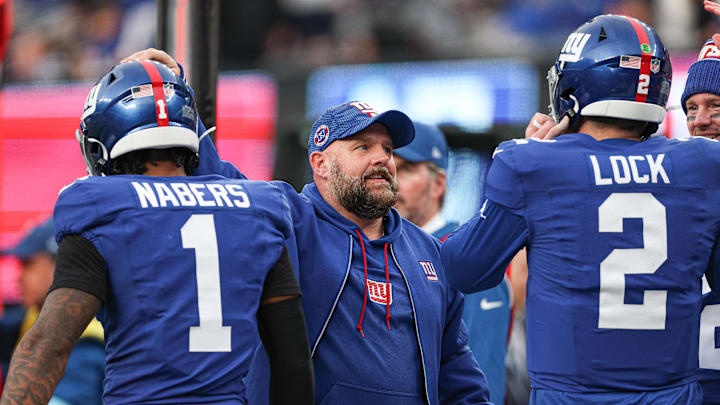
Changes should be made within the scheme and gameplan realms before the season kicks off next fall if the Giants want to see the results they crave. It’s uncertain whether head coach Brian Daboll will have his entire main staff back for the road ahead.
Still, there will at least be some similarity, with the only domino left to potentially fall being assistant head coach/offensive coordinator Mike Kafka, who is in the running for the Saints’ head coaching gig.
Should the core of Daboll, Kafka, and Bowen all stick together in East Rutherford, it can’t just be business as usual. The Giants must figure out actionable methods to improve the efficiency of their offense and defense to suit the growing competition that is taking place everywhere, including inside of their own NFC East division.
Sure, how they utilize the cap space and draft capital to bring in fresh faces that can perform at a higher level will help make a difference. Still, execution matters in this league, and the Giants haven’t been the greatest organization in the past several seasons.
Let’s look at a few simple yet actionable offseason adjustments the Giants can make to rebound to greater success for the 2025 season.
Increase Yards Per Game
One of the biggest problems plaguing the Giants offense during the 2024 season was their inability to create explosive plays and become more vertically dangerous.
It can be admitted that it is hard for any NFL team to establish a consistent or even more volatile offensive identity when you are fluctuating through four different quarterbacks like the Giants did when they released Daniel Jones ahead of Week 12.
The Giants went from having a serviceable dual-threat option in Jones, who could make things happen with his arm and legs and was averaging 6.1 yards per play despite his frequent deficiencies as a passer, to three other arms in Drew Lock, Tommy DeVito, and Tim Boyle who couldn’t match that same efficiency.

Each of those replacements averaged under 5.9 yards per play in the Giants’ remaining seven contests and couldn’t amass more than 133.9 yards per game in the same span. They were held to a much more short-range offensive game that the run would complement except for the Week 17 win over the Colts and finished with a 4.7 average play that ranked 30th in the league.
That marked the second straight season that the Giants finished with an average snap before 5.0 yards and only represented a slight increase from the 4.5-yard mean with which they finished the 2023 season.
With an offensive guru in head coach Brian Daboll and a bunch of weapons that can create deep, it’s not a good stat that they haven’t breathed the 6.0-yard average since the 2018 season.
While most of their skilled players are set to return next season, and a couple of new additions that can be added via free agency or the draft, the keys will be for the Giants to bolster their offensive line further and find their quarterback who has the football IQ and can let it rip to connect at all different levels.
The offensive line has been a thorn in the Giants’ side for a long time, particularly since their stout unit during their last run to the Super Bowl in 2011, but it wasn’t a problem from the jump this year. The unit started hot as one of the top 15 fronts in the game and had only allowed three sacks before injuries started to pile up midway into the season.
Once Andrew Thomas went down and other starters followed suit, the avalanche was released, and the Giants went from a sharper offensive team to a 1-10 streak with an average of 16.1 points per game and 34 sacks allowed.
With all the changes up front, they never regained the momentum that was seen in their two rare wins against Cleveland and Seattle when they moved the ball well. Having time to step back, read the field, and extend plays became a challenge for any quarterback under center.
Even if they find some much-needed depth on the line, especially with the offensive tackle positions dealt the biggest blow, the biggest factor will be having that quarterback who is comfortable making plays with pressure in the pocket. One who can step up and thread the needle through the defense or extend the field using the right reads and touch to finish the play.
Very rarely did any of the Giants' options this season do that confidently. One of either Shedeur Sanders or Cam Ward could fill any of those needs, but adding a veteran will also help the cause of learning how to excel against NFL competition, where the speed is taken up a notch.
Lessen the Chunk Pass Plays Against
Regarding the Giants and their defensive identity, it is clear how the first two levels of the interior are regarded as the operation's strengths for defensive coordinator Shane Bowen. The secondary, on the other hand, is an area that needs some work in more ways than one.
Most importantly, the depth has been the biggest area of concern. Ever since the Giants have embarked on their youth movement at the top level of the defense, it’s been a bumpy road with their pass coverage as the inexperience and injuries haven’t kept pace with the elite receiving competition they’re asked to face every Sunday.
And the struggles weren’t just coming in small doses. The Giants’ secondary has been getting carved up for chunk plays, which carried into this season at a rate that should bring great alarm to the team this offseason as they look to retool the position group.
Among the team’s five eligible defensive backs with at least 315 coverage snaps played, all five were targeted at least 31 times and allowed a catch percentage of 65.9% or greater, according to NFL.com’s nearest defender statistics.

The two biggest culprits were the Giants’ perimeter corners, Deonte Banks and Cor’Dale Flott, who began the year as the team’s starting options. The duo were targeted 118 times for a combined 991 yards and seven touchdowns, each netting a catch rate over expected (CROE%) of at least 5.9% in that span of attempts.
Yet, the rest of the secondary didn’t have their hands clean of the mishaps either, as they combined for a catch percentage of 69.0% with a rate over expected as high as 16.7%, which went to safety Jason Pinnock. Their inability to stop chunk plays of 20+ yards was also fueled by an average separation between 2.1 and 3.6 yards and yards after catch as high as 5.8 yards.
The lone exception to this issue was sophomore corner Tre Hawkins III, who took a bigger leap later in the season as his name was called to a larger workload. He finished the year with a --17.2 % catch rate over expected and zero touchdowns allowed, which was astounding for a young player. However, his season was cut short by a spinal injury suffered in Week 14, which held him out the last four games.
It seems preposterous that the Giants secondary could be porous when they switched to a defensive system behind Bowen that was supposed to be friendlier to them with less exotic blitzes leading to unstable 1-on-1 matchups in open space.
Still, the extra usage of Cover 3 and quarters zone packages didn’t slow down the feast that came at the hands of New York’s group, and it feels like the first solution is to add some veteran pieces into the mix that could fulfill major roles and mentor the young ballhawks into becoming better coverage defenders.
The Giants have recently moved away from that, and the best they could muster up was Adoree Jackson, who has had his role switched up numerous times in their defense and is set to test the free agent market, making his return uncertain. If he departs, the Giants have little experience in that room who can show these players how to gain leverage that will lessen the chunk plays from ravaging them.
A secondary priority will be taking advantage of opportunities to force or create turnovers. The Giants didn’t do enough of that this past season, holding just one interception made by inside linebacker Darius Muasau in the season opener against Minnesota until Hawkins III finally earned his first pick thirteen weeks later against the Saints.
There is a promise to be had with Dru Phillips, the slot corner who dominated in man coverage, and safety Tyler Nubin, who led the team in tackles before he left with an ankle injury that ended his debut year four games early.
Banks hasn’t been the same player he was in year one as the No. 1 option, and the Giants desperately need to find talented veterans who can fill depth and clean up the coverage numbers next season. The pool will be large this offseason, and options should be available within reasonable price ranges.
Finishing in the Redzone
It’s almost as if you could predict it happening anytime the Giants started to develop a nice offensive possession that made its way into enemy territory. They would sneak into the red zone before the offense suddenly stalled and be forced to settle for three points or less.
Even though their offense lacked the expected performances from most of their skilled players, this was how the Giants fared inside the 20-yard line during the 2024 season.
Per Pro Football Reference, they had the worst year of any team in the NFL when it came to scoring, notching just 19 red zone touchdowns on 44 total visits for a dismal 43.2% efficiency rating.
The Giants also held the 31st-ranked scoring percentage in general, with points landed on just 27.9% of their possessions this season, and they averaged only 1.45 points per drive in the same spa,n which was greatly abetted by their six games in which they scored less than 11 points.

These trends mark the second straight season that the Giants owned one of the worst scoring offenses in the league (they ranked 31st in 2023). It’s very concerning when one considers that they spent a large sum of money to strengthen the offensive line so that the quarterback and his weapons had a better chance to breathe in the pocket and compete.
The familiar injury bug up front and constant changes at the gunslinger position rarely help the cause, but it’s hard to argue that the Giants didn’t have their opportunities to punch in points.
It boils down to poor execution, often fueled by questionable coaching decisions, like going for unnecessary fourth downs early in ball games when points could have been had in field goal range or mishaps in targeting the right players to seal the deal.
Moreover, it was interesting that the Giants severely lacked tight-end usage inside the red zone. Truthfully, that issue goes back to last season with Darren Waller, a veteran the Giants acquired in a trade to be a reliable receiving option over the top for Daniel Jones, who came with consecutive 1,000+ yard seasons with the Las Vegas Raiders.
As the story unfolded, Waller struggled to remain on the field, and when he did, he rarely saw the football in the biggest moments and mismatches. Instead, he mustered up just one touchdown to go with his 52 receptions for 552 yards, a mediocre stint albeit finishing second on the Giants’ leaderboard.
That history repeated this time with rookie tight end Theo Johnson, a fourth-round steal New York brought in to serve a similar purpose given his gifted size and contested catching ability.
Yet, injuries aside, Johnson played in the Giants' first 13 games and only tallied 331 yards with the same one touchdown, which he made on an over-the-top route against the Washington Commanders in Week 9.
To make matters worse, the Giants rarely took advantage of the rookie’s intangibles in the open field. Johnson recorded just three catches of 20+ air yards on his 43 total targets this season per Pro Football Focus and turned that into 60 yards, ranked third-lowest among first-year players.
The Giants have wanted to pride themselves on being an offense that features versatile tight ends and gets them the football when the wide receiving options are paid more attention. Still, the results haven’t matched that desire, and it’s been one of the main reasons their scoring has gone way down to historically low depths.
Much attention will likely remain on limiting the damage of the team’s vertical threats like Malik Nabers and Darius Slayton, granting the latter returns to the organization amid his free-agent experience.
There can be plays for the tight end position, particularly in the intermediate game when speed can open up the middle and create big catch spots on crossing routes.
Putting that position alongside the others, the Giants need to do a better up, beginning up front and extending to the quarterback, of getting that football in the hands of a playmaker inside the endzone.
The NFL is becoming more about offensive prowess than defensive willpower, and it’ll be hard to win more games in 2025 without that formula being infused into the Giants’ weekly performances.
More Giants Coverage
New York Giants On SI Social Media
- Follow and like us on Facebook.
- Submit your questions for our mailbag.
- Follow on Instagram.
- Check out the New York Giants on SI YouTube Channel.
 Add us as a preferred source on Google
-1ca98c375b90186224f7ec5e456f6e73.webp "Stephen Lebitsch")
“Stephen Lebitsch is a graduate of Fordham University, Class of 2021, where he earned a Bachelor’s degree in Communications (with a minor in Sports Journalism) and spent three years as a staff writer for The Fordham Ram. With his education and immense passion for the space, he is looking to transfer his knowledge and talents into a career in the sports media industry. Along with his work for the FanNation network and Giants Country, Stephen’s stops include Minute Media and Talking Points Sports.
Follow SLebitschSports