%20%20--%3E%0A%3Csvg%20version%3D%221.1%22%20id%3D%22Layer_1%22%20xmlns%3D%22http%3A%2F%2Fwww.w3.org%2F2000%2Fsvg%22%20xmlns%3Axlink%3D%22http%3A%2F%2Fwww.w3.org%2F1999%2Fxlink%22%20x%3D%220px%22%20y%3D%220px%22%0A%09%20width%3D%2239px%22%20height%3D%2240px%22%20viewBox%3D%220%200%2039%2040%22%20enable-background%3D%22new%200%200%2039%2040%22%20xml%3Aspace%3D%22preserve%22%3E%0A%3Cpath%20fill%3D%22%23FFFFFF%22%20d%3D%22M38.5%2C7H28.2v26h10.3V7z%22%2F%3E%0A%3Cpath%20fill-rule%3D%22evenodd%22%20clip-rule%3D%22evenodd%22%20fill%3D%22%23FFFFFF%22%20d%3D%22M26.1%2C25.5c0%2C5.8-4.1%2C7.5-12.9%2C7.5C3.9%2C33%2C0%2C31.2%2C0%2C25.2v-1.1h11.6%0A%09v2.4c0%2C0.7%2C0.1%2C1.4%2C1.2%2C1.4c1%2C0%2C1.2-0.4%2C1.2-1.3v-0.9c0-1.6-0.9-1.6-3.5-2.2C2.2%2C21.7%2C0%2C19.7%2C0%2C15.3v-0.9C0%2C9.3%2C5.5%2C7%2C12.9%2C7%0A%09c10.2%2C0%2C12.8%2C2.6%2C12.8%2C7.4v1.8h-11v-2.9c0-0.6-0.4-1.1-1.2-1.1c-0.6%2C0-1.2%2C0.4-1.2%2C1.1v0.9c0%2C1.5%2C0.9%2C2%2C3.3%2C2.5%0A%09c8%2C1.6%2C10.5%2C3.3%2C10.5%2C7.5V25.5z%22%2F%3E%0A%3C%2Fsvg%3E%0A)
Re-Grading the Micah Parsons Trade, With Cowboys and Packers Playing One Year Later
In this story:
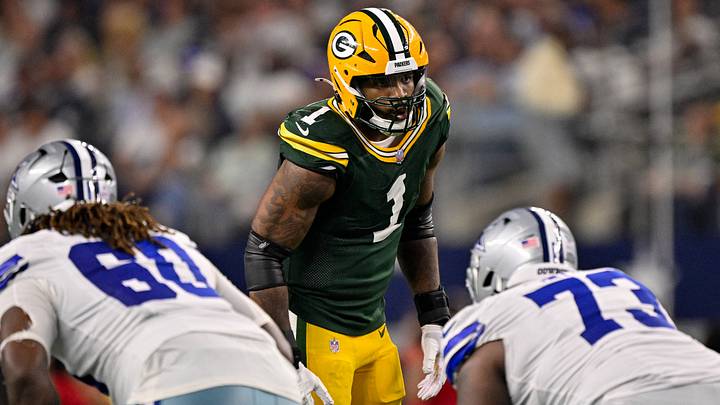
More than a year has passed since the Cowboys traded superstar pass rusher Micah Parsons to the Packers in exchange for two first-round picks and defensive tackle Kenny Clark, a move intended to change the fortunes of both franchises for the better.
Cowboys owner Jerry Jones proclaimed on the day he dealt arguably the franchise’s best player, “This gives us a chance to be a better team than we’ve had the last several years.”
But have the Cowboys or Packers improved because of the Parsons trade?
The two trade partners met up on the field exactly a month after the deal was made, playing to a thrilling 40–40 tie on Sunday Night Football. Perhaps that tie was a hint of what the result of the trade would be, that neither team has separated itself as a “winner” in the move.
As the Packers and Cowboys prepare to face off again on Sunday, here’s a look at how both teams have fared since, with new trade grades for each side.
Packers awaiting Parsons’s return from torn ACL
In trading for Parsons and signing him to a four-year, $188 million extension, the Packers essentially made a “win-now” move, the kind of deal that signals Super Bowl or bust. The Packers are typically not known for making hyper-aggressive moves like this, but they went for a move that they thought could help them win another title, like they previously did with Reggie White and Charles Woodson, who both won a Super Bowl in Green Bay.
At first, the deal for Parsons appeared to be a raging success. In their first game with him, they dominated the Lions 27–13 while looking like a Super Bowl–caliber squad. Parsons’s presence was quickly felt as he recorded his first sack as a Packer, even while playing a limited number of snaps. They defeated the Commanders in commanding fashion the following week before losing a clunker to the Browns, 13–10. Even after the loss to the Browns and tie against the Cowboys, the Packers still started the season 9-3-1, all while Parsons was turning in another first-team All-Pro season.
Soon, however, the Packers’ season fell apart as Parsons sustained a season-ending torn ACL in a Dec. 14 loss to the Broncos. The Packers lost their final four games of the season, earning the No. 7 seed in the playoffs for the third consecutive season. In the playoffs, they entered the fourth quarter of their wild-card matchup against the Bears with a 21–6 lead, only to collapse and lose 31–27.
The end of the season was discouraging for the Packers, but there was still reason for optimism ahead, especially when Parsons would return in 2026. In the offseason, however, they didn’t do enough to improve the team. Facing decreased cap space and not having a first-round pick because of the Parsons trade, the Packers lost players such as LB Quay Walker, LT Rasheed Walker, WR Dontayvion Wicks and WR Romeo Doubs. Their biggest move was likely trading for linebacker Zaire Franklin. Parsons, after all, was their primary investment to take the next step.
The addition of Parsons hasn’t been enough, especially since he hasn’t been on the field. Through the first four weeks of the 2026 season, the Packers were a shell of themselves, going 2–2 with their problems going well beyond Parsons’s absence. Their under-manned offensive line struggled to protect Jordan Love while the running game has practically been nonexistent with Josh Jacobs on the commissioners exempt list, ranking last as a team in rushing yards.
The Packers earned a feel-good win by dominating the Bears 31–7 on Sunday. Before the victory, the Packers were trending in the wrong direction. With this win over a divisional rival and the return of Parsons imminent, perhaps they can gain momentum and emerge as contenders again. The good news is that even if the Packers fall short of a deep playoff run this season, Parsons remains signed through the 2029 season, and could certainly be a part of Green Bay contending for the Super Bowl in the future. For now though, the Packers still have a ways to go before they solidify themselves as a top team and true contenders—even with Parsons’s return looming.
Re-grade: C-
Cowboys failing to replace Parsons’ production
When the Cowboys drafted Parsons with the No. 12 pick in 2021, it marked the second consecutive year in which the “best player available” approach worked out spectacularly in their favor. A year prior, receiver CeeDee Lamb fell to Dallas at No. 17. In 2021, Parsons slipped to 12th.
In Parsons, who transitioned from primarily playing linebacker at Penn State to edge rusher in the NFL, the Cowboys landed the kind of rusher that typically doesn’t fall outside the first five picks in the draft. Parsons quickly became a star, recording at least 12 sacks in each of his first five seasons, earning first-team All-Pro honors in each of his first two years and finishing in the top three in Defensive Player of the Year voting in each of his first three seasons.
Instead of extending the superstar ahead of the final season of his rookie deal, the Cowboys moved on after months of failed negotiations and drama which included Parsons requesting a trade, appearing disinterested during a preseason game and owner Jerry Jones making a dig at Parsons’s injury history.
The Cowboys used the picks they got in the deal to trade for defensive tackle Quinnen Williams at the 2025 trade deadline, and draft edge Malachi Lawrence, corner Devin Moore and defensive lineman LT Overton. The Cowboys have since signed Williams to a three-year, $105.9 million extension.
While the Cowboys have gotten more players than they would have had they kept and re-signed Parsons, their defense has not improved. Following Parsons’s departure, the Cowboys’ defense became the worst in the league, dropping from 30th in defensive EPA per play (0.05) in 2024 to 32nd (0.13) in 2025 and from 24th (45.22%) to 32nd (48.03%) in opponent success rate. The Cowboys’ defensive regression began when defensive coordinator Dan Quinn left to become the Commanders’ coach in 2024. In 2022 and 2023, when Quinn was still the DC, the Cowboys’ defense ranked in the top five in EPA per play allowed.
As the defense crumbled, the Cowboys made trading Parsons part of their solution, saving cap space and giving them draft capital to invest in multiple players, rather than one superstar. The Cowboys have spent money and picks on other players, but so far, the money has not been well-spent. As NFL Daily’s Gregg Rosenthal pointed out, the Cowboys signed corner DaRon Bland to a four-year, $92 million extension days after trading Parsons. The Cowboys are now paying Williams and Bland $11.8 million more per year than Parsons is being paid, but their impact has not been as great as Parsons’s was.
One of Jones’s explanations for trading Parsons was a desire to improve the run defense. Historically, Williams has been a very good run defender, including when he arrived in Dallas last season. This year, however, he has not been as effective as the Cowboys rank last in the league in rushing yards allowed (168.4 per game). Neither has Clark, who was also brought in to help with the run defense efforts.
The Cowboys traded Micah Parsons in August of 2025. In the 22 games they've played since, their defense ranks:
— Sheil Kapadia (@SheilKapadia) October 9, 2026
32nd in EPA per drive
32nd in success rate
32nd in explosive play rate allowed
31st in rushing success rate
They hired former Eagles defensive backs coach Christian Parker to become their defensive coordinator and improve the unit, but five games into the 2026 season, the results have been poor. Parker doesn’t have the most talented unit to work with, but he also hasn’t made his players significantly better early in the season. Once again, the Cowboys are in need of pass-rush help and they certainly won’t find anyone of Parsons’s caliber if they bring in an edge at the deadline.
These issues have been reflected in the Cowboys’ start to the week. Per Clarence Hill Jr., the Cowboys’ defense held a players-only meeting and the team hired former defensive coordinator and Browns head coach Mike Pettine as a defensive assistant to help Parker. The Cowboys have used both of the picks they got in return for Parsons, but their defense is still at the bottom of the league and in need of more help across the board.
For a team that wants to end its Super Bowl drought and win while it has quarterback Dak Prescott and a high-flying offense, keeping Parsons could have been the better “win-now” move for Dallas. Rather, the Cowboys are stuck in the never-ending cycle of building a defense that remains far from the middle of the pack, let alone championship-caliber.
Re-grade: F
 Add us as a preferred source on Google
Eva Geitheim is an NFL writer at Sports Illustrated. Prior to joining SI in December 2024, she wrote for Newsweek, Gymnastics Now and Dodgers Nation. A Bay Area native, she has a bachelor’s in communications from UCLA. When not writing, she can be found baking or rewatching Gilmore Girls.
Follow EGeitheim