%20%20--%3E%0A%3Csvg%20version%3D%221.1%22%20id%3D%22Layer_1%22%20xmlns%3D%22http%3A%2F%2Fwww.w3.org%2F2000%2Fsvg%22%20xmlns%3Axlink%3D%22http%3A%2F%2Fwww.w3.org%2F1999%2Fxlink%22%20x%3D%220px%22%20y%3D%220px%22%0A%09%20width%3D%2239px%22%20height%3D%2240px%22%20viewBox%3D%220%200%2039%2040%22%20enable-background%3D%22new%200%200%2039%2040%22%20xml%3Aspace%3D%22preserve%22%3E%0A%3Cpath%20fill%3D%22%23FFFFFF%22%20d%3D%22M38.5%2C7H28.2v26h10.3V7z%22%2F%3E%0A%3Cpath%20fill-rule%3D%22evenodd%22%20clip-rule%3D%22evenodd%22%20fill%3D%22%23FFFFFF%22%20d%3D%22M26.1%2C25.5c0%2C5.8-4.1%2C7.5-12.9%2C7.5C3.9%2C33%2C0%2C31.2%2C0%2C25.2v-1.1h11.6%0A%09v2.4c0%2C0.7%2C0.1%2C1.4%2C1.2%2C1.4c1%2C0%2C1.2-0.4%2C1.2-1.3v-0.9c0-1.6-0.9-1.6-3.5-2.2C2.2%2C21.7%2C0%2C19.7%2C0%2C15.3v-0.9C0%2C9.3%2C5.5%2C7%2C12.9%2C7%0A%09c10.2%2C0%2C12.8%2C2.6%2C12.8%2C7.4v1.8h-11v-2.9c0-0.6-0.4-1.1-1.2-1.1c-0.6%2C0-1.2%2C0.4-1.2%2C1.1v0.9c0%2C1.5%2C0.9%2C2%2C3.3%2C2.5%0A%09c8%2C1.6%2C10.5%2C3.3%2C10.5%2C7.5V25.5z%22%2F%3E%0A%3C%2Fsvg%3E%0A)
The 20 Best Soccer Players of the 2010s—Ranked
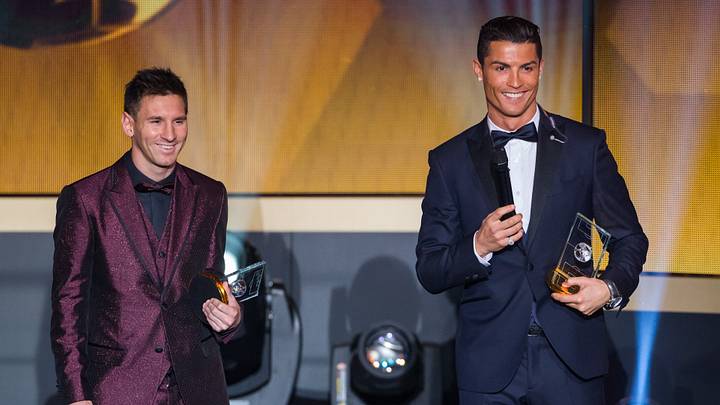
We all know the 2010s belonged to two players: Cristiano Ronaldo and Lionel Messi.
Together, they scored well over 1,000 goals, collected a combined 41 trophies and claimed eight Ballons d’Or—four apiece.
But while Messi and Ronaldo were undoubtedly the defining stars of the decade, they weren’t the only players who shaped it. And yes, if you’re here to find out which of the two we have ranked No. 1, you’ll have to keep reading.
This list also features a player who has won more trophies than anyone else in soccer history, another who managed to win the Ballon d’Or despite competing directly against Messi and Ronaldo, and a revolutionary figure who fundamentally changed the way the game is played.
So, without further ado, here are Sports Illustrated’s 20 best soccer players of the 2010s, ranked from No. 20 to No. 1.
20. Arjen Robben

You might think watching a magician perform essentially the same trick for nearly 17 years would eventually lose its appeal. Somehow, Arjen Robben never did.
The Dutch winger was must-see television wherever he played, combining blistering speed with a magical left foot and a move that became almost impossible to stop. From the right flank, Robben would cut inside onto his stronger foot, create just enough room and whip a shot into the far corner with remarkable precision and power.
And it wasn’t merely a party trick. Robben won league titles in the Netherlands, England, Spain and Germany, establishing himself as a star at every stop. He was just as influential internationally, helping the Netherlands reach the World Cup final in 2010 and finish third in 2014.
19. Mohamed Salah

Mohamed Salah spent the second half of the 2010s rebuilding his reputation after an underwhelming spell at Chelsea left many wondering whether he could cut it in the Premier League.
He found his footing in Italy with Fiorentina and AS Roma, earning himself another shot in England when Liverpool came calling. This time, Salah made sure there would be no doubts.
The Egyptian quickly became the attacking centerpiece of Jürgen Klopp’s Liverpool, helping turn the Reds into a genuine European and domestic force. That rise reached its first major peak with the 2018–19 Champions League triumph.
Liverpool’s Premier League titles came in the years that followed, but the 2010s were when Salah laid the groundwork for becoming one of the game’s elite forwards.
18. Sergio Aguero

From his teenage emergence at Independiente to becoming a Manchester City icon, Sergio Agüero spent his career doing one thing exceptionally well: scoring goals.
The Argentine was a ruthless finisher and a constant source of match-winning moments during his decade at the Etihad, regularly delivering when City needed him most.
But no goal came close to matching the significance of his stoppage-time winner against QPR in 2012. With the Premier League title on the line, Agüero’s unforgettable strike sent the Etihad into delirium, secured City’s first league championship in 44 years and instantly made him immortal in club history.
17. Manuel Neuer

It wouldn’t be a list of the 2010’s greatest players without Manuel Neuer, the goalkeeper who arguably changed the position forever.
Neuer took the sweeper-keeper role to another level, combining extraordinary reflexes with remarkable confidence and technical ability when playing outside his penalty area. He wasn’t simply a goalkeeper who could make spectacular saves—he was effectively an additional outfield player when Bayern Munich had possession.
The German was named UEFA Goalkeeper of the Year from 2011 through 2015, while his trophy cabinet grew to include seven consecutive Bundesliga titles and a Champions League crown with Bayern.
Neuer’s legacy goes far beyond the saves themselves. His aggressive positioning, willingness to rush off his line and comfort with the ball at his feet helped redefine what was expected from a modern goalkeeper and inspired an entire generation of shot-stoppers.
16. Eden Hazard

From lighting up Ligue 1 with Lille to becoming a nightmare for Premier League defenders at Chelsea, Eden Hazard had a rare ability to make extraordinary things look routine.
The Belgian combined acceleration, balance and close control with an almost unmatched talent for beating defenders. Once he got moving, opponents often had little choice but to backpedal and hope he ran out of space before reaching the box.
Hazard was more than a spectacular dribbler, though. His creativity, composure and ability to produce in decisive moments made him the centerpiece of two hugely successful spells at Lille and Chelsea.
When he eventually left both clubs, the emotional reaction from their supporters said everything about the mark he had left behind.
15. Zlatan Ibrahimovic

Dare to Zlatan. Dare to attempt the impossible. Dare to ignore convention, reject the script and carve out your own path.
Zlatan Ibrahimović was never simply a soccer player. He became a phenomenon, inspiring millions with his confidence, individuality and refusal to play by anyone else’s rules.
Across a remarkable career that took him through some of Europe’s biggest clubs, as well as LA Galaxy in MLS, Zlatan scored more than 500 goals, won 13 league titles and earned nine Ballon d’Or nominations.
Wherever he went, the story was remarkably similar: arrive, adapt, dominate, and move on. Zlatan wasn’t just a globetrotter—he made a habit of leaving every destination with another chapter added to his extraordinary legacy.
14. Giorgio Chiellini

Giorgio Chiellini embodied the win-at-all-costs mentality better than almost anyone during the 2010s.
Throw himself in front of a shot? Absolutely. Head away anything near the box? Of course. Launch into a 50-50 knowing he’d probably feel it afterward? Every time.
Whatever Juventus or Italy needed, Chiellini delivered. He regularly played through injuries and knocks—including a split head, broken nose, twisted knee and rolled ankle—yet somehow continued performing at an elite level.
That relentless toughness, leadership and refusal to surrender made him one of the decade’s ultimate defenders—and a winner through and through.
13. Marcelo

Replacing a legend like Roberto Carlos at Real Madrid was never going to be an easy assignment, but Marcelo eventually made the position his own.
The Brazilian became a fixture at left back, combining relentless energy with trademark flair and technical quality. His performances were particularly influential in the Champions League, where he helped Madrid establish an era of unprecedented dominance, collecting three titles in just four seasons.
With a trophy cabinet packed with major honors and individual recognition, Marcelo’s inclusion as the only left back on this list is perhaps all the evidence needed of just how exceptional he was.
12. Toni Kroos

Rejection, injuries and years of being overlooked did little to derail Toni Kroos’ remarkable career.
After emerging at Bayer Leverkusen, the German developed into one of the most reliable and technically gifted midfielders of his generation, capable of controlling games from deep or influencing them further forward.
Kroos rarely needed the spotlight to dominate. His calm decision-making, pinpoint passing and almost absurd consistency made him an ideal fit alongside the superstar talent at Real Madrid, where his trophy collection became almost comical in its size.
Throughout the 2010s, he routinely ranked among the game’s best for passing accuracy and chance creation, making him one of the safest choices whenever the conversation turned to the world’s elite central midfielders.
11. Robert Lewandowski

Robert Lewandowski would have been a superstar in virtually any era, and his exploits with Borussia Dortmund and Bayern Munich during the 2010s proved exactly that.
Poland’s greatest-ever player combined strength, movement and technical ability into one devastating package. In Germany, he became a relentless goalscorer, collecting multiple Bundesliga titles and major trophies while establishing himself among the very best forwards in the world.
Despite his extraordinary numbers and longevity, Lewandowski has often received less recognition than some of his contemporaries. As the Bundesliga’s all-time leading foreign-born scorer, his place among the greatest strikers in soccer history is beyond question.
10. Neymar

A global superstar blessed with extraordinary talent, Neymar was once widely viewed as the heir apparent to Lionel Messi and Cristiano Ronaldo at the very top of the sport.
The Brazilian has delivered countless unforgettable moments throughout his career, including a starring performance in Barcelona’s historic Champions League comeback against Paris Saint-Germain.
There is still a sense of unfulfilled potential, with injuries and inconsistency preventing him from sustaining the otherworldly level many predicted early in his career. Even so, few players in soccer history have possessed Neymar’s combination of flair, creativity, technique and natural talent.
9. Gareth Bale

It’s hard to believe now, but Gareth Bale was once jokingly viewed as a bad-luck charm at Tottenham after failing to win a Premier League game during his first two seasons.
That all changed when he announced himself on the biggest stage with a sensational Champions League hat trick against Inter Milan in 2010, repeatedly leaving Maicon helpless. Before long, Bale had become one of the most coveted players in the world—and the most expensive at the time.
His move to Real Madrid brought enormous expectations and a series of frustrating injuries, but his trophy haul tells the real story. Bale won four Champions League titles during the 2010s and was far more than a supporting player.
He played decisive roles in the finals in 2014, 2016 and 2018, including one of the greatest goals ever scored in a Champions League final.
8. Dani Alves

Dani Alves had the stare of a man who could see straight through you—and a trophy cabinet that looked almost absurd. The Brazilian won 25 club trophies during the 2010s alone, an outrageous haul by any standard.
By the middle of the decade, most full backs would typically be approaching their physical peak or beginning to decline. Alves ignored that timeline entirely. He was never a conventional full back, constantly pushing forward and influencing games in ways that helped redefine the position.
He ended the decade at 36, back in Brazil, having won seven league titles across three of Europe’s top five leagues. Somehow, he still had more left to give: in 2019, while a free agent, Alves was named the Copa América Player of the Tournament.
Unstoppable, unique and ridiculously decorated—Dani Alves was in a class of his own.
7. Franck Ribery

Franck Ribéry is one of the Bundesliga’s most decorated servants, and his time at Bayern Munich will be remembered for his majestic grace on the ball, his tormenting of desperate full backs and a consistent end product.
Ribéry was the star of Bayern’s left flank for 12 years and won the Bundesliga title an unbelievable nine times. He also lifted the Champions League and reached a World Cup final with France in 2006.
Even in his advanced years, the diminutive Frenchman continued to light up the world stage, sprinkling his magic over in Italy with Fiorentina and Salernitana.
6. Luis Suarez

Luis Suárez was powered by emotion. It was a defining part of his identity and one of the things that set him apart from the other great striker of his generation outside of Lionel Messi and Cristiano Ronaldo: Robert Lewandowski.
Lewandowski’s game was built around ruthless efficiency and remarkable consistency. Suárez, by contrast, played with an intensity that seemed to run through every part of him. His South American passion could be channeled into brilliance—or occasionally spill over with consequences.
But that fire was also his greatest weapon. It fueled his competitiveness, sharpened his instincts and pushed him to squeeze every last drop of ability from himself.
That edge is a huge part of what made Suárez so special—and why his legacy will endure.
5. Andres Iniesta

When Andrés Iniesta was just 15, he impressed Pep Guardiola so much that the future Manchester City manager reportedly turned to Xavi and said: “You will retire me, but this kid will retire us both.”
He wasn’t wrong.
Iniesta rarely needed to make a spectacle of his brilliance. Instead, the Spanish midfielder had an extraordinary ability to glide through pressure, find impossible passes and make the most technically demanding parts of the game look routine.
A key architect of arguably the greatest Barcelona team ever assembled, Iniesta’s intelligence, composure and understated brilliance made him one of the defining midfielders of his generation.
So it was only fitting that his final appearance at Camp Nou ended in tears.
4. Sergio Ramos

Between 2010 and 2020, Sergio Ramos built one of the most decorated résumés in modern soccer: two La Liga titles, four Champions League crowns, four Club World Cups, two Copa del Reys, the European Championship and the World Cup.
There was always controversy surrounding Ramos, and his aggressive style came with its share of flaws. But none of that stopped him from remaining at the very top of the sport. By the end of the decade, he was still being selected for the FIFPro World XI.
The look evolved—new hair, brighter teeth, a sharper beard and plenty more tattoos—but the player never really changed. Ramos remained the ultimate big-game center back: aggressive, fearless, spectacular and always ready to play the villain.
3. Luka Modric

You already know why Luka Modrić comes in at No. 3 on our list of the 2010’s greatest soccer players.
It’s actually very simple: he won the Ballon d’Or.
In fact, Modrić was one of only three players to claim the prestigious award during the 2010s.
So, really, the case for No. 3 speaks for itself. Simple.
2. Cristiano Ronaldo

What more can really be said about Cristiano Ronaldo that hasn’t already been said countless times?
Five Ballons d’Or, five Champions League titles and more than 900 goals for club and country barely begin to capture the scale of his career. And much of that remarkable production came during the 2010s, when he was operating at an almost absurd level.
But Ronaldo was never content to rely on natural ability. He understood early that talent could only take him so far, and his relentless work ethic became just as important as his extraordinary gifts. His meticulous approach to fitness, recovery and preparation allowed him to maintain an elite level for far longer than almost anyone else.
Very few players have ever reached Ronaldo’s heights. Even fewer have managed to stay there.
Except for one ...
1. Lionel Messi

There is no modern soccer player comparable to Lionel Messi—and the 2010s provided more than enough evidence of that.
The decade was defined by Messi’s brilliance. While countless young players were labeled the “next Messi” or their country’s own version of him, none came remotely close to matching what the Argentine produced year after year.
Messi wasn’t simply one of the best players of the 2010s; he was the standard everyone else was measured against. The goals, assists, dribbles, outrageous passes, individual awards and seemingly endless moments of magic made him the defining player of the era.
Cristiano Ronaldo pushed him harder than anyone, but even in a decade filled with extraordinary talent, Messi stood alone.
There was no Spanish Messi, German Messi or Scottish Messi.
There was just Messi—the defining player of the 2010s, and for many, the greatest of all time.
THE CURRENT BEST 25 PLAYERS FOR EVERY POSITION IN WORLD SOCCER
 Add us as a preferred source on Google
Barnaby Lane, better known as Barney, is a soccer writer for SI FC. With nearly a decade of experience in the industry, he has worked for a range of household-name publications in both the United States and the United Kingdom, and has interviewed some of the world’s biggest athletes—from Usain Bolt and Rafael Nadal to Christian Pulisic (though his favorite interview remains Adebayo Akinfenwa). Barney specializes in Premier League soccer, covering everything from the nostalgia of years gone by to the modern, vastly different landscape of today’s game. He also has experience reporting on La Liga and Major League Soccer, the latter of which he developed a particular affinity for during his university days at Virginia Commonwealth University in Richmond.