%20%20--%3E%0A%3Csvg%20version%3D%221.1%22%20id%3D%22Layer_1%22%20xmlns%3D%22http%3A%2F%2Fwww.w3.org%2F2000%2Fsvg%22%20xmlns%3Axlink%3D%22http%3A%2F%2Fwww.w3.org%2F1999%2Fxlink%22%20x%3D%220px%22%20y%3D%220px%22%0A%09%20width%3D%2239px%22%20height%3D%2240px%22%20viewBox%3D%220%200%2039%2040%22%20enable-background%3D%22new%200%200%2039%2040%22%20xml%3Aspace%3D%22preserve%22%3E%0A%3Cpath%20fill%3D%22%23FFFFFF%22%20d%3D%22M38.5%2C7H28.2v26h10.3V7z%22%2F%3E%0A%3Cpath%20fill-rule%3D%22evenodd%22%20clip-rule%3D%22evenodd%22%20fill%3D%22%23FFFFFF%22%20d%3D%22M26.1%2C25.5c0%2C5.8-4.1%2C7.5-12.9%2C7.5C3.9%2C33%2C0%2C31.2%2C0%2C25.2v-1.1h11.6%0A%09v2.4c0%2C0.7%2C0.1%2C1.4%2C1.2%2C1.4c1%2C0%2C1.2-0.4%2C1.2-1.3v-0.9c0-1.6-0.9-1.6-3.5-2.2C2.2%2C21.7%2C0%2C19.7%2C0%2C15.3v-0.9C0%2C9.3%2C5.5%2C7%2C12.9%2C7%0A%09c10.2%2C0%2C12.8%2C2.6%2C12.8%2C7.4v1.8h-11v-2.9c0-0.6-0.4-1.1-1.2-1.1c-0.6%2C0-1.2%2C0.4-1.2%2C1.1v0.9c0%2C1.5%2C0.9%2C2%2C3.3%2C2.5%0A%09c8%2C1.6%2C10.5%2C3.3%2C10.5%2C7.5V25.5z%22%2F%3E%0A%3C%2Fsvg%3E%0A)
From the Highest of Highs to the Lowest of Lows, This Is the Real Michael Carrick
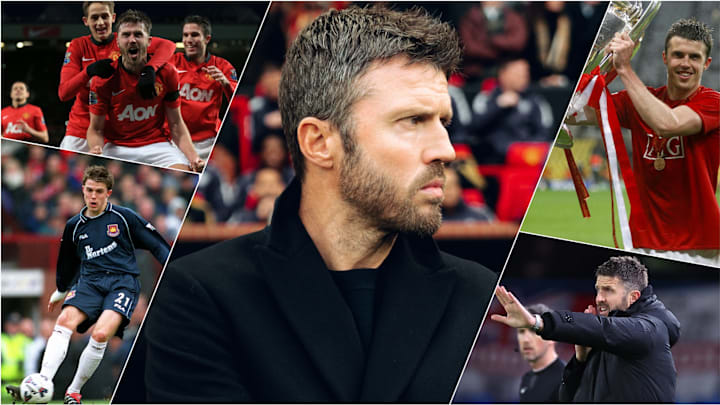
Michael Carrick, one of the favourites for the permanent Manchester United manager’s job, has suffered rejection, depression after being given the runaround by Lionel Messi, a heart scare and, as a child, almost ended up in a wheelchair.
Carrick has fought through much in his 44 years. These experiences make him even more determined to seize his current opportunity in charge of United for the rest of the season. Overcoming such challenges also makes Carrick even more suited to understanding players, and rebuilding their belief. There is so much more to his candidacy than being a much-loved former player.
A triumphant first game in charge, a deserved 2-0 Premier League win over Manchester City at a jubilant Old Trafford on Saturday, has everyone talking up Carrick’s chances of gaining the job full-time. Fans loved seeing their team play with confidence, resilience, pace and width again, especially against their loathed neighbours.
For many supporters and observers, Carrick is now ahead of Crystal Palace’s outgoing Oliver Glasner in the running for the full-time—the bookmakers say otherwise at this moment in time—yet there will be a few A-listers like Thomas Tuchel, Carlo Ancelotti and Julian Nagelsmann possibly becoming available after this summer’s World Cup. Carrick could not afford a false start. What matters is that Carrick’s up and running now in the race to be successor to Ruben Amorim, who spoke too much and delivered too little. Carrick’s the opposite.
Fascination with the identity of United’s permanent boss is as intense as it is inevitable. United are the biggest club in England, the second biggest in the world after Real Madrid and anything that occurs at Old Trafford is automatically headline news. United claim they have 1.1billion followers worldwide. Whoever is in charge of their footballing fortunes comes under immense scrutiny.
A History of Overcoming the Odds

So everyone wants to know what Carrick is really like. They see this measured character in his press conference, calmly not being drawn into tricky questions about criticism from pundits like Roy Keane, a United legend. They see this smiling individual, know how popular Carrick is at United where he won five Premier League titles and the Champions League and wonder how tough he can be. But they don’t truly know him.
They don’t how a glittering playing career almost never happened. I helped Carrick write his memoirs in 2018, and was astonished to learn he had knock knees as a kid and a consultant recommended remedial surgery. This came with a risk. If the operation failed, Carrick would probably be confined to a wheelchair. His mother Lynn, a very strong character, very religious, and his football-mad father Vince decided against surgery. They hoped Carrick’s legs would eventually strengthen as he grew.
Nature was kind, although his right leg is shorter than his left. He wore orthotic insoles throughout his 19-year career apart from one game at Wigan Athletic. United’s legendary kit-man, Albert, forgot to transfer Carrick’s insoles from his training boots to his match-day ones and the player had a poor game.
Michael Carrick’s tougher than some of the headlines suggest. Tough enough to leave home at 15 for West Ham, move into digs with a bunch of Aussies, go out on loan to Swindon and Birmingham, fight his way up the professional ladder, argue with Daniel Levy in protracted departure…
— Henry Winter (@henrywinter) January 16, 2026
Carrick didn’t look for excuses then. He never has. His story transcends sport. Many moments in Carrick’s journey will echo experiences of those in other walks of life. Throughout his career, no matter what he’s just won, Carrick keeps telling himself, “Are you willing to keep pushing yourself? Yes. Have you got it in you to climb Everest and then set off to climb it all over again? Yes.” The real high achievers don’t just do it once but again and again and that’s what United need now. Win after win.
Hailing from the north east of England, Carrick has always been obsessed by football. It’s in his blood. His great uncle John turned out for Millwall. His grandfather Owen had trials with England but World War II broke out, he was drafted into the Navy and was on the destroyer that helped sink the feared German battleship Bismarck in 1941. Vince played for Durham County Boys, a good representative standard, until suffering a broken leg. Carrick’s brother Graeme was a real prospect at West Ham United until a chronic back problem ended his professional dream.
Attention to Detail That Fuels Ambition

Graeme, now a respected coach, and Carrick talk every day about tactics. Michael was doing his coaching A-licence at home near Manchester when I visited one day in 2018. He was sitting at the kitchen table with Graeme, deep in tactical talk, and preparing the eight-week training plan demanded by the course tutor. Carrick had all his colour pens lined up, like soldiers awaiting inspection. I quickly noted this attention to detail, so meticulous it bordered on obsessive behaviour.
If he left the room when we were working on his book, I’d quickly rearrange the magazines on the coffee table and cushions on the sofa to see if he’d notice. He’d return, continuing the conversation, and automatically sort the cushions out and put the magazines back in the right order, making sure they were at right angles to the table. He was a neat player as a midfielder, tidy and precise, traits evident in his personality.
Carrick willingly admits he’s OCD. He has an elite, obsessive mentality familiar to high-performance individuals in other sports. If his wife Lisa is cooking, Carrick washes up each pan as she finishes with it. His desk has to be clear. If Carrick is staying in a hotel, all those notepads and local travel brochures are gathered up and put in a drawer. Out of sight, out of mind. He tidies his hotel room before leaving, used towel put in the bath, bed made, partly out of respect for the cleaner—Lynn and Vince always told him “you show respect, you get respect”—but also because that’s Carrick. He tidies. Texts are grammatically spot on, the spelling good, the capitals present and correct. He’s very focused. I always knew never to message on the day of the game. He was in the zone.
“I didn’t just play for Manchester United. I lived for them.” Michael Carrick when retiring as a United player in 2018. His blood runs red, still does, and as head coach, he’s restored some traditional qualities, pace, width, intensity, togetherness, attacking, feeding off the…
— Henry Winter (@henrywinter) January 17, 2026
That mindset helped Carrick deliver on the pitch. Watching the major moments of Carrick’s playing career for United and England, it was clear how he embraced pressure. His nerveless despatch of his penalty in the 2008 Champions League shootout was an obvious example. But also the way he constantly accepted a pass under pressure, and then would leave it until the last split-second before releasing to ensure maximum impact. He had the courage to wait and the technique.
So when a 25-game unbeaten run in the Champions League was ended by Messi in Rome in 2009, Carrick struggled to compute it. He withdrew from an end-of-season England international, and almost withdrew from the world. Carrick sat in his garden and grieved. The game reminded Carrick of his own mortality in the presence of an opponent in Messi considered a footballing immortal. He almost gave up playing. During his 18 months of inner turmoil, Carrick mentioned his depression only to Lisa, Graeme, Lynn and Vince. He’s always hidden his true emotions to those outside his inner circle.
Understanding What it Takes to Succeed

Time eased the pain, a lingering Achilles cleared up and talk about a new contract made him feel more positive about the future and the dark cloud lifted. His strength of character saw him through. It also helped him see off challengers to his position at United.
Carrick needed his resolve again when feeling unwell during a cup tie against Burton Albion in 2017. Doctors discovered an irregular heart rhythm, he underwent an operation and was able to continue playing before deciding to retire the following year. He played 464 times and is 17th in their all-time appearance list of the 983 who have represented United.
So much experience. He represented England on 34 occasions over 15 years and was rarely used properly. That frustrated him deeply but did give him even more awareness of what makes players tick and how they are best handled. That’s helped him in management. Even during his 136 games in charge of Middlesbrough from 2022 to 2025, he learned so much. When Morgan Rogers was sold by Boro to Aston Villa, the attacker texted Carrick to thank him for helping his footballing and personal development.
Carrick’s a good people person. He’s down to earth. He has his close friends from growing up, Steven, Stephen, Hoody and his brother Graeme. Steven and Stephen aren’t even especially big football fans, they just want to support the friend they know as Mick and they also love going in hospitality with Carrick at big sporting events.
Carrick himself, away from the cameras, loves a laugh and a party—and almost got locked in a walk-in fridge in a nightclub at the Montreal Grand Prix. As a player, he loved seeing all the team’s togetherness when a trophy has been won. When the work’s been done. Deliver first. That’s what Michael Carrick is about.
READ HENRY WINTER’S WEEKLY SPORTS ILLUSTRATED COLUMN
 Add us as a preferred source on Google
Henry Winter has been voted the UK’s Football Writer of the Year seven times, has covered nine World Cups, written for The Independent, Telegraph and London Times, and is a Ballon d’Or judge. He captained the England media team until losing the dressing-room in Kazakhstan.
Follow henrywinter