%20%20--%3E%0A%3Csvg%20version%3D%221.1%22%20id%3D%22Layer_1%22%20xmlns%3D%22http%3A%2F%2Fwww.w3.org%2F2000%2Fsvg%22%20xmlns%3Axlink%3D%22http%3A%2F%2Fwww.w3.org%2F1999%2Fxlink%22%20x%3D%220px%22%20y%3D%220px%22%0A%09%20width%3D%2239px%22%20height%3D%2240px%22%20viewBox%3D%220%200%2039%2040%22%20enable-background%3D%22new%200%200%2039%2040%22%20xml%3Aspace%3D%22preserve%22%3E%0A%3Cpath%20fill%3D%22%23FFFFFF%22%20d%3D%22M38.5%2C7H28.2v26h10.3V7z%22%2F%3E%0A%3Cpath%20fill-rule%3D%22evenodd%22%20clip-rule%3D%22evenodd%22%20fill%3D%22%23FFFFFF%22%20d%3D%22M26.1%2C25.5c0%2C5.8-4.1%2C7.5-12.9%2C7.5C3.9%2C33%2C0%2C31.2%2C0%2C25.2v-1.1h11.6%0A%09v2.4c0%2C0.7%2C0.1%2C1.4%2C1.2%2C1.4c1%2C0%2C1.2-0.4%2C1.2-1.3v-0.9c0-1.6-0.9-1.6-3.5-2.2C2.2%2C21.7%2C0%2C19.7%2C0%2C15.3v-0.9C0%2C9.3%2C5.5%2C7%2C12.9%2C7%0A%09c10.2%2C0%2C12.8%2C2.6%2C12.8%2C7.4v1.8h-11v-2.9c0-0.6-0.4-1.1-1.2-1.1c-0.6%2C0-1.2%2C0.4-1.2%2C1.1v0.9c0%2C1.5%2C0.9%2C2%2C3.3%2C2.5%0A%09c8%2C1.6%2C10.5%2C3.3%2C10.5%2C7.5V25.5z%22%2F%3E%0A%3C%2Fsvg%3E%0A)
What Happened the Last Time Man Utd Started a Season With Five Points From Five Games?
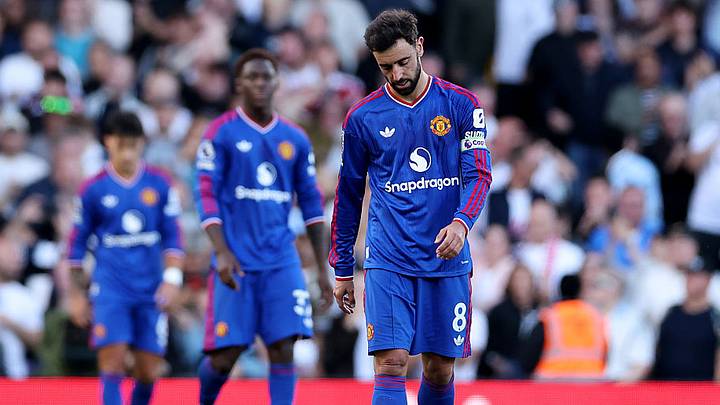
Following on from last season, when Michael Carrick’s team took 39 points from a possible 51 in the final 17 games—more than Arsenal and Manchester City over the same period, Manchester United probably hoped for a stronger start to the 2026–27 campaign.
This is more or less the same XI, save for Youri Tielemans subbing in for Casemiro and Marcus Rashford back in favor after 28 goal contributions during his loan at Barcelona.
But United were stunned by two Hull City set pieces on the opening day—the Tigers have continued to defy expectation since. The Red Devils put five past Ipswich Town, but a late Everton equalizer, a controversial Manchester City winner that has since been confirmed as a refereeing/VAR mistake, and a slow first 70 minutes punished by Fulham have made this a challenging start.
The numbers suggest that United are getting the ball into the right areas. Opta data reveals that no team has had more touches in the opposition’s box (182), while they have also allowed the fewest touches in their own box (92). It’s perhaps why Carrick doesn’t appear overly concerned, because it suggests tweaks are needed rather than major changes. But the results are yet to consistently come.
United have taken five points out of a possible 15 from five games, which matches their lowest tally in the Premier League era—since 1992—at this stage of a season.
United had a ropey start to the inaugural Premier League season, losing successive games against Sheffield United and Everton off the bat and not getting a first win until game four. But things then picked up, and by the time they’d played five games, it was seven points on the board. No, the only previous time the club collected as few as five points was much more recent: 2014–15.
5 - With five points, this is Manchester United's joint-lowest tally after five games of a Premier League season, also picking up five in 2014-15.
— OptaJoe (@OptaJoe) September 20, 2026
Sluggish. pic.twitter.com/UZTBWRpGnm
Underwhelming Start to Louis van Gaal Era

After the David Moyes experiment failed and the plug was pulled 10 months on as United headed to what was then a worst finish—7th—in the Premier League era, 2014–15 marked the start of a new era. Louis van Gaal, a national champion with Barcelona and Bayern Munich and a Champions League winner with Ajax, began work. That the Dutchman had just guided the Netherlands to an unexpected but brilliant third place at the 2014 World Cup only added to the hype and excitement.
United went big in the transfer market, too, tying up early deals for Ander Herrera and Luke Shaw, before adding Real Madrid wing wizard Ángel Di María and World Cup stars Marcos Rojo and Daley Blind after the season had begun. Radamel Falcao also joined on loan.
Even the fixture list was kind, but United were trying to learn a new way of playing on the job and results suffered. A 2–1 defeat to Swansea City at Old Trafford was the first time the club had lost at home in a season opener since 1972. The performance was described in news reports at the time as “disjointed,” and injuries meant debuts for Jesse Lingard and Tyler Blackett. Successive away draws against Sunderland (1–1) and Burnley (0–0) followed.
Then came the September international break, followed by the visit of Queens Park Rangers in which Di María, Rojo and Blind all started. Di María shone on his home debut and United, having already been eliminated from the Carabao Cup by MK Dons in a shock 4–0 thrashing, had their first win of the campaign. The 4–0 scoreline, which included goals from Di María and Herrera, looked as though it would mark a corner turned.

Although his form ultimately wouldn’t last amid struggles settling off the field, Di María continued to be excellent against Leicester City a week later, scoring an unorthodox lob to help his team open up a 3–1 lead. But an astonishing collapse ensued, with the game finishing 5–3 in Leicester’s favor and marking the first time United had ever lost a Premier League match in which they held a two-goal lead.
Van Gaal’s United did largely recover from that inauspicious start to the season. Things started to click in November, with a run of six-straight wins firing the team from ninth to third, part of a longer unbeaten run in the league that lasted two months and 10 games.
From mid-January to mid-April, United only lost one of 10 Premier League matches, including another run of six-straight wins to sit third in the standings. But what followed was only one win from the final six games to limp home in fourth, rather than mount a late title challenge. The eight-point gap that existed to leaders Chelsea with six games left, became 17 by the end. Still, a top-four finish meant Champions League qualification.
A Good or Bad Start Doesn’t Always Define the Season

It defintely wasn’t unusual for Alex Ferguson-led United teams to accumulate single-figure points through the opening five matches of a Premier League season. It happened eight times and the Red Devils still won the title in six of them. But the Scot also often threw down 11, 12 or 13, and achieving 10 or more points over that number of games to start a campaign is rarer now.
In 14 seasons since 2012–13—including this one—United have taken 10 or more points from the first five matches in only three. The year after his record-low five-point haul, Van Gaal pulled in 10, while José Mourinho’s second season began in blistering fashion with 13 points. That was also how many Ole Gunnar Solskjӕr delivered in 2021–22, before results fell off a cliff and he lost his job.
Only once in 35 Premier League seasons has a United team achieved a perfect record through five games. That was in 2011–12, which ironically didn’t end in a championship. But it goes to show that while the first five results of a season are important, they’re not always defining.
Man Utd’s Points From the First Five Games of Every Premier League Season
Season | Points After Five Games | Final Position |
|---|---|---|
1992–93 | 7 | 1st |
1993–94 | 13 | 1st |
1994–95 | 10 | 2nd |
1995–96 | 12 | 1st |
1996–97 | 9 | 1st |
1997–98 | 13 | 2nd |
1998–99 | 8 | 1st |
1999–00 | 13 | 1st |
2000–01 | 11 | 1st |
2001–02 | 8 | 3rd |
2002–03 | 8 | 1st |
2003–04 | 12 | 3rd |
2004–05 | 6 | 3rd |
2005–06 | 11 | 2nd |
2006–07 | 12 | 1st |
2007–08 | 8 | 1st |
2008–09 | 8 | 1st |
2009–10 | 12 | 2nd |
2010–11 | 11 | 1st |
2011–12 | 15 | 2nd |
2012–13 | 12 | 1st |
2013–14 | 7 | 7th |
2014–15 | 5 | 4th |
2015–16 | 10 | 5th |
2016–17 | 9 | 6th |
2017–18 | 13 | 2nd |
2018–19 | 9 | 6th |
2019–20 | 8 | 3rd |
2020–21 | 7 | 2nd |
2021–22 | 13 | 6th |
2022–23 | 9 | 3rd |
2023–24 | 6 | 8th |
2024–25 | 7 | 15th |
2025–26 | 7 | 3rd |
2026–27 | 5 | - |
 Add us as a preferred source on Google
Jamie Spencer is a writer and editor for SI FC. Jamie grew up in Manchester, England, in the 1990s and fell in love with the game at the same time as the Premier League was taking off. With more than a decade of experience behind him in sports media, he specializes in Manchester United and the overall Premier League, still living in England’s north-west soccer hotbed. Jamie is also an expert on the women’s game and enjoys old school nostalgia, telling stories from soccer’s rich history and culture.