%20%20--%3E%0A%3Csvg%20version%3D%221.1%22%20id%3D%22Layer_1%22%20xmlns%3D%22http%3A%2F%2Fwww.w3.org%2F2000%2Fsvg%22%20xmlns%3Axlink%3D%22http%3A%2F%2Fwww.w3.org%2F1999%2Fxlink%22%20x%3D%220px%22%20y%3D%220px%22%0A%09%20width%3D%2239px%22%20height%3D%2240px%22%20viewBox%3D%220%200%2039%2040%22%20enable-background%3D%22new%200%200%2039%2040%22%20xml%3Aspace%3D%22preserve%22%3E%0A%3Cpath%20fill%3D%22%23FFFFFF%22%20d%3D%22M38.5%2C7H28.2v26h10.3V7z%22%2F%3E%0A%3Cpath%20fill-rule%3D%22evenodd%22%20clip-rule%3D%22evenodd%22%20fill%3D%22%23FFFFFF%22%20d%3D%22M26.1%2C25.5c0%2C5.8-4.1%2C7.5-12.9%2C7.5C3.9%2C33%2C0%2C31.2%2C0%2C25.2v-1.1h11.6%0A%09v2.4c0%2C0.7%2C0.1%2C1.4%2C1.2%2C1.4c1%2C0%2C1.2-0.4%2C1.2-1.3v-0.9c0-1.6-0.9-1.6-3.5-2.2C2.2%2C21.7%2C0%2C19.7%2C0%2C15.3v-0.9C0%2C9.3%2C5.5%2C7%2C12.9%2C7%0A%09c10.2%2C0%2C12.8%2C2.6%2C12.8%2C7.4v1.8h-11v-2.9c0-0.6-0.4-1.1-1.2-1.1c-0.6%2C0-1.2%2C0.4-1.2%2C1.1v0.9c0%2C1.5%2C0.9%2C2%2C3.3%2C2.5%0A%09c8%2C1.6%2C10.5%2C3.3%2C10.5%2C7.5V25.5z%22%2F%3E%0A%3C%2Fsvg%3E%0A)
Lionel Messi’s Landmark Argentina Moments in Pictures
Lionel Messi’s 21-year international career has reached its end.
The iconic Estadio Monunmental in Buenos Aires will play host to a piece of soccer history as the 39-year-old superstar signs off with his 208th and final match for Argentina in a friendly against Benin on Tuesday.
There will be fireworks and waterworks in equal measure at the big farewell for one of Argentina and the world’s greatest-ever players.
From 2005 to 2026, here’s a look back at the Argentina moments that made Messi, from the significant and the spectacular. It’s been some ride.
2000s
Disaster Debut vs. Hungary (August, 2005)

In a quirk of fate, a floppy-haired, 18-year-old Messi makes his senior Argentina debut against Hungary—the very same opponent Diego Maradona had faced in his first appearance for the national team back in 1977.
The match is not exactly the anointing of Maradona’s successor many had anticipated. Messi comes on after 63 minutes and was sent off by German referee Markus Merk on 65, having been judged to have thrown an elbow at defender Vilmos Vanczak (above) in a tussle for the ball.

The BBC’s South American soccer expert Tim Vickery calls the controversial sending off a “crime against football.”
First World Cup Goal (June, 2006)

Messi is not yet 19 when he scores his first World Cup goal.
Argentina confirmed its spot in the knockout stages with an emphatic 6–0 win over Serbia & Montenegro in Gelsenkirchen, with Messi making his tournament debut off the bench.
The teenager only had 15 minutes of the second half to make an impact but set up Hernán Crespo for the fourth, before adding the sixth himself—darting into space at the edge of the box and striking neatly across goal, with what would soon become a trademark finish.
Mexico Goal (July, 2007)

Grizzled veteran Juan Sebastián Verón is reduced to a giddy fanboy as Messi made it 2–0 in the Copa América semifinal against Mexico.
Messi—with shoulder-length hair and wearing the number 18 on his back—loops one over Oswaldo Sánchez from the edge of the 18-yard box. It is as aesthetically pleasing a goal as you are ever likely to see and one which announced Messi as the superstar everyone in Argentina and Barcelona told the world he would be.
2010s
World Cup Disappointment (July, 2010)

The attempt to pair with Messi and Maradona as player and manager proved a flawed experiment as Argentina is eliminated at the 2010 World Cup quarterfinal having been torn to pieces by Germany in a 4–0 defeat.
Having played lighter as the exciting, up-and-coming prospect at previous tournaments, 2010 was the first time Messi—by now a Champions League and Ballon d’Or winner—felt the crushing weight expectation to replicate the heroics of the man in the dugout. He ended the 2010 tournament with no goals in five games.
Brazil Hat Trick (June, 2012)

MetLife Stadium was the venue for Messi’s first-ever international hat trick, with more than 80,000 watching live as the superstar powered Argentina to an all-time classic of a 4–3 friendly win against Brazil—a clash that was billed as Messi vs. Neymar in the buildup.
World Cup Final Defeat (July, 2014)

Messi glumly accepted the Golden Ball as the 2014 World Cup’s best player moments after Argentina fell to an extra-time defeat to Germany in the final in Rio de Janeiro. Meanwhile, photos are snapped of the forward looking on at the trophy he really wanted.
With the forward in his peak years and three tournaments in, questions are beginning to be asked about how many more chances he would get at soccer’s grand prize.
Back-to-Back Copa América Defeats (June, 2016)

The World Cup final loss triggers a run of painful final defeats, with Messi’s Argentina falling short in back-to-back Copa América tournaments—both times on penalties, both times to Chile.
In the 2016 Centenario tournament held in the United States, Messi scored five times but missed the opening penalty of the shootout the final.

Messi, then 29, retires from Argentina duty following the heartbreak, saying: “For me, the national team is over. I've done all I can. It hurts not to be a champion.”
• ✍️ NEXT: From Devil to Deity: How Lionel Messi Rewrote His Argentina Story
Ecuador Hat Trick (October, 2017)

A national campaign convinces Messi to return to Argentina. He eventually does and helps a struggling team clinch qualification for the 2018 World Cup with a sensational hat trick away against Ecuador—in turn meaning old Copa América foes Chile miss out on the tournament.
Missed Penalty vs Iceland (June, 2018)

Goalkeeper and part-time film director Hannes Þór Halldórsson saves a penalty from Messi as Argentina fail to beat tournament debutants and smallest-ever World Cup nation Iceland at 2018 World Cup.
A fine Messi goal against Nigeria helps Argentina through to the knockout stages, but it is his only major contribution of the tournament.
France Defeat (June, 2018)

A Round of 16 clash of the ages ends with France defeating Argentina 4–3 in Kazan, with Messi still without any World Cup knockout goal in 756 minutes of soccer played.
Meanwhile, teenage sensation Kylian Mbappé scores twice in what felt like a passing of the baton.
2020s
Copa America Triumph (July, 2021)

At the age of 34, Messi finally wins his first international trophy, as Argentina beat Brazil in a dramatic Copa América final at the Maracanã.
Messi ends the tournament as joint top scorer with four goals and the tournament’s MVP.
Netherlands Victory (December, 2022)

Messi arrives at the 2022 World Cup in Qatar on a mission and—after a shock group stage defeat to Saudi Arabia—helps power Argentina through the tournament.
An ill-tempered quarterfinal battle with Netherlands bring out a spikier edge in Messi who relishes the confrontation. After the penalty shootout victory, Messi is caught on camera saying “Qué mirás bobo?” (What are you looking at, idiot) to Dutch striker Wout Weghorst—a phrase that immediately became enshrined in the national lexicon in Argentina.
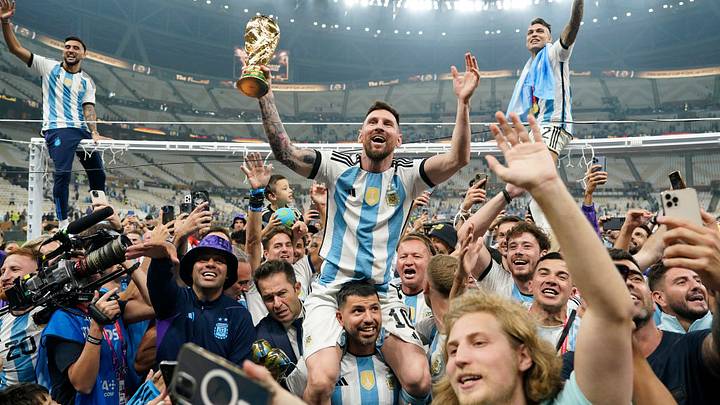
World Cup Victory (December, 2022)

Messi finally gets his crowning moment, as Argentina defeat France on penalties after the match ends 3–3 in the greatest-ever World Cup final, with the 35-year-old scoring twice. Lifting the iconic trophy aloft while wearing a Qatari bisht, Messi becomes the first player to win the Golden Ball twice.

Four million people lined the streets of Buenos Aires for the country’s first triumph since 1986, while a reported 1.5 billion watched the final around the globe.
Back-to-Back Copa America Success (July, 2024)

After years of so many near misses, the trophies come thick and fast for Messi and Argentina in the final years of his international career.
Argentina beat Italy 3–0 in the Finalissima, before winning the 2024 Copa América final against Colombia in Miami—now Messi’s home city.
Algeria Treble (June, 2026)

Days before his 39th birthday, Messi scores the first hat-trick of the 2026 World Cup, as Argentina power past Algeria—any talk that the superstar is too old or too satisfied with his trophy haul is quickly put to bed, as North America sits up and takes notice once again.
The world is once again mesmerised by Messi as he puts in match-winning displays against the likes of Cape Verde, Egypt and England.
The End of an Era (July, 2026)

Messi scores eight goals and is arguably even more impressive than in his 2022 showing as Argentina reach the final once again. However, Messi’s sixth and final World Cup does not get a fairytale ending as Spain run out deserved winners after extra time.
Messi, who has announced this tournament will be his last for Argentina, cries at the final whistle at MetLife Stadium.
 Add us as a preferred source on Google
Andy Headspeath is a Real Madrid correspondent for Sports Illustrated FC. Originally from the UK, the weather, culture and soccer lured him to Spain over a decade ago where he lives with his wife, son and two untrainable dogs. A player of unspeakably limited talents and only one fully functional knee, he has more than a decade's experience in a wide variety of editorial roles within sports media, from match reporting to in-depth feature writing and interviews. He specializes in soccer history and culture, as well as—of course—La Liga.