%20%20--%3E%0A%3Csvg%20version%3D%221.1%22%20id%3D%22Layer_1%22%20xmlns%3D%22http%3A%2F%2Fwww.w3.org%2F2000%2Fsvg%22%20xmlns%3Axlink%3D%22http%3A%2F%2Fwww.w3.org%2F1999%2Fxlink%22%20x%3D%220px%22%20y%3D%220px%22%0A%09%20width%3D%2239px%22%20height%3D%2240px%22%20viewBox%3D%220%200%2039%2040%22%20enable-background%3D%22new%200%200%2039%2040%22%20xml%3Aspace%3D%22preserve%22%3E%0A%3Cpath%20fill%3D%22%23FFFFFF%22%20d%3D%22M38.5%2C7H28.2v26h10.3V7z%22%2F%3E%0A%3Cpath%20fill-rule%3D%22evenodd%22%20clip-rule%3D%22evenodd%22%20fill%3D%22%23FFFFFF%22%20d%3D%22M26.1%2C25.5c0%2C5.8-4.1%2C7.5-12.9%2C7.5C3.9%2C33%2C0%2C31.2%2C0%2C25.2v-1.1h11.6%0A%09v2.4c0%2C0.7%2C0.1%2C1.4%2C1.2%2C1.4c1%2C0%2C1.2-0.4%2C1.2-1.3v-0.9c0-1.6-0.9-1.6-3.5-2.2C2.2%2C21.7%2C0%2C19.7%2C0%2C15.3v-0.9C0%2C9.3%2C5.5%2C7%2C12.9%2C7%0A%09c10.2%2C0%2C12.8%2C2.6%2C12.8%2C7.4v1.8h-11v-2.9c0-0.6-0.4-1.1-1.2-1.1c-0.6%2C0-1.2%2C0.4-1.2%2C1.1v0.9c0%2C1.5%2C0.9%2C2%2C3.3%2C2.5%0A%09c8%2C1.6%2C10.5%2C3.3%2C10.5%2C7.5V25.5z%22%2F%3E%0A%3C%2Fsvg%3E%0A)
From Devil to Deity: How Lionel Messi Rewrote His Argentina Story
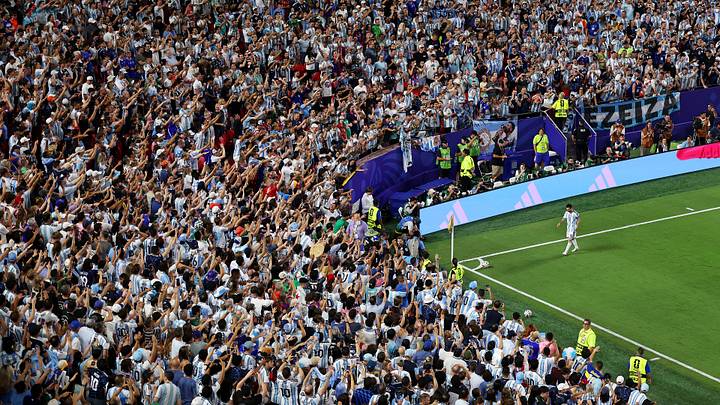
It’s both depressing and oddly fitting that New Jersey’s MetLife Stadium, that giant air conditioner plonked in the middle of a sprawling parking lot, should end the international career of the greatest player in the history of the sport—not once, but twice.
Lionel Messi’s final competitive appearance for Argentina, the last he would ever play before his father passed away, was a defeat to Spain in this summer’s World Cup final. A decade earlier, that same potato field in East Rutherford was the scene of Messi’s first international retirement.
“For me, the national team is over,” Argentina’s beleaguered No. 10 meekly revealed in the bowels of the MetLife, hunched over and clutching a wash bag after missing a penalty in a shootout defeat which handed Chile the 2016 Copa América. “I wanted this title more than any other but it wasn’t meant to be.”
Two finals, two defeats and two international retirements in the same soulless pit of concrete. However, the universal love-in which has greeted Messi’s decision to definitively step away from the blue and white stripes this time around is remarkably different to the vast array of emotions he inspired at his first retirement.
Why Argentina Hated Messi

The editor of the popular publication Diario El Sol, Federico Brusotti, once wrote: “There is something more Argentine than dulce de leche. It is our ability to turn our athletes into heroes or villains.”
While it can be hard to imagine given his current godly status, Messi has actually spent more time as Argentina’s villain than its hero.
By his own description, the nation’s all-time leading appearance maker and top scorer was “blamed, cursed at, lied about with no apparent remorse” for more than a decade while on international duty. There were reasons for this hate, just no justifiable ones.
Not Diego Maradona

Borocotó, the revered editor of the seminal magazine El Gráfico, came up with what the physical embodiment of the Argentine game should look like in 1928:
“A pibe [urchin] with a dirty face, a mane of hair rebelling against the comb; with intelligent, roving, trickster and persuasive eyes and a sparkling gaze that seem to hint at a picaresque laugh that does not quite manage to form on his mouth, full of small teeth that might be worn down through eating yesterday’s bread.”
Almost half a century later, Diego Maradona would debut for Argentina, turning that description into flesh and giving rise to an obsession which would last for almost another 50 years. The 1986 World Cup winner was not far from the status of a deity, with some of his disciples even setting up a Church of Maradona.
This suffocating level of acclaim was the consequence of Maradona’s play and his personality. He was the pibe who rose from poverty to the pinnacle of soccer (and thereby life), quite literally freeing himself from a pile of human excrement in the slums of his childhood.
Messi is a different character entirely. Also short, slight and left footed, but there was no raw sewage in the lower middle class home of his youth. Not that any average Argentinian would know much about Messi’s upbringing or anything he did off the pitch given his chronic reluctance to utter a single word—in public or private.
One of Messi’s school teachers recalled a classmate speaking on behalf of little Leo, such was his fear of being heard. When he joined Barcelona’s youth team, Cesc Fàbregas “thought he was mute.” Juan Sebastián Verón remembered a petrified Messi pacing around their shared room before he had to give his first team talk as Argentina captain: “The kid didn’t know what to do.”
The contrasts with his predecessor were sharp. Messi got criticized for mistakenly walking past a child’s outstretched hand while lost in contemplation after a match. Maradona spent his postgame fiddling with a prosthetic dummy penis to evade doping tests. Messi stopped talking to journalists in protest, Maradona opened fire on them with an air rifle.
The issue for Messi, particularly during the early years of his Argentina career, was that these differences with the country’s greatest idol were impossible to avoid while Maradona was his actual manager for the national team.

The great player was no grand tactician, cycling haphazardly through more than 80 call-ups as Argentina unconvincingly qualified for the 2010 World Cup. Messi went seven months without an international goal at one point in the buildup to a tournament he failed to score at entirely. After a humiliating quarterfinal exit to Germany, the narrative which had been forming was clearly set: Blame Messi.
“He isn’t ready to shoulder the burden of the team; he isn’t cut out to take on the role of playmaker,” Martín Palermo, Messi’s former international teammate, scoffed after the tournament. “Messi doesn’t have Maradona’s mentality.”
At the 2011 Copa América on home soil, Messi went through another major tournament without a goal and was booed by the Santa Fé crowd. “He leaves Argentina truly hurt every time people speak ill of him,” Messi’s mother Celia Cuccitini fretted. “Why is it always him? He suffers a great deal; he leaves feeling terrible, and it takes him a long time to bounce back.”
Ironically, had Messi shown Argentina his suffering, it may have stopped.
Not Argentinian Enough
Messi’s popularity rating sunk so low La Nación’s Claudio Mauri quipped that he had “less fans than a referee.” Hernán Claus recalled in Olé that Messi was accused of “not knowing the national anthem, that he feels Spanish, that he doesn’t love the shirt.”
The argument was built on the fact that Messi left Argentina for Barcelona as a 13-year-old and never returned. Fans scornfully called him ‘The Catalan’ and ignored the fact that his boyhood Argentinian club, Newell’s Old Boys, had refused to pay for the growth hormone treatment he needed.
Carlos Rexach, the man responsible for getting Messi’s father to sign the famous paper napkin at a Catalan tennis club to tie his future to Barcelona, offered the compelling theory that he “doesn’t belong to any specific group.” “Perhaps if he had come up through Boca, there would be plenty of ‘pro-Messi’ fans today,” Rexach argued, “but that’s not the case. Since he developed at Barcelona, Argentines view him as a foreigner.”
It’s obviously nonsense. Messi still speaks with an Argentinian accent. His favorite food is the milanesa napolitana his mom made in Rosario and he is rarely without his trusty mate tea set or pack of Truco cards. He is married to Antonela Roccuzzo, who grew up in the same area of Rosario.
“Nothing makes me angrier than them telling me that I’m not an Argentine,” Messi once seethed. “What do they know about my emotions?”
“Life took me to Barcelona,” he explained. “As a child, I dreamed about playing in the Argentine first division, to put on the blue and white; nothing gives me more motivation. I think like an Argentine and I live in Catalonia, but I feel very Argentine.”
Not the Messi of Barcelona

It wasn’t just that Messi lived in Barcelona which rankled with Argentinian fans, it was that he played so much better for the Catalan outfit.
“Thank God Messi doesn't play for the Argentine national team even 10% as good as he does for Barcelona,” Brazil President Lula da Silva guffawed on local radio station O Dia in 2009. “That leaves us Brazilians satisfied.”
Messi was voted the best player on the planet in four consecutive years between 2009–12. Yet, the serial Champions League winner with Barcelona could not force Argentina toward an international title.
Rather than combining with the likes of Xavi Hernández and Andrés Iniesta—two figures who would have won their own individual accolades in any other era—Messi was tasked with hauling a far inferior roster to the sport’s zenith. Argentina did reach three consecutive finals, only to lose the 2014 World Cup to Germany before twice failing to beat Chile in Copa América penalty shootouts.
After the first of those continental defeats, Maradona reasoned: “It’s logical to go after Messi; it’s easy. We have the best player in the world—he goes and scores four goals against Real Sociedad, then comes here [to Argentina] and barely touches the ball. You find yourself asking: ‘Are you Argentine or Swedish?’”
“Always in Argentina, in politics and in football, we look for a providential person [to save the day],” Maradona’s fellow World Cup winner Jorge Valdano eloquently outlined. “They are forgiven anything, except not succeeding. Messi is a winner who has not won and Argentina is an implacable country with him.”
Messi’s Lowest Point Was His Turning Point

“No te vayas, Lio.” Those words—‘Don’t go, Lio’—were trending on social media, plastered across airport noticeboards and even echoed by Argentina’s president immediately after Messi announced his first international retirement in 2016. Hundreds chanted the plea while gathered in the pouring rain around the Obelisk on the central avenue in Buenos Aires.
The day after the final, Alejandro Wall wrote a revered piece titled: “I love you just the way you are—without World Cups or trophies.” Within it, he described Messi’s retirement as a “neutron bomb that turned our stomachs into thousands of Hiroshimas and reduced the defeat against the Chileans to a mere footnote.”
Even Maradona had changed his tune. “Messi was abandoned and I don’t want to abandon him,” he cried.
Within five days, reports claimed that Messi had changed his mind. But what changed the public’s?
Those Tears

There had always been a cool sense of detachment to Messi which never sat well in South America. Federico Brusotti wrote in MDZ before the 2010 World Cup: “He shows no sign of the defiance that might make his apparent listlessness and lack of interest—whenever he dons La Albiceleste jersey—more bearable. A bowed head and a vacant stare are the most common images of the Rosario native while defending the nation’s colors.”
Messi was constantly accused of “pecho frío”—a cold chest, heartlessness. The public only discovered that he had cried in the locker room after the 2015 Copa América final after his teammate Lucas Biglia let it slip days later.
But the world saw Messi’s tears at MetLife Stadium in 2016. Those images of a sobbing 29-year-old, hair askew and Sergio Agüero weeping into his shoulder blade were beamed across the country and lapped up by an increasingly sympathetic public.
Those Fans

Messi would eventually be helped by a younger generation of players on the field, but it was a younger generation of fans who paved the way for his return. Each year there were fewer supporters to compare Messi to Maradona, fewer to remember the feeling of winning the World Cup, or any trophy at all. Sometimes, those players and fans were one and the same.
A 15-year-old kid in River Plate’s academy captured the emotion of his generation in an open letter to Messi on Facebook. “How can we convince you—when we’ve never faced even 1% of the pressure resting on your shoulders?” he asked. “How can we convince you when we never stopped for a second to realize that you aren’t to blame for the anger we feel when we lose—anger that often stems from our own stirred-up frustrations?
“Do whatever you want, Lionel, but please consider staying. But stay to have fun—because that is what these people have taken away from you.”
That teenager would grow up to be Enzo Fernández, the Manchester City midfielder who won the 2022 World Cup with Messi.
In the years it took the likes of Fernández, Alexis Mac Allister and Julián Alvarez to grow old enough to play with their idol, Messi still endured some sour moments. After the 2018 World Cup exit to eventual champion France, Messi’s 6-year-old son asked him: “Why do they kill you in Argentina, daddy?”
But the tide had clearly turned, with that long awaited goodwill washing his way once Argentina finally won the 2021 Copa América. “I needed to remove from myself the thorn of achieving something with the national team,” Messi beamed while weighed down by the gigantic trophy.
Matias Manna, Argentina’s assistant coach during the modern golden era which began with that Copa triumph and ended in defeat to Spain in the 2026 World Cup final, explained that even an extraordinary soloist like Messi still had to wait for the right orchestra: “Platini needed Giresse‑Fernández-Tigana; Zico needed Andrade-Tita-Adílio; Cruyff needed Neeskens, Haan, Mühren. Messi needs his support. Good controlling midfielders can enhance even the very best players and, obviously, Messi improved them all.”
That young core propelled Argentina to glory which gave Messi his greatest triumph: the approval of his public. “Now I see a lot of people who turned around,” the accepted champion noted after winning the 2022 World Cup. “I feel it like a triumph for me to have changed that situation and won over all the people of Argentina. Today 95% or 100% of Argentines love me and that’s a beautiful feeling.”
Even as Messi found himself back at MetLife Stadium in July, sobbing after losing the final of another major tournament, the pain was nowhere near as raw. The dream of winning another World Cup had faded, but the love of his country wasn’t going anywhere.
 Add us as a preferred source on Google
Grey Whitebloom is an Associate Editor for SI FC. He has more than half a decade of experience in sports media across all its various guises, from the fast-paced demands of news articles and match reports to in-depth research required for features. Whitebloom graduated with a First Class Honours from University College London and found himself named on the Dean’s List—which, despite his initial fears, was a form of praise rather than a punishment. He specialises in the Premier League and Champions League, while also boasting an extensive track record of La Liga coverage.