%20%20--%3E%0A%3Csvg%20version%3D%221.1%22%20id%3D%22Layer_1%22%20xmlns%3D%22http%3A%2F%2Fwww.w3.org%2F2000%2Fsvg%22%20xmlns%3Axlink%3D%22http%3A%2F%2Fwww.w3.org%2F1999%2Fxlink%22%20x%3D%220px%22%20y%3D%220px%22%0A%09%20width%3D%2239px%22%20height%3D%2240px%22%20viewBox%3D%220%200%2039%2040%22%20enable-background%3D%22new%200%200%2039%2040%22%20xml%3Aspace%3D%22preserve%22%3E%0A%3Cpath%20fill%3D%22%23FFFFFF%22%20d%3D%22M38.5%2C7H28.2v26h10.3V7z%22%2F%3E%0A%3Cpath%20fill-rule%3D%22evenodd%22%20clip-rule%3D%22evenodd%22%20fill%3D%22%23FFFFFF%22%20d%3D%22M26.1%2C25.5c0%2C5.8-4.1%2C7.5-12.9%2C7.5C3.9%2C33%2C0%2C31.2%2C0%2C25.2v-1.1h11.6%0A%09v2.4c0%2C0.7%2C0.1%2C1.4%2C1.2%2C1.4c1%2C0%2C1.2-0.4%2C1.2-1.3v-0.9c0-1.6-0.9-1.6-3.5-2.2C2.2%2C21.7%2C0%2C19.7%2C0%2C15.3v-0.9C0%2C9.3%2C5.5%2C7%2C12.9%2C7%0A%09c10.2%2C0%2C12.8%2C2.6%2C12.8%2C7.4v1.8h-11v-2.9c0-0.6-0.4-1.1-1.2-1.1c-0.6%2C0-1.2%2C0.4-1.2%2C1.1v0.9c0%2C1.5%2C0.9%2C2%2C3.3%2C2.5%0A%09c8%2C1.6%2C10.5%2C3.3%2C10.5%2C7.5V25.5z%22%2F%3E%0A%3C%2Fsvg%3E%0A)
Man Utd’s Historic European Cup Milestone Is Fitting for a Club That Has Carried England’s Torch
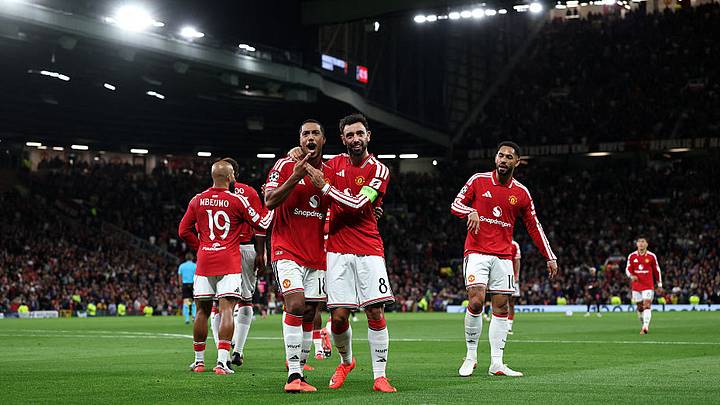
Manchester United returned to the Champions League on Thursday night for the first time in nearly three years. With it came a significant milestone, as the Red Devils became the first English club to play 300 matches in Europe’s premier club competition.
Game number 299 had been an evening to forget in Dec. 2023, beaten 1–0 by Bayern Munich to condemn a team managed by Erik ten Hag to last place in the group standings. United competed in the Europa League in 2024–25, a competition the club has become increasingly familiar with over the last decade, and didn’t qualify for any UEFA tournament in 2025–26.
United hadn’t gone two consecutive seasons without Champions League soccer in more than 30 years, dating back to the early 1990s when Alex Ferguson was hunting down the inaugural Premier League title to end a 26-year championship drought.
But fans always hoped, always knew, that Manchester United would soon be back.
Prior to taking on Sabah, debutants from Azerbaijan, at Old Trafford, manager Michael Carrick had called the Champions League “magical.” The United boss is responsible for bringing the club back after masterminding a third-place Premier League finish last season. He was a winner as a player in 2008 and a two-time runner-up in 2009 and 2011.
“It’s where we all want to be,” he enthused. “When you’re out of it, you realize how special it is and when you’re in it, you want to make the most of it.”
Realistically, fans might have preferred for a bigger occasion to mark such a milestone. Sabah were barely known outside Azerbaijan prior to this season’s European adventure that began in the first qualifying round more than two months ago—when Sabah kicked off against The New Saints of Wales on July 7, the 2026 World Cup was still yet to reach the quarterfinals.
But while this was no legendary European night of years gone by against the likes of Real Madrid, Juventus, Bayern Munich or Barcelona, it was perhaps a comfortable way to ease back into competing at this level. United had little trouble cruising to victory, dominating the match to the point of leading 3–0 by halftime, eventually making it 4–0 and recording a first clean sheet of the season after publicized defensive frailty in the opening weeks of the Premier League.
Man Utd Are England’s European Trailblazers
Once upon a time, English soccer didn’t want its clubs competing on an international stage, fearing it would undermine and damage the integrity of the domestic game. There was no English representation in the inaugural European Cup in 1955–56 because Alan Hardaker, chairman of the Football League (EFL), blocked reigning champions Chelsea from entering.
When Manchester United won the English championship in 1956, manager Matt Busby was determined to have his team play—with backing from the FA, they did.
The ‘Busby Babes’ went to the semifinals in their first attempt, losing out to defending champions Real Madrid in the final four—Los Blancos went on to lift the trophy again, followed by three more in a yet unrivaled display of continental dominance.
Another semifinal run followed in 1957–58, but tragedy struck when, after the quarterfinal against Red Star Belgrade, eight players were killed as a result of the Munich air disaster. The plane stopped in Germany for scheduled refueling and crashed in the icy conditions on its third attempt to take off after two previous aborts. It could have broken the club.
Busby pulled through after fighting for his life but needed persuasion not to give up on his dream of making Manchester United the champions of Europe. With a rebuilt team a decade later, he completed the vision, hammering a generational Benfica team at Wembley Stadium in 1968. England’s first European participant and England’s first European champion.
Once the Champions League era replaced the old European Cup, Alex Ferguson’s United became the first English team to win that, too—in dramatic style, in 1999.
What Can Man Utd Achieve in the Champions League This Season?

Even the most optimistic Manchester United fan might consider Champions League glory beyond the team for this season. Consolidating in the Premier League is the more important objective and this is a squad that is still developing and arguably still incomplete in terms of a rebuild that began last summer and has so far addressed attack and midfield.
However, the league phase fixture list is potentially a lot kinder than it could have been, avoiding Real Madrid, Barcelona and Paris Saint-Germain. A win and three points, even at this early stage, puts the knockout phase into a much clearer view.
Last season, nine points were enough for a place in the top 24 and progression into the playoff round. A seeded place in that round required 12 points and automatic passage straight to the round of 16 took 16 points from a possible 24.
The knockout playoff is very achievable and it is a round that is winnable, making the last 16 not an unrealistic prospect. From there, the competition stiffens immensely, but anything is ultimately possible and it is a solid grounding from which to build in the coming seasons.
Man Utd League Phase Fixtures—2026–27
- Man Utd 4–0 Sabah: Sept. 10, 2026
- Atlético Madrid vs. Man Utd: Oct. 13, 2026
- Como vs. Man Utd: Oct. 21, 2026
- Man Utd vs. Roma: Nov. 3, 2026
- Sporting CP vs. Man Utd: Nov. 25, 2026
- Man Utd vs. RB Leipzig: Dec. 8, 2026
- Man Utd vs. Bayern Munich: Jan. 20, 2027
- Villarreal vs. Man Utd: Jan. 27, 2027
 Add us as a preferred source on Google
Jamie Spencer is a writer and editor for SI FC. Jamie grew up in Manchester, England, in the 1990s and fell in love with the game at the same time as the Premier League was taking off. With more than a decade of experience behind him in sports media, he specializes in Manchester United and the overall Premier League, still living in England’s north-west soccer hotbed. Jamie is also an expert on the women’s game and enjoys old school nostalgia, telling stories from soccer’s rich history and culture.