%20%20--%3E%0A%3Csvg%20version%3D%221.1%22%20id%3D%22Layer_1%22%20xmlns%3D%22http%3A%2F%2Fwww.w3.org%2F2000%2Fsvg%22%20xmlns%3Axlink%3D%22http%3A%2F%2Fwww.w3.org%2F1999%2Fxlink%22%20x%3D%220px%22%20y%3D%220px%22%0A%09%20width%3D%2239px%22%20height%3D%2240px%22%20viewBox%3D%220%200%2039%2040%22%20enable-background%3D%22new%200%200%2039%2040%22%20xml%3Aspace%3D%22preserve%22%3E%0A%3Cpath%20fill%3D%22%23FFFFFF%22%20d%3D%22M38.5%2C7H28.2v26h10.3V7z%22%2F%3E%0A%3Cpath%20fill-rule%3D%22evenodd%22%20clip-rule%3D%22evenodd%22%20fill%3D%22%23FFFFFF%22%20d%3D%22M26.1%2C25.5c0%2C5.8-4.1%2C7.5-12.9%2C7.5C3.9%2C33%2C0%2C31.2%2C0%2C25.2v-1.1h11.6%0A%09v2.4c0%2C0.7%2C0.1%2C1.4%2C1.2%2C1.4c1%2C0%2C1.2-0.4%2C1.2-1.3v-0.9c0-1.6-0.9-1.6-3.5-2.2C2.2%2C21.7%2C0%2C19.7%2C0%2C15.3v-0.9C0%2C9.3%2C5.5%2C7%2C12.9%2C7%0A%09c10.2%2C0%2C12.8%2C2.6%2C12.8%2C7.4v1.8h-11v-2.9c0-0.6-0.4-1.1-1.2-1.1c-0.6%2C0-1.2%2C0.4-1.2%2C1.1v0.9c0%2C1.5%2C0.9%2C2%2C3.3%2C2.5%0A%09c8%2C1.6%2C10.5%2C3.3%2C10.5%2C7.5V25.5z%22%2F%3E%0A%3C%2Fsvg%3E%0A)
Mauricio Pochettino’s USMNT World Cup Dream Had Been Coming for 341 Days
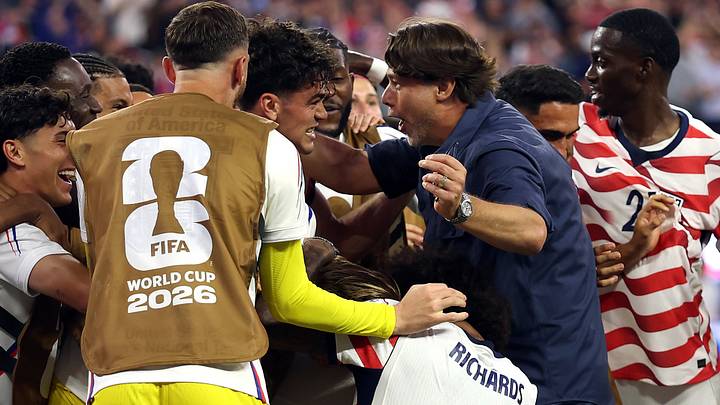
INGLEWOOD, Calif. — Mauricio Pochettino arrived at his press conference in the aftermath of the U.S. men’s national team’s 4–1 drubbing of Paraguay on Friday night in an odd mood.
What should have been a sweet moment to savor the greatest performance of his entire managerial tenure in the States instead began with a rant about the moderately offputting mechanical clank of the air conditioning unit in the corner of the room. “We can’t work in these conditions,” he lamented before a question had even been asked.
Once someone had managed to quell the whirring which had so infuriated the USMNT coach, he was soon bothered by the noise coming out of the rows of seats in front of him. The focus was too much on the individuals for Pochettino’s liking.
Christian Pulisic was “amazing, of course,” the coach scoffed. “Balo [Folarin Balogun] was amazing, of course. Tim Ream was amazing, of course...” All 10 outfielders got name-checked during a bizarre tirade which felt more like a list of people to punish rather than praise. As he would explain, Pochettino had a different “principal actor” in mind.
“I need to press one thing,” the Argentine coach stressed. “The fans. They were amazing. On behalf of the whole team, a massive thank you to the fans because the energy they transmit to the team was amazing.”
That kind of atmosphere has been a long time coming for Pochettino—341 days, to be precise.
One Year in the Making
What an unreal crowd tonight! Thanks for showing up and supporting the #USMNT! What an amazing start to the #FIFAWorldCup! pic.twitter.com/SwUfWtKEcv
— Cindy Cone (@cone_cindy) June 13, 2026
As recently as last summer, home crowds were considered more of a hindrance than a help for the USMNT.
The first game for the hosts at the 2025 Gold Cup against Trinidad and Tobago drew just 12,610 fans. While there were small venues in use for the Concacaf competition, Curaçao’s goalless draw with El Salvador in the exact same stadium inspired a larger attendance.
Even when supporters did bother turning up, they weren’t necessarily cheering for the hosts. The USMNT’s semifinal and final showdowns with Honduras and Mexico respectively were both sellouts, but American midfielder Tyler Adams described the atmosphere as “an away game in a hostile environment.”
On July 6, 2025, Pochettino set out a challenge for the U.S. fans to replicate the cacophony created by Mexico’s support in the Gold Cup showpiece. “I would love to see my players playing with 70,000 people cheering,” he wistfully reflected. “We need the people. We need the fans. The fans have one year to realize how important are the fans in soccer.” They realized.
There were 70,492 switched-on supporters stuffed into the steep tiers of SoFi Stadium on Friday. Even with the fight for attention posed by the ongoing NBA Finals and upcoming UFC event at the White House, this south western slice of L.A. County was painted an unmistakable shade of red and white.
USA goals in the 2022 group stage: 2.
— Sports Illustrated FC (@SI_FootballClub) June 13, 2026
USA goals in the first half v Paraguay: 3. pic.twitter.com/BXClcwpAS6
The vast 4K screen suspended above the pitch displayed a decibel reader which peaked at 112 dBA before the first ball had been kicked. An even louder burst of the nation’s initials at the opening whistle set the tone for a contest which the players very much played at full volume.
“Being in America, having this crowd around us, seeing the red, white and blue, all our red and white striped shirts in the crowd, it’s awesome,” Pulisic beamed. “I mean, hearing the ‘U-S-A’ chants, it’s really pushing us forward.”
The tide of American apathy towards soccer from the stands had begun to turn during the pre-World Cup friendlies—so much so that some of the players were even caught by surprise. However, those games were several orders of magnitude cheaper than a ticket to SoFi.
Fans heading to Soldier Field in Chicago could get a seat for the clash with Germany for just $150. Yet, at no point over the last nine months has a ticket for the USMNT’s World Cup opener been available on general sale for less than $850, per Ticket Data. One supporter told me he had spent $6,000 on a single entry to the meeting with Paraguay, his grin fading as I failed to hide the disdain which involuntarily washed across my face.
Nevertheless, those who paid up played their part. Although Pulisic was quick to note: “We just hope it continues like that.”
The U.S. Needs to Keep Cheering

The overwhelming emotion bubbling around the ground ahead of kickoff was unbridled excitement. This has been an occasion years in the making and fans flocked from across the country to Inglewood, Calif. for a chance to see the start of this journey in the flesh.
Yet every feeling, however powerful, is forever fleeting.
One jubilant spectator was bouncing around in the queue to head inside the stadium when he saw a group of Paraguayans in their red-and-white kit. “What?! Paraguay wear our jerseys, how are we going to know who to root for?” he exclaimed, all while wearing an expression far too glum for someone in a star spangled hot dog costume.
The emphatic nature of the opening day victory against an opponent many had tipped to be defiantly obdurate (including their own manager) has undoubtedly sent expectations soaring. While most fans won’t stretch to the same extremes as Alexi Lalas—the former U.S. international and professional antagonist hailed the first 45 minutes as “the greatest half of group play from a men’s team at a World Cup in history”—pre-tournament predictions no doubt need an update.
Based on the spread of votes in Sports Illustrated’s prematch poll, a group-stage exit was considered twice as likely as a maiden U.S. World Cup triumph—and more probable than a run to the quarterfinals.
Hopes could spin in a wildly different direction if the U.S. fails to demonstrate the same attacking verve against Australia next week. Yet, it is imperative that the crowd in Seattle remains as committed as the L.A. contingent.
The Power of Home Advantage at World Cups
Year | Host | Pre-Tournament ELO Ranking | World Cup Finish |
|---|---|---|---|
1930 | Uruguay | 5th | 1st |
1934 | Italy | 4th | 1st |
1938 | France | 35th | 8th |
1950 | Brazil | 5th | 2nd |
1954 | Switzerland | 27th | 5th |
1958 | Sweden | 14th | 2nd |
1962 | Chile | 22nd | 3rd |
1966 | England | 3rd | 1st |
1970 | Mexico | 30th | 6th |
1974 | West Germany | 2nd | 1st |
1978 | Argentina | 10th | 1st |
1982 | Spain | 15th | 12th |
1986 | Mexico | 19th | 6th |
1990 | Italy | 4th | 3rd |
1994 | USA | 56th | 14th |
1998 | France | 4th | 1st |
2002 | Japan | 15th | 9th |
2002 | South Korea | 34th | 4th |
2006 | Germany | 10th | 3rd |
2010 | South Africa | 63rd | 20th |
2014 | Brazil | 1st | 4th |
2018 | Russia | 44th | 8th |
2022 | Qatar | 48th | 32nd |
The importance of home support cannot be stressed enough at a World Cup. While some may question whether this remains the case—seven of the first 11 hosts reached the competition’s final, but none since France in 1998 have actually won it—the wait for a home-based winner is simply a consequence of who has hosted the tournament in the 21st century.
No one would really expect Japan, South Korea or Russia to hoist the trophy aloft. Yet, with the power of home advantage, all three majorly outperformed expectation by making deep runs in the knockouts. Germany (2006) and Brazil (2014) both reached the semifinals, while South Africa collected a respectable four points from three group games in 2010. Qatar stands out as the only host to not enjoy a noticeable boost, although the unique circumstances surrounding the 2022 World Cup help explain that anomaly.
While the individual players are obviously key, the entire collective will continue to be boosted by this unusual swell of support.
“We can do amazing things,” Pochettino predicted, “if the fans are in this way.”
But before the satisfied conductor left his lectern at the press conference, he made FIFA’s representative promise one thing: fix the air conditioner.
READ THE LATEST WORLD CUP NEWS, ANALYSIS AND INSIGHT FROM SI FC
 Add us as a preferred source on Google
Grey Whitebloom is an Associate Editor for SI FC. He has more than half a decade of experience in sports media across all its various guises, from the fast-paced demands of news articles and match reports to in-depth research required for features. Whitebloom graduated with a First Class Honours from University College London and found himself named on the Dean’s List—which, despite his initial fears, was a form of praise rather than a punishment. He specialises in the Premier League and Champions League, while also boasting an extensive track record of La Liga coverage.