%20%20--%3E%0A%3Csvg%20version%3D%221.1%22%20id%3D%22Layer_1%22%20xmlns%3D%22http%3A%2F%2Fwww.w3.org%2F2000%2Fsvg%22%20xmlns%3Axlink%3D%22http%3A%2F%2Fwww.w3.org%2F1999%2Fxlink%22%20x%3D%220px%22%20y%3D%220px%22%0A%09%20width%3D%2239px%22%20height%3D%2240px%22%20viewBox%3D%220%200%2039%2040%22%20enable-background%3D%22new%200%200%2039%2040%22%20xml%3Aspace%3D%22preserve%22%3E%0A%3Cpath%20fill%3D%22%23FFFFFF%22%20d%3D%22M38.5%2C7H28.2v26h10.3V7z%22%2F%3E%0A%3Cpath%20fill-rule%3D%22evenodd%22%20clip-rule%3D%22evenodd%22%20fill%3D%22%23FFFFFF%22%20d%3D%22M26.1%2C25.5c0%2C5.8-4.1%2C7.5-12.9%2C7.5C3.9%2C33%2C0%2C31.2%2C0%2C25.2v-1.1h11.6%0A%09v2.4c0%2C0.7%2C0.1%2C1.4%2C1.2%2C1.4c1%2C0%2C1.2-0.4%2C1.2-1.3v-0.9c0-1.6-0.9-1.6-3.5-2.2C2.2%2C21.7%2C0%2C19.7%2C0%2C15.3v-0.9C0%2C9.3%2C5.5%2C7%2C12.9%2C7%0A%09c10.2%2C0%2C12.8%2C2.6%2C12.8%2C7.4v1.8h-11v-2.9c0-0.6-0.4-1.1-1.2-1.1c-0.6%2C0-1.2%2C0.4-1.2%2C1.1v0.9c0%2C1.5%2C0.9%2C2%2C3.3%2C2.5%0A%09c8%2C1.6%2C10.5%2C3.3%2C10.5%2C7.5V25.5z%22%2F%3E%0A%3C%2Fsvg%3E%0A)
Michael Carrick, Man Utd ‘DNA’ Lining Up to Realize ‘Project 150’
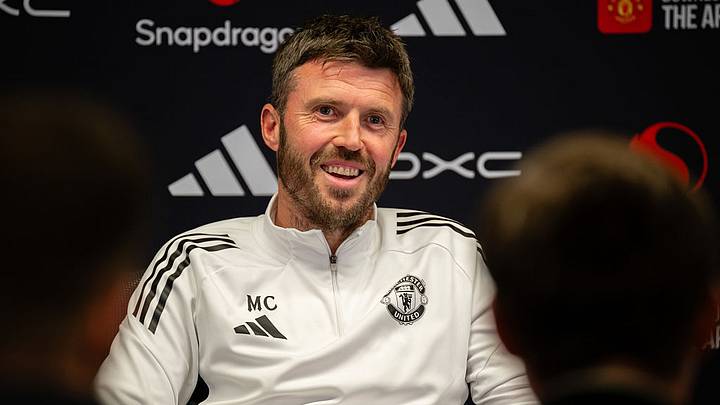
Manchester United did not explicitly say it, but Michael Carrick signing a contract to the end of the 2027–28 season means he is the manager the club has entrusted to bring ‘Project 150’ to life.
It was a target that chief executive Omar Berrada announced in the early weeks of last season, a vision to become Premier League champions to coincide with—or before—the club marks the 150th anniversary of its 1878 foundation in a railway depot in north-east Manchester. The same goal also applies for the women’s team seeking its maiden WSL title.
Even after United tumbled to 15th in the Premier League last season, Berrada stuck by the ambition. “Why not aim for it?” he told the popular fanzine United We Stand in the summer of 2025. “Why not do everything in our power? I firmly believe we can do it.”
Things have changed considerably since the project’s inception, with United quickly moving on from Erik ten Hag and then backing Ruben Amorim. But Carrick’s audition period suggests he is already closer to realizing the ultimate goal than either of his predecessors.
With the same group of players that Amorim had badly struggled for consistency with, Carrick has taken more points from his first 16 matches in charge than any other Premier League team over the same period of time. It’s led some United fans to even speculate about whether a title challenge this season might have been possible had the change been made sooner. The team’s average points per game under Carrick (2.25) equates to 85.5 over a full season. For reference, champion Arsenal’s maximum tally will be 85, logic which puts the Red Devils in a hypothetical mix.
With that positive momentum and considerable improvement on a 51-year low just 12 months, United certainly are heading in the right direction. But the club must strike while the iron is hot.
Michael Carrick, ‘United DNA’
Carrick was born and raised in suburban Newcastle and got his break in pro soccer in east London, but there are few around who can be considered more intrinsically ‘Manchester United’ than he is.
When his continuation as permanent manager was announced, Carrick proudly said that he “felt the magic of Manchester United” from the moment he first entered the building in 2006.
He went to the top of the mountain within his first few seasons, playing in a generational team that won back-to-back-to-back Premier League titles, won the Champions League and reached two other finals. From there, he was club Players’ Player of the Year prize—as voted for by his colleagues—in the ‘Van Persie’ season, became captain, made the last of his 464 appearances and joined the staff.
By the time Carrick left in December 2021, after a three-match spell as caretaker boss, to take the first steps on the managerial career ladder, he had been at Old Trafford for more than 15 years and seen the club from every conceivable angle.
It’s easy to dismiss the importance of ‘knowing’ the club—and plenty of cynics have—but it does matter. There’s no getting away from it. “I know what it takes and hopefully I can give that experience a little bit to the players and they can feed off it, and we can keep pushing for more,” Carrick explained to club media when his new status and contract was revealed.
Ole Gunnar Solskjær, mocked for failure at Cardiff City before and his doomed Beşiktaş spell since, achieved better Premier League finishes with United than José Mourinho and Louis van Gaal, two era-defining managers. Carrick fell short of his objective in his only other managerial appointment at Middlesbrough, but it’s clicked into place at Old Trafford. Pep Guardiola and Zinedine Zidane had only ever managed B team soccer at Barcelona and Real Madrid respectively, before delivering unprecedented success for the senior side. History matters.
Complicated tactics rarely work at Manchester United, neither does a defense-first approach. Carrick has tapped into what he knew as a player, praised for simplifying things by those who now play under him, and getting results in a manner that fits the United way.
Recruitment Is Critical

When Berrada reiterated ‘Project 150’ 11 months ago, he noted that there would be “two or three summer transfer windows” at the club’s disposal.
The first of those has already been and gone. And while the players—Matheus Cunha, Bryan Mbeumo, Benjamin Šeško, Senne Lammens—were being brought in for Ruben Amorim, all four have made a substantially positive difference working to Carrick’s instruction.
United need more of the same, not least because central midfield, an area already identified as a weak spot, is losing Casemiro. With a situation developing where Kobbie Mainoo could be the only current senior midfielder still at the club, there could be as many as three new signings in just one position. Otherwise needed will be a left winger, left back and backup goalkeeper.
The club will have a lot more games next season—eight in the Champions League league phase alone—so it’s about giving Carrick a squad capable of navigating the extra demands, beyond just improving the starting XI.
READ THE LATEST MAN UTD NEWS, ANALYSIS AND INSIGHT FROM SI FC
 Add us as a preferred source on Google
Jamie Spencer is a writer and editor for SI FC. Jamie grew up in Manchester, England, in the 1990s and fell in love with the game at the same time as the Premier League was taking off. With more than a decade of experience behind him in sports media, he specializes in Manchester United and the overall Premier League, still living in England’s north-west soccer hotbed. Jamie is also an expert on the women’s game and enjoys old school nostalgia, telling stories from soccer’s rich history and culture.