%20%20--%3E%0A%3Csvg%20version%3D%221.1%22%20id%3D%22Layer_1%22%20xmlns%3D%22http%3A%2F%2Fwww.w3.org%2F2000%2Fsvg%22%20xmlns%3Axlink%3D%22http%3A%2F%2Fwww.w3.org%2F1999%2Fxlink%22%20x%3D%220px%22%20y%3D%220px%22%0A%09%20width%3D%2239px%22%20height%3D%2240px%22%20viewBox%3D%220%200%2039%2040%22%20enable-background%3D%22new%200%200%2039%2040%22%20xml%3Aspace%3D%22preserve%22%3E%0A%3Cpath%20fill%3D%22%23FFFFFF%22%20d%3D%22M38.5%2C7H28.2v26h10.3V7z%22%2F%3E%0A%3Cpath%20fill-rule%3D%22evenodd%22%20clip-rule%3D%22evenodd%22%20fill%3D%22%23FFFFFF%22%20d%3D%22M26.1%2C25.5c0%2C5.8-4.1%2C7.5-12.9%2C7.5C3.9%2C33%2C0%2C31.2%2C0%2C25.2v-1.1h11.6%0A%09v2.4c0%2C0.7%2C0.1%2C1.4%2C1.2%2C1.4c1%2C0%2C1.2-0.4%2C1.2-1.3v-0.9c0-1.6-0.9-1.6-3.5-2.2C2.2%2C21.7%2C0%2C19.7%2C0%2C15.3v-0.9C0%2C9.3%2C5.5%2C7%2C12.9%2C7%0A%09c10.2%2C0%2C12.8%2C2.6%2C12.8%2C7.4v1.8h-11v-2.9c0-0.6-0.4-1.1-1.2-1.1c-0.6%2C0-1.2%2C0.4-1.2%2C1.1v0.9c0%2C1.5%2C0.9%2C2%2C3.3%2C2.5%0A%09c8%2C1.6%2C10.5%2C3.3%2C10.5%2C7.5V25.5z%22%2F%3E%0A%3C%2Fsvg%3E%0A)
Why Spain’s 2026 World Cup Win Is a Dangerous Lesson for Soccer’s Biggest Clubs
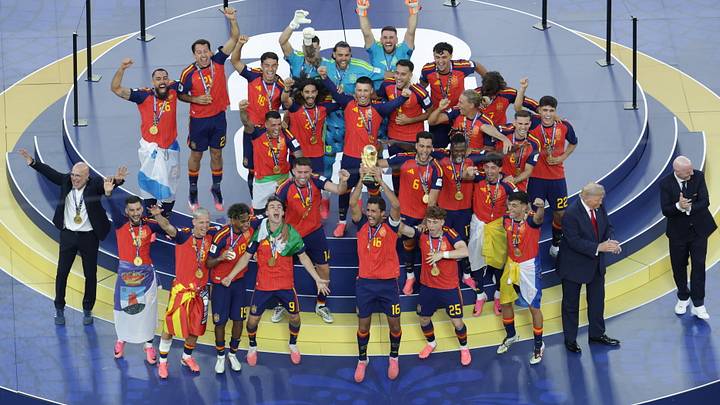
It’s a truism that history is written by the victors, but those that win also have a big say in what the future looks like. That is especially the case in soccer.
This is a sport which is constantly evolving. As the legendary Manchester United forward Denis Law used to say, “The only thing that has never changed in the history of the game is the shape of the ball.”
The inspiration for these evolutions invariably come from the most successful teams. Who better to imitate than the sides which do the thing everyone else is striving to achieve: Win. And there is no more glorious spotlight than the World Cup.
Spain serves as a very inviting global champion to aspire to. Luis de la Fuente’s side demonstrates a theoretically obvious style of play which has already been hailed by countless neutrals. Former German World Cup winner Toni Kroos was not alone in greeting Spain’s victory over Argentina with the conclusion, “Football won.”
But for the world’s clubs to copy what Spain has done this summer would be a desperately dangerous undertaking—especially if they have a muddled idea about what actually made the team world champion.
History’s Unflattering Copycats

As long as there has been the vague concept of tactics, there have been teams willing to copy those approaches and mangle them in the process.
Herbert Chapman is upheld as one of the first managers to ever bother with anything as prosaic as deciphering an organized strategy for success. While this approach with the likes of Huddersfield Town and Arsenal in the 1920s was initially disregarded as an outrageous eccentricity, it soon became apparent that the former munitions factory manager was onto something.
Among his many innovations, Chapman is most synonymous with establishing the WM formation at Arsenal. This setup, a 3-2-2-3 system instead of the ubiquitous 2-3-5, effectively introduced a third defender in place of one of the forwards.
As the Gunners embarked upon a trophy-laden spell in the 1930s, most teams followed Chapman’s example of adding an extra player at the back. Yet, without the tactical nuance of the gruff Yorkshireman or his appreciation for the qualities of the players at their disposal, this trend inspired a wave of largely negative soccer—for which Chapman was blamed. But Arsenal were anything but defensive. The change of system gave them more solid foundations, but the side that won the league in 1930–31 still scored 127 goals.

This pattern of failed copycats has played out across the subsequent decades. Even to this day, so many coaches try, first and foremost, to replicate the style which Pep Guardiola first installed at Barcelona in 2008. Incidentally, Spain’s last men’s world champion was one of them.
The World Cup winning manager from 2010, Vicente del Bosque, admitted that his side’s obsession with possession was “a simplification” of Guardiola’s complex approach. Nevertheless, the club game still tried to copy Spain.
Blackpool manager Ian Holloway made little secret of his ambitions following promotion to the Premier League in 2010: “After watching the World Cup, I’ve realized that we need to get more like Spain.” The Tangerines dutifully enjoyed a brilliant first half of the season, climbing as high as seventh and giving eventual champions Manchester United a chastening afternoon.
Passing the ball suddenly became a goal in and of itself.
When David Moyes replaced Sir Alex Ferguson at Manchester United, he made a point of flagging passing statistics. “He’d say, ‘Today I want us to have 600 passes in the game. Last week it was only 400,’” center back Rio Ferdinand recalled. “Who cares? I’d rather score five goals from 10 passes.”
Those concerns were justified. Blackpool’s system was built around one good passer, Charlie Adam, rather than a team full of them, like Spain. There were only three wins after Christmas as Blackpool were relegated. “The fat lady has finished singing and unfortunately I don’t like her tune,” Holloway sighed.
Guardiola was the fiercest critic of this international fascination. “I loathe all that passing for the sake of it, all that tiki-taka,” he would say. “It’s so much rubbish. I hate tiki-taka. Tiki-taka means passing the ball for the sake of it, with no clear intention, and it’s pointless.”
It could be easily missed, but this Spain team do not necessarily play tiki-taka.
Spain’s World Cup Success Is Not All Down to Passing
La Roja reign again. pic.twitter.com/mWvSmeKEOl
— Sports Illustrated FC (@SI_FootballClub) July 19, 2026
Passing is one part of Spain’s style, but the way De la Fuente’s team press the ball is far more important.
Türkiye, who went home in the group stage in tears fearing grand recriminations from a furious public, recorded a higher possession figure than the champion this summer. Spain’s best performance of the entire tournament, the most complete display from any team in fact, was against France in the semifinal. La Roja had just 51% possession that day.
Spain’s success is where these passes were played, not how many of them there were.
Rodri offered a succinct insight into his team’s strategy: “Stop them [the opposition] playing and bring the game to our terrain.” That terrain was as far away from Unai Simón’s goal as possible.
Spain had the highest defensive line of any team this summer, squeezing more than 46 meters up the pitch to keep the ball invariably out of its own half. Once the opposition had possession, it was wrestled back with a press which recorded a tournament-leading number of high turnovers.
If any club team is going to copy Spain, they should focus on what the world champion did without the ball rather than what it got up to with it. No team in the Premier League from last season, for example, can come close to Spain’s press intensity at the World Cup.

No New Solutions

For all of Spain’s abundant qualities, no one was reinventing the wheel in North America. If anything, De la Fuente was forced to adopt an inferior approach compared to the electric success of the 2024 European Championship because his best two players that summer, Lamine Yamal and Nico Williams, weren’t fully fit this time around.
Another downfall for any elite club side trying to copy Spain would be a failure to ignore its opponents. Uruguay, Austria, Portugal, Belgium and France all came onto the eventual champion. The one side which sat back in an organized block—the type of challenge which the vast majority of top domestic teams so regularly face—was Cabo Verde, who forced Spain into a goalless draw.
Argentina also sat back and took Spain to extra time. It was noticeable how much more dangerous La Roja looked when Williams came off the bench to dovetail so well with Yamal in the final. The Athletic Club winger had the ball in the net himself only to be denied by a soft foul before teeing up Ferran Torres’s winner.
“At one time it was all about possession,” legendary manager Carlo Ancelotti once mused, “with all the analysts concentrating upon that. Why? Because it was something they could measure.
“But as Albert Einstein said: ‘Not everything that can be counted counts, and not everything that counts can be counted. ’Possession alone doesn’t win the game.” It’s crucial that clubs remember that lesson.
READ THE LATEST WORLD CUP NEWS, ANALYSIS AND INSIGHT FROM SI FC
 Add us as a preferred source on Google
Grey Whitebloom is an Associate Editor for SI FC. He has more than half a decade of experience in sports media across all its various guises, from the fast-paced demands of news articles and match reports to in-depth research required for features. Whitebloom graduated with a First Class Honours from University College London and found himself named on the Dean’s List—which, despite his initial fears, was a form of praise rather than a punishment. He specialises in the Premier League and Champions League, while also boasting an extensive track record of La Liga coverage.