%20%20--%3E%0A%3Csvg%20version%3D%221.1%22%20id%3D%22Layer_1%22%20xmlns%3D%22http%3A%2F%2Fwww.w3.org%2F2000%2Fsvg%22%20xmlns%3Axlink%3D%22http%3A%2F%2Fwww.w3.org%2F1999%2Fxlink%22%20x%3D%220px%22%20y%3D%220px%22%0A%09%20width%3D%2239px%22%20height%3D%2240px%22%20viewBox%3D%220%200%2039%2040%22%20enable-background%3D%22new%200%200%2039%2040%22%20xml%3Aspace%3D%22preserve%22%3E%0A%3Cpath%20fill%3D%22%23FFFFFF%22%20d%3D%22M38.5%2C7H28.2v26h10.3V7z%22%2F%3E%0A%3Cpath%20fill-rule%3D%22evenodd%22%20clip-rule%3D%22evenodd%22%20fill%3D%22%23FFFFFF%22%20d%3D%22M26.1%2C25.5c0%2C5.8-4.1%2C7.5-12.9%2C7.5C3.9%2C33%2C0%2C31.2%2C0%2C25.2v-1.1h11.6%0A%09v2.4c0%2C0.7%2C0.1%2C1.4%2C1.2%2C1.4c1%2C0%2C1.2-0.4%2C1.2-1.3v-0.9c0-1.6-0.9-1.6-3.5-2.2C2.2%2C21.7%2C0%2C19.7%2C0%2C15.3v-0.9C0%2C9.3%2C5.5%2C7%2C12.9%2C7%0A%09c10.2%2C0%2C12.8%2C2.6%2C12.8%2C7.4v1.8h-11v-2.9c0-0.6-0.4-1.1-1.2-1.1c-0.6%2C0-1.2%2C0.4-1.2%2C1.1v0.9c0%2C1.5%2C0.9%2C2%2C3.3%2C2.5%0A%09c8%2C1.6%2C10.5%2C3.3%2C10.5%2C7.5V25.5z%22%2F%3E%0A%3C%2Fsvg%3E%0A)
A Victory 16 Years in the Making: Mexico Rediscovers Its ‘Unconditional’ Support
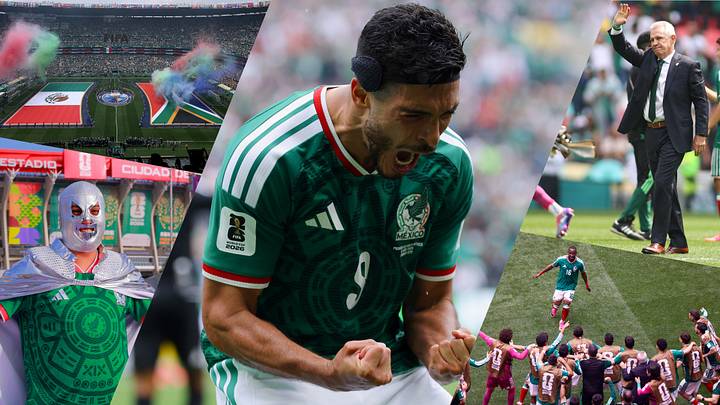
MEXICO CITY — Less than 10 minutes into the 2026 World Cup, more than 80,000 souls inside the Estadio Azteca began crying out the opening lines of “Cielito Lindo,” the unofficial anthem of the Mexico national team.
As if the song was supposed to trigger Mexico’s high press, Erik Lira pick-pocketed Sphephelo Sithole and Julián Quiñones pounced on the loose ball to score the opening goal of the 2026 World Cup. The roar of an ecstatic Azteca erupted before it could even finish singing Cielito Lindo’s chorus.
Fast forward to the second half and it was the introduction of Gilberto Mora—the youngest player in Mexico’s World Cup history—that electrified the Azteca again, with chants of “Mora, Mora!” now triggering a nice move down the right wing that culminated with Roberto Alvarado finding Raúl Jiménez at the back post for the legendary Mexican striker to finally, at 35 years old, score his first career World Cup goal on his first ever tournament start. Mexico’s advantage was doubled and Jiménez established himself as the joint-second greatest goalscorer in El Tri’s history.
That header sufficed for Mexico to defeat South Africa 2–0 in the opening game of the 2026 World Cup. It could’ve been more lopsided, it could’ve been prettier, it could’ve been better overall, but winning El Tri’s first ever World Cup curtain-raiser, at the eighth time of asking, was the primary mission of Javier Aguirre’s side.
El Tri will surely already be thinking about what comes next—South Korea in a week’s time. But it’s also important for Mexico and its fans to relish and savor the opening victory against South Africa. It’s one that was 16 years in the making.
El Tri’s Déjà Vu

On a day that symbolized the start of an unprecedented World Cup that will witness 48 nations battle for glory across three North American countries and 104 matches, the curtain-raiser had a unique sense of familiarity for the Mexico national team and its manager, Javier Aguirre.
Exactly 16 years ago, Aguirre was at the helm of El Tri when it tried to spoil an entire continent’s party as South Africa became the first African nation in history to host a World Cup. Immersed in a hostile environment half a world away, Aguirre combated the deafening and unmistakable sound of vuvuzelas as he barked out orders from the touchline trying to will Mexico past the Bafana Bafana and over 80,000 in attendance at the Soccer City Stadium.
Siphiwe Tshabalala’s majestic hit into the top corner and the celebrations that followed rightfully remain the everlasting memory of the opening match of the 2010 World Cup. Veteran goalkeeper Óscar Pérez was powerless to deny South Africa from taking the lead, but that didn’t stop Mexican supporters from growing increasingly angry at Aguirre’s controversial decision to bench a then 24-year-old shot-stopper by the name of Guillermo Ochoa.
Now 41, Ochoa was once again on Mexico’s bench as a backup in a World Cup opener against South Africa, taking part in his record-setting sixth World Cup and standing out as the lone representative from the 46 players that either played or where on the bench in the 2010 curtain-raiser. He was unknown outside of Mexico in 2010, he’s since become the nation’s most recognizable World Cup figure of all time thanks to iconic saves over the last three tournaments that force many to believe he could’ve stopped Tshabalala’s emblematic strike.
Much less remembered is the second goal that was scored that day. Mexico managed to respond and rescue a draw thanks to a late equalizer from the man that 16 years later stood alongside Aguirre singing the Mexican national anthem as his first assistant coach, the legendary Rafael Márquez.
Back then, Márquez was a 31-year-old less than a month removed from the last of 242 appearances he amassed during an incredibly successful six-season stint at Barcelona. That, along with the five different World Cup finals where he wore the armband for El Tri make him one of the two greatest Mexican players in history. Now taking the first steps of his managerial career, what he achieved during his playing days won’t be an acceptable excuse—as fellow Mexican all-time great Húgo Sánchez found out—when he takes over from Aguirre as Mexico’s manager following the World Cup.
Comparisons between the two curtain raisers 16 years apart are endless, but beyond that, Mexico beating South Africa couldn’t have happened at a better time.
An Excuse to Heal Wounds

From the moment the first ever rematch in an opening game of a World Cup was announced during last December’s tournament draw, an entire generation was flooded with memories of that morning in Mexico and afternoon in South Africa on June 11, 2010.
The feeling of pure unfiltered nostalgia invaded millions of El Tri fans ... and it’s perhaps the greatest thing that could’ve happened to Aguirre’s side.
Aguirre took over in the summer of 2024 obliged to rescue a sinking ship—again. Like prior to 2002 and 2010, El Tri needed a leader that could steer them towards an acceptable World Cup performance at least and glory at best. Twice before, Aguirre corrected course and led Mexico to its historical ceiling in the round of 16, but never managed to help El Tri progress to the infamous "Quinto Partido” (the fifth game), which previously meant reaching the World Cup quarterfinals.
Mexico reached the last 16 in seven consecutive World Cups until a humbling group stage elimination last time out in Qatar 2022. El Tri sunk to a 30-year low, and another group stage exit in the Copa América two years later forced Mexico to use its break-in-case-of-emergency plan. Fourteen years and 12 managers later, Aguirre returned for his third stint.
But by the time Aguirre was back, fan discontent towards El Tri was at an all-time high. Even after winning two Concacaf titles in 2025 there was still friendly fire directed Mexico’s way. Then came the World Cup group stage draw result, and the nostalgia of turning back the clock to 2010 captivated Mexico as a nation. The past is always a wonderful place to visit, and Mexico was given the perfect excuse to rekindle the fire of hopes and dreams previously left behind.
A run of strong results in the lead up to the 2026 World Cup added fuel to the fire and suddenly, the talk in Mexico stopped revolving around the possibility of another group stage exit and was replaced by the likelihood of El Tri beating England in a potential last 16 matchup to finally make the quarterfinals.
El Tri was surging, its fans were starting to believe again. All that was left to do was crown the positive momentum by 16 years later finally beating South Africa in the opening game of the World Cup.
The Perfect Outcome

The sun hadn’t even risen and the streets near the Estadio Azteca resembled green colored streams as waves of El Tri fans marched towards the soccer temple located deep in the southern part of Mexico City. By the time the clock hit 8 a.m., five hours prior to the start of the game, the area surrounding the stadium was as packed as the streets near the Mexico City center, where the ancient civilization the only three-time World Cup host stadium in history owes its name to once thrived.
By the time 10:30 a.m. hit, the disperse green colored streams were no more, they had morphed into a sea of green inside the imposing Azteca. Chants of “Mexico! Mexico!” began echoing within the stadium walls even before the players had arrived. Gone were the days of Mexico needing to sell two-for-one tickets to fill stadiums, El Tri was back to being the most expensive show in town.
Arguably a step below the eruption of players such as Quiñones, Brian Gutiérrez, Álvaro Fidalgo, Mora and Lira during Aguirre’s tenure and particularly since the turn of the year, is the fact that Mexico found a way to recover the “unconditional”—as they are officially nicknamed—support of a fanbase that had fallen completely out of love with the national team.
It’s not even been a year since fans in Torreón, Mexico whistled and insulted Aguirre and El Tri players in a friendly against Uruguay. The hostilities prompted Jiménez and Edson Álvarez to publicly criticize the home support, with the former even stating that “that’s why they always take us [to play] in the United States.”
Now, Jiménez was moved to tears after scoring Mexico’s second, which he dedicated to his late father, and the Azteca serenaded his name like it did so many times over a decade ago when he burst into the scene for Club América.
Raúl Jiménez, you deserve it all. https://t.co/zdAM03gsD6 pic.twitter.com/xnIg6Uv1pI
— Sports Illustrated FC (@SI_FootballClub) June 11, 2026
Later in the match, the nearly 100,000 people in attendance at the Azteca were finally able to sing "Cielito Lindo” without any interruptions. It was a more emotional rendition than usual, as if it was a cathartic moment that had been suppressed for far too long.
The same can be said about the prematch rendition of the Mexican national anthem, that moved players—namely Armando González—and fans alike to tears. This set the scene and empowered a rocking crowd that chanted the classic "Olé, Olé” with every pass even before the one-minute mark. Less than four minutes in, though, whistles, groans and two very vivid screams asking "what are you doing, you son of a b---,” took over when Brian Gutiérrez hit a free-kick directly at the wall.
That’s the perfect description of El Tri’s “unconditional” fanbase, it lives in the margins, toeing a fine line between the need to burn it all to the ground and the need to celebrate there’s still something worth burning it all down for.
When the final whistle blew, the Azteca as a whole exhaled before it let out one final roar, one that Mexico denied its “unconditionals” 16 years ago. The win all but guarantees Mexico’s place in the knockout rounds of the World Cup, with the expanded 48-team field leading to the creation of the round of 32, where the best eight third-placed finishers from all 11 groups will also qualify.
But perhaps what’s more important is that on June 11, 2026, exactly 5,844 days since that 1–1 draw in Johannesburg, Aguirre and El Tri finally righted their wrongs and convincingly defeated South Africa, closing the chapter on a roller coaster period in the perfect way possible, with more than 80,000 of it’s passionate supporters signing as one, "Sing and don’t cry, because sing, Cielito Lindo, makes the hearts happy.”
READ THE LATEST WORLD CUP NEWS, ANALYSIS AND INSIGHT FROM SI FC
 Add us as a preferred source on Google
Roberto Casillas is a writer for SI FC, focusing primarily on FC Barcelona, the Mexico National Team, Liga MX and all things Latin American football. Born and raised in Mexico City, he developed a deep passion for football from an early age and fell in love with Cruz Azul. The once future star of Mexican football still likes to showcase what’s left of his talent on the Sunday league pitch. He’s also a big fan of the New England Patriots—so much so he moved to the region for four years—, Chicago Cubs and is a life-long Formula 1 follower. When he takes a break from sports, he enjoys traveling the world, watching the latest great TV show, going to concerts and spending plenty of time with friends and family.