%20%20--%3E%0A%3Csvg%20version%3D%221.1%22%20id%3D%22Layer_1%22%20xmlns%3D%22http%3A%2F%2Fwww.w3.org%2F2000%2Fsvg%22%20xmlns%3Axlink%3D%22http%3A%2F%2Fwww.w3.org%2F1999%2Fxlink%22%20x%3D%220px%22%20y%3D%220px%22%0A%09%20width%3D%2239px%22%20height%3D%2240px%22%20viewBox%3D%220%200%2039%2040%22%20enable-background%3D%22new%200%200%2039%2040%22%20xml%3Aspace%3D%22preserve%22%3E%0A%3Cpath%20fill%3D%22%23FFFFFF%22%20d%3D%22M38.5%2C7H28.2v26h10.3V7z%22%2F%3E%0A%3Cpath%20fill-rule%3D%22evenodd%22%20clip-rule%3D%22evenodd%22%20fill%3D%22%23FFFFFF%22%20d%3D%22M26.1%2C25.5c0%2C5.8-4.1%2C7.5-12.9%2C7.5C3.9%2C33%2C0%2C31.2%2C0%2C25.2v-1.1h11.6%0A%09v2.4c0%2C0.7%2C0.1%2C1.4%2C1.2%2C1.4c1%2C0%2C1.2-0.4%2C1.2-1.3v-0.9c0-1.6-0.9-1.6-3.5-2.2C2.2%2C21.7%2C0%2C19.7%2C0%2C15.3v-0.9C0%2C9.3%2C5.5%2C7%2C12.9%2C7%0A%09c10.2%2C0%2C12.8%2C2.6%2C12.8%2C7.4v1.8h-11v-2.9c0-0.6-0.4-1.1-1.2-1.1c-0.6%2C0-1.2%2C0.4-1.2%2C1.1v0.9c0%2C1.5%2C0.9%2C2%2C3.3%2C2.5%0A%09c8%2C1.6%2C10.5%2C3.3%2C10.5%2C7.5V25.5z%22%2F%3E%0A%3C%2Fsvg%3E%0A)
What Rodrygo’s Devastating Injury Means for Real Madrid, Brazil and Himself
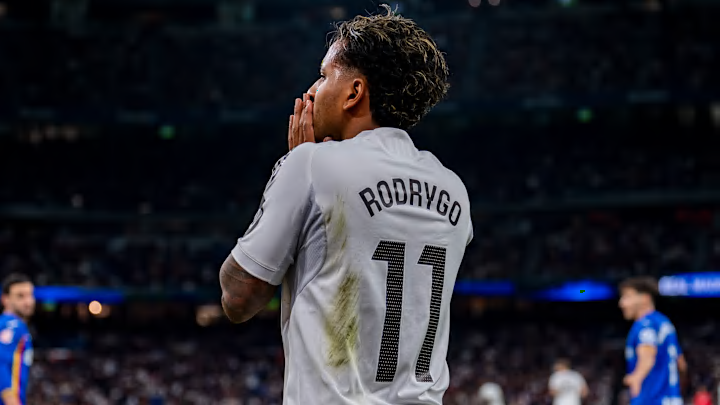
“Locked in,” Rodrygo wrote on social media last week, “and ready for a lot of chaos.” It would prove to be one of his more painfully prophetic captions.
Real Madrid’s Brazilian forward came off the bench for the final 35 minutes of Monday’s 1–0 defeat to Getafe in an attempt to offer the attacking spark which his teammates had lacked. Unfortunately, he only succeeded in lighting the rest of his season, if not the remainder of 2026, on fire.
The club confirmed the following day that Rodrygo had torn his anterior cruciate ligament (ACL) and lateral meniscus in the same right knee. A generous timeline would have the 25-year-old back on the pitch in nine months, ruling him out for the current campaign’s run-in and the entire 2026 World Cup with Brazil.
After suffering through plenty of heartache over the past 12 months, Rodrygo now faces the toughtest challenge of his career.
Real Madrid Robbed of ‘Fundamental Option’

“Rodrygo must be very important,” Álvaro Arbeloa declared ahead of his side’s clash with Getafe, billing the returning forward as “fundamental and decisive.”
“On the right wing, on the left, or through the middle—in all three attacking positions he gives us quality, vision, and presence in the box,” Madrid’s coach gushed. “He’s a very complete player, very difficult to defend.”
For much of the season, Rodrygo’s performances have not warranted that lofty praise. An insistence on only playing out wide in the left limited his opportunities under Xabi Alonso, who continued to favor Vinicius Junior for that position despite a clash of personalities. Rodrygo seemingly dropped that preference in December and swiftly rediscovered his best form. Across his last six starts for Madrid, the versatile winger had racked up three goals and as many assists.
With Kylian Mbappé’s uncertain fitness already a red flashing light for the capital club, Arbeloa has been robbed of another attacking option. This puts more onus on Franco Mastantuono—who promptly got himself sent off on Monday night for dissent—and may force Federico Valverde into a position wide on the right. Brahim Díaz is more of a natural winger, yet successive Real Madrid managers have now shown little faith in the Morocco international, who boasts a grand total of three league starts this term.
Given the severity of Rodrygo’s injury, Madrid may be inclined to supplement his lost output in the summer transfer window. Nico Paz already has one foot through the door but is far more of a central creator rather than an option out wide.
Brazil’s Attack Forced Into World Cup Reshuffle

There were concerns at the start of the season that Rodrygo may not be a part of Brazil’s World Cup roster even if he were fit. Carlo Ancelotti had stopped picking him for Madrid before taking over the Seleção and then promptly left the fleet-footed forward out of his squad for the September international break. Those fears were short lived.
“He’s a very important player for the national team, he has very important technical characteristics, he can play in all positions,” Ancelotti beamed after recalling Rodrygo for October’s friendlies. “So, I believe he can add a lot to the team.”
That stance was rapidly justified with a brace from Rodrygo against South Korea. Ancelotti, the ultimate Galáctico whisperer, had begun to settle on a roving four-man frontline of Rodrygo, Vinicius Junior, Matheus Cunha and Estêvão, with the flexible quartet given licence to rotate in yellow whirl.
Now Ancelotti has lost a tip from that four-pronged attack. Rodrygo’s absence presents the Italian coach with a choice: find a direct replacement with the same unique versatility or completely retool his attack three months out from the tournament. The latter may have been necessary anyway.
For all Brazil’s association with free-spirited, fun loving soccer, the modern game is not conducive to this approach, particularly at international level. Didier Deschamps’s France have reached consecutive World Cup finals by focusing more on defensive solidity than the array of attacking talent at their disposal; this was the same model blatantly copied by Sir Gareth Southgate as England went to back-to-back European Championship showpieces.
Rather than leave Casemiro and Bruno Guimarães drowning in a two-man midfield island, Ancelotti may be advised to bolster that central area of the pitch with someone a bit more defensively savvy than Rodrygo. Relying upon the accomplished creative triumvirate of Vinicius Jr, Cunha and Estêvão going forward is not going to inspire many violins.
Rodrygo Faces Another Mental Challenge

Real Madrid and the Brazil national team are two hulking establishments with swollen rivers of resources perfectly set up to deal with this sort of surprise absence. The most pressing concern should be the well-being of a 25-year-old man whose world has been turned upside down.
Since moving to Spain in 2019, Rodrygo has only been sidelined for more than a handful of successive matches once—and that hamstring injury at the end of 2020 lasted a little over two months. He now faces an absence of potentially five times that magnitude at a time when his career was already at a delicate point.
After an indifferent end to the 2024–25 campaign, Rodrygo spent the summer constantly linked with a move away from Real Madrid. The club were thought to be open to such a transaction, with the likes of Manchester City very much interested, yet it was the player who pushed to stay at the club he always dreamed of playing for.
“The truth is, I had a very difficult time on a personal level,” Rodrygo revealed to AS back in October, reflecting on those summer months. “I went a long time without speaking to anyone. No one knew what I was going through. It was a very difficult time. I wasn’t well, either physically or mentally. That was really hard for me.
“First God, then my family... and Coach Ancelotti helped me get through all that,” he reflected. “Carlo helped me a lot. He saw every day that I wasn’t well, that I wasn’t fit to play, that I couldn’t help the team. But there was no time to recover because we played every three days, and then you can’t stop to solve the problem. He saw that I’m a person and I had real problems.”
It got worse before it got better. Rodrygo’s wait for a Real Madrid goal stretched to 32 consecutive appearances by the start of December, the longest drought recorded by any forward in the club’s entire 123-year history.
The Brazilian mercifully ended his wait against a fitting opponent, Manchester City, in the Champions League’s league phase after a return to the right wing role he had shunned for much of the campaign.
That chastening experience changed Rodrygo. “It’s true that I’m a completely different person now,” he observed. “I’ve come out of it with a different mindset, a different enthusiasm, more mature.” He’ll need all of those lessons and more to overcome another daunting challenge.
READ THE LATEST SOCCER NEWS, ANALYSIS AND INSIGHT FROM SI FC
 Add us as a preferred source on Google
Grey Whitebloom is an Associate Editor for SI FC. He has more than half a decade of experience in sports media across all its various guises, from the fast-paced demands of news articles and match reports to in-depth research required for features. Whitebloom graduated with a First Class Honours from University College London and found himself named on the Dean’s List—which, despite his initial fears, was a form of praise rather than a punishment. He specialises in the Premier League and Champions League, while also boasting an extensive track record of La Liga coverage.