%20%20--%3E%0A%3Csvg%20version%3D%221.1%22%20id%3D%22Layer_1%22%20xmlns%3D%22http%3A%2F%2Fwww.w3.org%2F2000%2Fsvg%22%20xmlns%3Axlink%3D%22http%3A%2F%2Fwww.w3.org%2F1999%2Fxlink%22%20x%3D%220px%22%20y%3D%220px%22%0A%09%20width%3D%2239px%22%20height%3D%2240px%22%20viewBox%3D%220%200%2039%2040%22%20enable-background%3D%22new%200%200%2039%2040%22%20xml%3Aspace%3D%22preserve%22%3E%0A%3Cpath%20fill%3D%22%23FFFFFF%22%20d%3D%22M38.5%2C7H28.2v26h10.3V7z%22%2F%3E%0A%3Cpath%20fill-rule%3D%22evenodd%22%20clip-rule%3D%22evenodd%22%20fill%3D%22%23FFFFFF%22%20d%3D%22M26.1%2C25.5c0%2C5.8-4.1%2C7.5-12.9%2C7.5C3.9%2C33%2C0%2C31.2%2C0%2C25.2v-1.1h11.6%0A%09v2.4c0%2C0.7%2C0.1%2C1.4%2C1.2%2C1.4c1%2C0%2C1.2-0.4%2C1.2-1.3v-0.9c0-1.6-0.9-1.6-3.5-2.2C2.2%2C21.7%2C0%2C19.7%2C0%2C15.3v-0.9C0%2C9.3%2C5.5%2C7%2C12.9%2C7%0A%09c10.2%2C0%2C12.8%2C2.6%2C12.8%2C7.4v1.8h-11v-2.9c0-0.6-0.4-1.1-1.2-1.1c-0.6%2C0-1.2%2C0.4-1.2%2C1.1v0.9c0%2C1.5%2C0.9%2C2%2C3.3%2C2.5%0A%09c8%2C1.6%2C10.5%2C3.3%2C10.5%2C7.5V25.5z%22%2F%3E%0A%3C%2Fsvg%3E%0A)
Why Gabriel Wasn’t Sent Off for Violent Clash With Erling Haaland
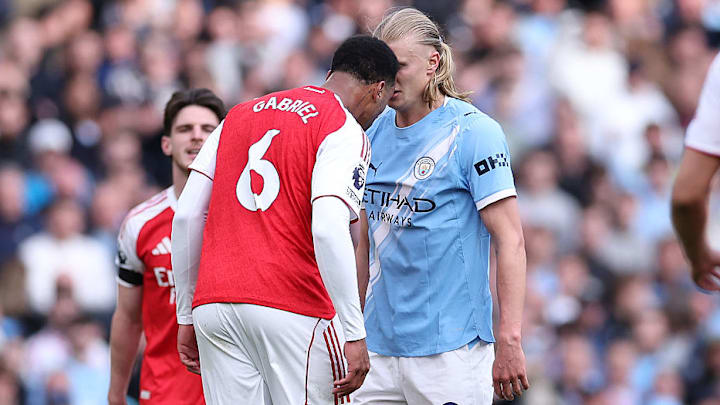
Arsenal defender Gabriel avoided a red card for his physical confrontation with Erling Haaland during Sunday’s defeat to Manchester City because his conduct was deemed not aggressive enough.
Having battled against each other for every inch all match, a flashpoint towards the end of the contest saw both Gabriel and Haaland lock horns after yet another aerial tangle.
Forehead to forehead, the Arsenal center back pushed forward with his. Haaland didn’t really react, which may have saved his opponent from being dismissed as things threatened to get out of control. Referee Anthony Taylor quickly brandished a yellow card at both players, although there was some surprise as to why Gabriel was given the same punishment, having been the clear aggressor.
The incident was reviewed by the VAR official on duty and the match moved on without intervention.
The Premier League’s Match Center gave the following update as to why no additional action was taken: “The referee’s call of no red card was checked and confirmed by VAR—with the action from Gabriel deemed not to be excessively aggressive or violent.”
Haaland Praised Over Gabriel Confrontation

The sight of soccer players feigning injury to try and get opponents punished is too familiar, so the fact that Haaland didn’t do that when Gabriel clearly pushed his head forward was sort of refreshing. Still, players shouldn’t have to be hurt for a referee to take action against bad conduct—on this occasion the violent intent was still clearly there from the Arsenal man.
That Gabriel stayed on the pitch after the incident surprised plenty.
“I can’t believe that that’s not a red,” said Gary Neville in disbelief during live Sky Sports commentary. “I think Gabriel can thank Haaland for not reacting.”
Haaland later said he didn’t feel enough contact to “fall on the floor.”
Speaking to Sky Sports, the City striker admitted he could have made more to get Gabriel punished.
“I think if I fell on the floor, which I will not do unless someone really attacks me, it will maybe be a red card. I’m not sure,” Haaland said. “But it is what it is, I will not fall on the floor. Yellow card for me, I’m not sure why, he comes up to my face. But it is what it is.”
Discussing the wider match-long battle between them, he added “I think it’s always like this, a lot of fighting and things like this. It’s up to others to decide if I won that battle or not. I scored the goal so I won the battle in that moment, it was a great goal, it was a decisive moment and we win.”
What Is the Impact of Gabriel Not Getting a Red Card?

By avoiding a red card during the match, Gabriel has also avoided the three-match suspension that is automatically applied to violent conduct situations.
The Brazilian cannot be retrospectively banned by the FA either, because the original incident was handled in the moment. The FA only has those powers if something is missed by both the on-field officials and the VAR. In other words, the incident cannot be re-refereed now the match is over.
It’s significant because perhaps Gabriel ought to have been banned for three of Arsenal’s final five Premier League games of the season—against Newcastle United, Fulham and West Ham United.
Even though Manchester City have all but erased Arsenal’s lead, the title is hypothetically still the Gunners’ to win. To have lost Gabriel to suspension at this stage, when center back partner William Saliba is already playing with a lingering ankle injury, could have been disastrous.
We might think back to this moment if Arsenal do go on to win the title, ending their 22-year drought, and Gabriel has played a big part across the final five weeks.
READ THE LATEST PREMIER LEAGUE NEWS, ANALYSIS AND INSIGHT FROM SI FC
 Add us as a preferred source on Google
Jamie Spencer is a writer and editor for SI FC. Jamie grew up in Manchester, England, in the 1990s and fell in love with the game at the same time as the Premier League was taking off. With more than a decade of experience behind him in sports media, he specializes in Manchester United and the overall Premier League, still living in England’s north-west soccer hotbed. Jamie is also an expert on the women’s game and enjoys old school nostalgia, telling stories from soccer’s rich history and culture.