%20%20--%3E%0A%3Csvg%20version%3D%221.1%22%20id%3D%22Layer_1%22%20xmlns%3D%22http%3A%2F%2Fwww.w3.org%2F2000%2Fsvg%22%20xmlns%3Axlink%3D%22http%3A%2F%2Fwww.w3.org%2F1999%2Fxlink%22%20x%3D%220px%22%20y%3D%220px%22%0A%09%20width%3D%2239px%22%20height%3D%2240px%22%20viewBox%3D%220%200%2039%2040%22%20enable-background%3D%22new%200%200%2039%2040%22%20xml%3Aspace%3D%22preserve%22%3E%0A%3Cpath%20fill%3D%22%23FFFFFF%22%20d%3D%22M38.5%2C7H28.2v26h10.3V7z%22%2F%3E%0A%3Cpath%20fill-rule%3D%22evenodd%22%20clip-rule%3D%22evenodd%22%20fill%3D%22%23FFFFFF%22%20d%3D%22M26.1%2C25.5c0%2C5.8-4.1%2C7.5-12.9%2C7.5C3.9%2C33%2C0%2C31.2%2C0%2C25.2v-1.1h11.6%0A%09v2.4c0%2C0.7%2C0.1%2C1.4%2C1.2%2C1.4c1%2C0%2C1.2-0.4%2C1.2-1.3v-0.9c0-1.6-0.9-1.6-3.5-2.2C2.2%2C21.7%2C0%2C19.7%2C0%2C15.3v-0.9C0%2C9.3%2C5.5%2C7%2C12.9%2C7%0A%09c10.2%2C0%2C12.8%2C2.6%2C12.8%2C7.4v1.8h-11v-2.9c0-0.6-0.4-1.1-1.2-1.1c-0.6%2C0-1.2%2C0.4-1.2%2C1.1v0.9c0%2C1.5%2C0.9%2C2%2C3.3%2C2.5%0A%09c8%2C1.6%2C10.5%2C3.3%2C10.5%2C7.5V25.5z%22%2F%3E%0A%3C%2Fsvg%3E%0A)
50 Parting Thoughts From the 2026 U.S. Open
Emptying out the notebook from the 2026 U.S. Open.
• First, a reminder that if you want columns delivered to your inbox directly, DM me.
• The Served podcast’s full U.S. Open recap will be up on Tuesday.
• Icky self-promotion: preorder this Rafael Nadal collab here.
1. Alexander Zverev thwarted both Ben Shelton and history in Sunday’s men’s final to win the 2026 U.S. Open men’s title. Andy Roddick, to his dismay, remains the last American champion at a major. Meanwhile, three months ago, Zverev was the best player in tennis history to have never won a major. He’s now won two of the past three—with a Wimbledon final sandwiched between—and is the de facto men’s tennis MVP for 2026.
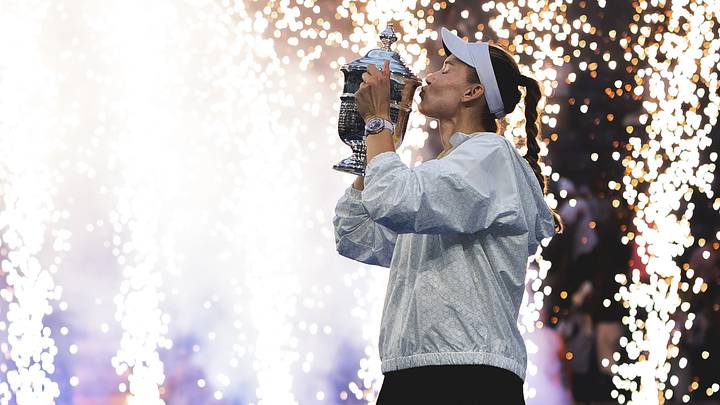
2. Elena Rybakina may not play the look-at-me game. Her corners may be a bit sharp. But wow, she’s a fine tennis player—so much easy power—and a worthy No. 1.
3. Shelton did not reverse the curse and, in his first major final, couldn’t quite summon his best tennis to topple Zverev. But after beating Carlos Alcaraz in a spellbinding witching-hour quarterfinal, resetting to beat Frances Tiafoe in the semifinals and gaining experience Sunday, Shelton leaves with his head high and his ranking (No. 4) the highest it’s been.
4. Aryna Sabalenka did her usual two-week residency in New York. She has advanced to the past four U.S. Open finals and won twice. What a generational player, but for the fifth time in nine major finals, she lost a three-setter she could have (should have?) won. Her run of 99 weeks at No. 1 now ends. Her year featured no major titles for the first time since 2022. She smashed her racket after match point on Saturday, and it made for an apt gesture for a frustrating year.
5. Alcaraz did not defend his title in New York, losing to Shelton in a match that rewarded the insomniacs with its quality and drama. But for a guy playing in his first event since April, recovering from a concerning wrist injury, Alcaraz could consider this tournament a win. I’m told an hour or so after the match, Craig Tiley and other tournament personnel went into the locker room to check on him. It was 4:30 a.m. ET. Alcaraz popped up, wearing a smile, and said, “Thank you for the stage.” As he left, he thanked all the remaining personnel. As one of you noted, “The guy handles a loss better than most people handle a grocery store queue”
6. Tiafoe, again, reached the semifinals, making good on his annual guarantee to elevate for the U.S. Open. He had few answers for Shelton but left New York proud, having improved much of his game, including his on-court decision making. But his best impromptu, instinctive move this tournament? Him hugging Alex Michelsen after their dramatic quarterfinal and then squeezing tighter when Michelsen began sobbing? It was almost unendurably touching and said more about Tiafoe than any press release of agent-crafted imaging.
FOE-NOMENAL 🇺🇸
— US Open Tennis (@usopen) September 8, 2026
From two sets and a break down, and then a break down in the fifth, Frances Tiafoe defeats Michelsen 5-7, 3-6, 7-5, 6-3, 7-6! pic.twitter.com/8PMMeQ0ETh
7. It was a bit of a strange event for Coco Gauff. In the eyes of many, she entered as the favorite, especially coming off her play at Wimbledon and in Cincinnati. She didn’t fulfill those expectations, but she played to her seeding, won some battles and took a set from Rybakina in the semifinals before retreating a bit in the third set. It was a slightly disappointing campaign—in the sense that she didn’t win; such is the standard—but no crisis, and no real sting. Her disposition after the loss reflected that.
8. The U.S. drought is over! An American wins! In a wild boys’ final, Marcel Latak saved, squandered, and eventually beat top seed Guto Miguel of Brazil to become the first American to win the event since Taylor Fritz in 2015. Inexplicably, the USTA scheduled the boys’ and girls’ final simultaneously. On the girls’ side, in a rematch of the Wimbledon final, Sun Xinran defeated Anna Pushkareva in the final, 6–4, 4–6, 6–0 to take the title. Colette Lewis has you covered, as ever.
9. Jessica Pegula may or may not win that elusive major—for the third consecutive U.S. Open she lost to a smoldering Sabalenka in the semifinals—but she is so admirable on so many levels. A stat that says a lot about Pegula: She failed to qualify for 12 majors before hitting her stride in her mid-20s. It’s hard to say a player deserves to win a major, but if she, say, pulled a Madison Keys and went on a heater in Australia, I can’t imagine a title going over better in the locker rooms and in the back corridors.
10. Taylor Townsend and Katerina Siniaková completed the Career Slam together, taking the women’s doubles title (their combined ranking: No. 3). In a three-set final, they beat American wild cards Robin Montgomery and Ashlyn Krueger (combined doubles ranking: No. 113). We’ll start banging the drum now: Siniaková is a Hall of Famer.
11. In men’s doubles, six of the top eight men’s teams made the quarterfinals. In the end, American Christian Harrison and his British partner Neal Skupski won their second major, defeating Germany’s Kevin Krawietz and Tim Puetz 6–4, 7–6 in the U.S. Open final on Saturday.
12. Three favorite images of this event: Michelsen losing a five-setter to Tiafoe and burying his head on his opponent’s shoulder. Alcaraz losing in a fifth-set tiebreak at 3:33 a.m. ET and leaving the court smiling, wearing an expression of, Shucks, I wish I had won; but it was fun to be a part of that. Qinwen Zheng seeing her team after a quarterfinal loss and both crying and laughing, the perfect encapsulation of a bittersweet result. She made the jump from qualifier to quarterfinalist, but then failed to close it out.
13. I had the good fortune of spending some time with various wheelchair players, particularly Tokito Oda, the most dominant player in tennis … until Saturday when—in the upset of the tournament?—Britain’s Alfie Hewett beat Oda, 6–0, 7–6. Hewitt also won the doubles title alongside fellow Briton Gordon Reid on Friday. On the other side of the ledger, for Japan, Yui Kamiji pulled the summer double, defeating No. 2 seed Diede de Groot of the Netherlands 6–2, 1–6, 6–3.
14. Who’s old enough to remember the mixed doubles event? Held again the week before singles play commenced, it featured various stars (and doubles regulars) in a shortened format. Karolina Muchová and Jakub Menšík—neither of whom did much in the singles, make of that what you will—took the title, which was nice because it has been a while since Czech players had tasted sweet success at a major. The new format might enrage the purists, but they are a minority (not even a particularly vocal one). Every major should be thinking like this.
15. There were some winners and some unforced errors, but it’s hard not to consider the first Craig Tiley Era U.S. Open a success. It was a three-week lollapalooza with record attendance, and surely, record revenues. There were a lot of complaints, but many came from the “It’s too crowded, and no one goes there anymore” camp.
16. Predictably, it became less of an issue as the tournament progressed, but the affordability/inaccessibility issue should not go unacknowledged. Thanks to many of you for your private messages.
A few points: A) It’s complicated, especially given New York’s lax scalping/reselling laws. B) It’s totally within the USTA’s power to do more and put more restrictions on Ticketmaster, if the political will exists. C) The USTA, to its credit, was already thinking during this tournament about how to improve this in 2027 and floated a few ideas by me.
17. What do we do about these late finishes and the unserious optics of play ending at 3:33 a.m. local time? In an age of self-driving cabs and personalized cancer vaccines, we should be able to solve this riddle. Three ideas: Start the Arthur Ashe Stadium night session earlier, say, 6:00 p.m. ET. (There were two day matches that often ended hours before the night session.) Play one match, à la Roland Garros, and pray no one gets hurt, but have a doubles match on hand to fill out the session. Jim Courier had the intriguing idea to move to no-ad scoring. He rightly points out that the points aren’t the extender; the multi-deuce games are.
18. Alexandra Eala did herself proud in a knock-down, drag-out battle against her friend Iva Jovic. She then stayed in New York for a week, practicing on-site, getting treatment and hanging out with friends like Eva Lys. Next month, you can catch her representing the Philippines at the Asian Games. On Dec. 8, she will play Janice Tjen in a Manila exhibition that could break the Roger Federer–Rafael Nadal record (51,954) for most fans to see a live match. Careers are long and sinuous. But now, there are literally zero reasons not to enjoy this story.
19. Matthew Futterman has a new tennis book, The Cruelest Game (order it here), and the U.S. Open validated the concept. Keys saved match point in one match and blew it in her next outing. Fritz cruised into the second week—a fair bet to win the event—until he lost a 2–0 sets lead in the third round and crashed hard. Michelsen was up two sets and a break … and collapsed into the arms of his opponent. Arthur Gea, getting in as a lucky loser, won three matches (and nearly $500,000) only to blow a lead in the quarterfinals and depart with bittersweet emotions. All but one of the 128 players in the draw will leave New York on a losing streak? Cruel is putting it charitably.
20. I feel like I’m obligated to mention the influencers, though, truthfully, I don’t have strong opinions. Rule 1: Respect the sport and the players. Abide by that? Tennis should be able to accommodate the ring-light brigade, no matter how cringe they may be. I posed this question on X, and the responses were immensely helpful. What does the U.S. Open get out of this? The influencers/creators get their clout and show off their brands. Hey, look at me! Validate me! I was at this cultural event! I know players! But the event? The event has sold its tickets and sponsorships, and everyone knows about Honey Deuces and trucker caps. Apart from feeding the algorithm and tennis breaching the mainstream feed—and maybe that’s enough—what’s the point? Wouldn’t this be better suited for lesser events and tournaments that really need the bump? Do this for Charleston and Dallas, not the event that already draws Taylor Swift and President Donald Trump. For all that plagues tennis and this event—starting, for instance, with the inaccessibility, unaffordability and the capitulation to Ticketmaster or the Kalshi stain (see below)—an army of influencers ranks low on my list.
21. Learner Tien and Michelsen are friends, fellow Orange County natives, born barely a year apart, and they have already played each other five times. More symmetry: On successive days, they lost heartbreaking five-setters. Both losses will sting. Both players, with some detachment, should be thrilled by their progress. Speaking of short-term sting and long-term satisfaction …
22. Quite unexpectedly, Linda Nosková won the previous major, Wimbledon. Isn’t that supposed to turn your life upside down and change everything? Nosková backed up her breakthrough with a thoroughly impressive U.S. Open, winning four rounds and nearly taking out the two-time defending champion in a quarterfinal that ended 7–6 in the third set. (And the next person to speak ill of Nosková will be the first.)

23. Two things can be true at once. The Williams sisters are titans not just of this sport, but of all sports, and their remarkable story and achievements will echo for generations. They are not beyond criticism, either. Their comeback and longevity inspire; two champions still out there at a combined age of 90. And it’s a pity it hasn’t come accompanied by more joy and grace. Closed practices. Uncommon demands made on tournaments. As you likely know, after losing in the first round of doubles, the Williams sisters, again, chose not to fulfill their media obligations. It’s easy to disrespect the media, and it’s particularly in vogue these days. But this is also a show of disrespect to the tournament (a tournament that, like Wimbledon, gave the sisters wild cards). It’s a show of disrespect to the other players (all of whom endured press conferences, even under brutal circumstances). And, ultimately, it’s disrespectful to the fans, who might dunk on the media, but devour the content and want uncurated, unscripted independent exchanges. Grinning behind clenched teeth, the USTA declined to fine Venus and Serena, though this is standard operating procedure. Look, the haters are going to hate, no matter what. The lovers will defend, no matter what. The middle, reasonable 70% of us—too often ceding ground to the yellers on the algorithmically-advantaged margins—will realize that people are complicated. But rules are rules. Bad behavior is bad behavior. The USTA, it appears, disagrees, but breaches should be acknowledged—especially, not except—when committed by the powerful.
24. I had a friend joke that players should be forced to play the first set of their matches in the same attire they walked onto the court in. This was a nod to Fritz and his smoking jacket and Naomi Osaka in her Allen Iverson–inspired get-up, among others. I reposted that facetious line and heard from many of you, often unhappily. To be clear: Tennis’s answer to the NBA and WNBA tunnel outfits is awesome. Tennis needs more of this, not less. If players use fashion as a canvas for expression, that’s great. I’d still pay to watch Osaka play points attired in this. But the more color, creativity, talking points and outlets, the better.
25. It’s become axiomatic that college tennis is having a big impact on the professional game. (And we need to add Francisco Cerúndolo’s name to the litany of college tennis alums.) But I spoke with many coaches who are distressed by the state of the sport, including NIL battles, transfers, seniors seeking fifth seasons, and the glut of international players. A coach told me: “It’s the Wild West. I don’t even know how to recruit or what to tell the kids.”
26. That photographer looks familiar. Wait, it’s Landry Shamet of the NBA champion New York Knicks who, for the third year, positioned himself not in the suites, but in the pit.
27. This is a bummer topic, and I acknowledge that bleating at every major gets old for you, dear readers. But something is fundamentally wrong with a sport that blithely tolerates so many injuries to so many players. Jannik Sinner, Holger Rune, Victoria Mboko, João Fonseca, Jack Draper, Emma Raducanu, Sebastian Korda, Hailey Baptiste and more missed the U.S. Open. All are 26 and under, and none were able to post. And who knows how many players there are like Montgomery, a lovely ascending player, who, unremarked upon at the time, recently missed eight months with a wrist injury. Injuries are part of sports. True. But you know what else is a part of most sports? A committed effort to research and address these injuries, and hack the playing conditions and schedule accordingly.
28. The Italian men and the Czech women lead the proverbial clubhouse. But the draw also points to other tennis hotbeds. Led by Eala, but including players from Indonesia (Tjen), Thailand (Lanlana Tararudee and Mananchaya Sawangkaew), and Hong Kong (Coleman Wong), Southeast Asian tennis is on the rise. And between the Argentines in the men’s draw (11), Peruvian Ignacio Buse, Paraguayan Adolfo Daniel Vallejo, and a welter of Brazilians in the juniors (though, remarkably, none in the men’s or women’s draw), South American tennis is reemerging.
29. From the boulevard of broken dreams that is the qualifying draw, top-10 stalwart Grigor Dimitrov and reigning Olympic gold medalist Zheng were among those who successfully passed the guard’s desk. Former champion Bianca Andreescu was up a set and a break and then lost in the final set of the final round. Kei Nishikori, a 2014 U.S. Open finalist, lost to fellow Japanese player Rei Sakamoto in the last major of his career.

30. Five players didn’t escape Week 1, but impressed nonetheless. Jaime Faria of Portugal, who beat Shelton last month, took a set off Alcaraz. Overlooked American Michael Zheng, the NCAA champion with a bright future, advanced to the third round. Alina Korneeva, a former junior rival of Mirra Andreeva, fell to Keys. Lilli Tagger (and her one-handed backhand) looks more comfortable with each passing event. Buyunchaokete—known professionally as Bu Yunchaokete—dominated Rafael Jódar and might be the best of the Chinese players.
31. I was warned about this during qualifying week (thanks to you, tipsters) and saw it firsthand. The subset of fans openly gambling on matches is wild. Fans cheering (and jeering) players—you’re messing up my parlay—as if they were racehorses. More money was wagered on points than the $140,000 the winners would receive for qualifying. The addictive, manipulative quality of it all. It’s either how my mom feels watching people smoke marijuana in public—what was once illegal and taboo has been normalized—or we are going to look back at this as a huge public policy and moral failure. Speaking of …
32. It’s hard to exaggerate the profound disappointment and revulsion that must greet the U.S. Open’s deal with Kalshi. Sometimes integrity has to trump commerce. Doesn’t it? Tennis has a huge match-fixing problem, so much so that an entire integrity agency tries to monitor corruption. (Note this list of caught match-fixers, so long it could be serialized.) Meanwhile, tennis players complain often—rightly—about the online death threats, harassment and bile they receive from losing bettors. So much so, the WTA has encouraged us to cover the “threat matrix” that assesses severity.
Knowing that a major event and a national federation—a governing body—has sold itself to a company that is, effectively, predicated on profiting from inside information? That creates more fixing opportunities? That is already in the crosshairs of New York’s governor and attorney general—perhaps not the kind of people you’d want to antagonize if, say, you were a New York-based nonprofit? That will endanger the safety and mental health of more players? That caters to bettors who are often anonymous and work through blockchain? When the “event contracts” are “regulated” by the supine CFTC?
“Hypocrisy” or “trashy” doesn’t do it justice. It’s totally unprincipled. This sport has close calls. This is not one of them. This Kalshi deal will go down as a stain, an abject moral failure. And next time the USTA trumpets its commitment to player mental health or trumpets Uber credit and $1,000 American Express vouchers as evidence of player welfare support, be appropriately skeptical.
33. Particularly with the ubiquitous Ro (a telehealth company for which Serena is a brand ambassador and her husband, Alexis Ohanian, is an investor and board member) commercials, there was chatter about the status of GLP-1 drugs regarding anti-doping. In tennis terms, it’s a strange no-man’s-land. Right now, GLP–1 drugs haven’t been moved from the “monitoring” column, which means they are not prohibited. It’s hard to make a credible case that they aren’t performance-enhancing. Yet plenty of other substances enhance performance and are still legal. Interestingly, this hasn’t been decided yet. But we will continue to, well, monitor this space.
34. This is a deep cut, but what a wild and wacky 2026 it’s been for Otto Virtanen—especially for a player outside the top 100. He played Alcaraz in Barcelona, the match that preceded Alcaraz’s long layoff (and featured this shot). Virtanen qualified at Wimbledon and then beat Shelton. In New York, he failed to qualify but got in as a lucky loser, then nearly upset Andrey Rublev before losing 7–6 in the fifth.
35. Can this be right? When players are assigned to show courts at Wimbledon, they—or, more accurately, their management agencies—get 40 tickets? At the U.S. Open, it can be even more, depending on the player and the context. I’m inclined to side with labor, especially in this sport, but the tournaments do have a point when they contend that total comp packages go beyond the prize money figures.
36. A friend threw this one my way, and it’s worth a thought. (With the obligatory reference to Nada’s great “if” press conference moment.) But if, if, if Federer had converted his match points (on serve!) against Novak Djokovic at 2019 Wimbledon and the 2011 U.S. Open—and in the latter case, gone on to win the event—we would have a three-way majors tie of 22 among the Big Three.
37. Will doubles players sue the ATP? Will the majors—which have no love for the ATP and no plans to reduce doubles—support the players?
38. Will the ATP start offering appearance fees to top players—as opposed to season-end bonuses—at Masters 1000 events?
39. Three more stories to watch:
1) Will the North American city that will host the WTA Finals and more (after this Indian Wells stopgap) help reverse the WTA’s dismal finances?
2) Will the Saudi Masters 1000 event be ready by 2028, given construction challenges and supply chain snarls owing to the Iran war?
3) Will the USTA fill Kathy Rinaldi’s position at player development?
40. After significant time off due to injury, Montgomery returned, qualified at Wimbledon, won a WTA title, and wasn’t offered a U.S. Open wild card? But Patrick Kypson, who won two matches in 2026 and had been out since Wimbledon, was? The Wimbledon junior champion, teenager Jordan Lee, was in the qualifying draw? But teenager Darwin Blanch, who had lost six consecutive matches coming in, got a main draw slot? The Venus Williams situation? The transcontinental caper that was the Stan Wawrinka mess?
Wild cards are, essentially, a necessary evil. Tournaments need a way to subvert rankings and get stars or late entrants (or former champions who are still competitive) into the main draw. Fine. And you could even argue, as a reward for their investment, that the majors staging the events deserve some of the special dispensation for homegrown talent. Fine. But we need some guardrails and guidelines here. We like player X. Player Y isn’t represented by our agency. We have a reciprocal agreement with the other majors (except for Wimbledon, which has the dignity to opt out). Those are not reasons to give or deny these increasingly valuable slots. This summer proves it: All parties would benefit from some rules of the road, a basic wild card framework.
41. The pretournament labor kerfuffle ended peacefully and, more critically, quietly. The players got a fat raise (a 20% increase in the prize pool), a contribution to a benefits plan and a seat on a commission. The USTA firmly said no to some sort of profit-sharing formula. There was no player protest, the way there had been at the previous two majors. I am amused that Wimbledon may have stumbled onto a key lever: comp tickets. I am told that if players had played hardball—pulling out of mixed doubles in protest; disparaging the event publicly—the U.S. Open was prepared to pull the players’ comp tickets, which, they estimate, are worth $5 million annually. Meanwhile, the new front: The majors want to appoint players to the commission, while the players want their own reps. Plus, Alcaraz declining to lend support is a blow to the labor side.

42. Federer was not only inducted but also helped the Hall of Fame immeasurably. Before his ceremony, he took part in a private dinner hosted by a wealthy tennis fan. As part of Federer’s appearance, the HoF received what I was told was a seven-figure donation. Attention now turns to next year. Will Serena Williams be on the ballot? Given the “five years after being a significant factor” criteria, she is either eligible in 2027 or the clock resets. As is so often the case, her desire will take precedence. If she wants, for instance, to be inducted alongside Venus, the Hall will have to wait. One surefire pick next summer: Ash Barty. Especially as few players are coming down the pipeline (thanks largely to the dominance of the Big Three), how about we reconsider a composite category for figures like Juan Carlos Ferrero, who both won and coached major singles titles? Note that Dick Gould, the John Wooden of college tennis, a 17-time title-winning coach, is not in the Hall of Fame.
43. We are a few weeks removed from the last one and a few weeks out from the next, but we must talk about the 12-day Masters 1000 event. We should demand experimentation and innovation. But we should also demand that when that experimentation is the equivalent of New Coke or the metaverse, the courage/humility exist to admit failure. I’ve asked about the ATP cutting bait and rewinding these contracts, and I’m told: “It’s more complicated than you might think.” But players (and coaches) don’t like them. Fans don’t like them. They crowd out other 500 and 250 events, but they also have the perverse effect of elevating the majors, as players aren’t forsaking the long Masters 1000s to maximize their chances at the four majors. Stretched like a tube sock, the Masters tournaments brag about record attendance (and you want to say, no kidding, you larded your event with tons of extra sessions. Attendance better not decline). A tennis executive I spoke with has a good idea to clean up the summer mess. Stage the men in Canada and the women in Cincinnati during the same week, then flip them. The downside is that the men and women don’t play together, but the tournaments get even more sessions. Players, coaches and fans go to two events in two weeks. The calendar opens up.
44. Speaking of which, keep an eye on Saudi Arabia. The ATP Masters 1000 is on the 2028 calendar. But the facility isn’t finished yet, and the war in the Middle East has disrupted supply chains. The ATP will be monitoring, I’m told, setting up thresholds that must be met to avoid postponing this event to ’29. Meanwhile, keep an eye on the WTA Finals in Indian Wells. Good for the WTA for recognizing Saudi Arabia wasn’t the answer, but suffice it to say, the ’26 purse will be less than the ’25 purse. But then the WTA will announce a new home (and a deeper relationship with a different American market), and this will be a win.
45. As much as we talked about players digging deep and playing through adversity, Chris Evert sets the standard (especially lately). She is an American treasure. She is a life force. Here’s to seeing her back soon in the Republic of Tennis.
46. This comes up every year, even among current and former employees. The USTA does a lot of good and features many capable, well-intentioned and hard-working people. And it suffers such an unfortunate reputation. I’ve likened it to Snowball in George Orwell’s Animal Farm: The leader who gets, conveniently, scapegoated for everything that people don’t like, fair or not.
But I wonder if a lot of it stems from the USTA structure, the dual missions of minting money and growing the sport. It’s not just an awkward juxtaposition; it’s untenable. Especially in today’s sports marketplace, you’re either a profit-driven behemoth or a nonprofit that acts like one. You can’t be both. The Yankees, for instance, may charge exorbitant prices for tickets, parking and concessions, but they don’t then plaster the ballpark with images and PSAs of under-resourced kids playing baseball, or send hourly press releases about reaffirming commitments to various social justice causes and groups. The USTA runs this carnival of commerce, taking money from Kalshi, selling $100 caviar confections, getting a cut of the Ticketmaster resale and talking openly about Disneyfication. Fine. But then, it turns around and trots out the names “Billie Jean King” and “Arthur Ashe” at every occasion, touts its “public park” site, and positions itself as a beneficent humanitarian NGO? Sorry, no. It just doesn’t work.
47. Let’s all resubmit the periodic question (still in search of a remotely satisfactory or mollifying answer): Where is Peng Shuai? This remains the most chilling and strange sports story I’ve ever covered. A former top tennis player—accessible, communicative and extroverted—made an explosive allegation against a high-ranking government official. And, subsequently/consequently, she has been effectively disappeared by the autocracy. No public appearances, no social media presence, no travel outside China, no ribbon-cuttings, no kids’ clinics and no ceremonial tournament director role for reassuring optics. She’s gone from the public square. And tennis’s collective response is, Welp, that’s China for you. What can ya do? The WTA is going broke, so we need this market. See you in a few weeks for the slate of tournaments (and a cup named for a social justice advocate) that we’re still holding there!
48. Thanks for all your notes about Tennis Channel and Served. On the former front, immodestly, it may lack a high-powered PR engine, but I’d put the daily pregame show—featuring both Jim Courier and Lindsay Davenport unplugged—against any live sports studio show. And on the latter front, thanks, especially to everyone who came to the live show with the players. We’re just a couple of knuckleheads talking tennis. Ultimately, it’s you—the audience—that has made it what it is. We’ll be taking our show on the road to the Laver Cup for live shows later this month—details to come.
49. So long, farewell to Stan Wawrinka, Sorana Cîrstea, Gaël Monfils, Rajeev Ram, Steve Dinkes and Venus Williams (?).
50. We shall miss Monfils, who, 19 days before the men’s final, pulled off the shot of the tournament. Treat him well, Swiss financial sector.
Mixed doubles magic from Monfils 🪄 pic.twitter.com/cdz9aHyL7m
— Tennis Channel (@TennisChannel) August 25, 2026
BACK TO THE DAY JOB. ALWAYS FUN HANGING OUT WITH YOU ALL IN TENNIS-LANDIA!
 Add us as a preferred source on Google
Jon Wertheim is a senior writer for Sports Illustrated and has been part of the full-time SI writing staff since 1997, largely focusing on the tennis beat, sports business and social issues, and enterprise journalism. In addition to his work at SI, he is a correspondent for “60 Minutes” and a commentator for The Tennis Channel. He has authored 11 books and has been honored with two Emmys, numerous writing and investigative journalism awards, and the Eugene Scott Award from the International Tennis Hall of Fame. Wertheim is a longtime member of the New York Bar Association (retired), the International Tennis Writers Association and the Writers Guild of America. He has a bachelor’s in history from Yale University and received a law degree from the University of Pennsylvania. He resides in New York City and Paris with his wife, who is a divorce mediator and adjunct law professor. They have two children.
Follow jon_wertheim