%20%20--%3E%0A%3Csvg%20version%3D%221.1%22%20id%3D%22Layer_1%22%20xmlns%3D%22http%3A%2F%2Fwww.w3.org%2F2000%2Fsvg%22%20xmlns%3Axlink%3D%22http%3A%2F%2Fwww.w3.org%2F1999%2Fxlink%22%20x%3D%220px%22%20y%3D%220px%22%0A%09%20width%3D%2239px%22%20height%3D%2240px%22%20viewBox%3D%220%200%2039%2040%22%20enable-background%3D%22new%200%200%2039%2040%22%20xml%3Aspace%3D%22preserve%22%3E%0A%3Cpath%20fill%3D%22%23FFFFFF%22%20d%3D%22M38.5%2C7H28.2v26h10.3V7z%22%2F%3E%0A%3Cpath%20fill-rule%3D%22evenodd%22%20clip-rule%3D%22evenodd%22%20fill%3D%22%23FFFFFF%22%20d%3D%22M26.1%2C25.5c0%2C5.8-4.1%2C7.5-12.9%2C7.5C3.9%2C33%2C0%2C31.2%2C0%2C25.2v-1.1h11.6%0A%09v2.4c0%2C0.7%2C0.1%2C1.4%2C1.2%2C1.4c1%2C0%2C1.2-0.4%2C1.2-1.3v-0.9c0-1.6-0.9-1.6-3.5-2.2C2.2%2C21.7%2C0%2C19.7%2C0%2C15.3v-0.9C0%2C9.3%2C5.5%2C7%2C12.9%2C7%0A%09c10.2%2C0%2C12.8%2C2.6%2C12.8%2C7.4v1.8h-11v-2.9c0-0.6-0.4-1.1-1.2-1.1c-0.6%2C0-1.2%2C0.4-1.2%2C1.1v0.9c0%2C1.5%2C0.9%2C2%2C3.3%2C2.5%0A%09c8%2C1.6%2C10.5%2C3.3%2C10.5%2C7.5V25.5z%22%2F%3E%0A%3C%2Fsvg%3E%0A)
Tennis Mailbag: The Best Men’s Player Never to Have Won a Major
Hey everyone, we have a quick column this week.
• Check back next week for our usual seed reports and Wimbledon chatter.
• Here’s this week’s Served:
• In non-tennis news: Here’s a piece on Lamine Yamal with Spain’s World Cup campaign underway.
• A reminder: Chris & Martina: The Final Set premieres on Netflix on June 26.
• This week’s unsolicited book recommendation: Odds Man Out by Jay Cohen.
Onward …
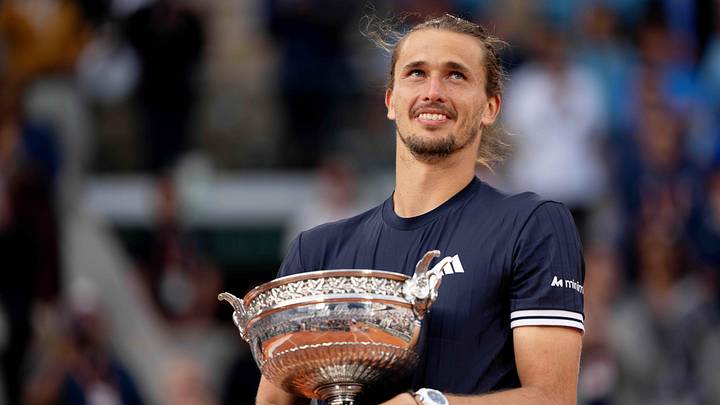
Let’s start with a question that came in various forms. Now that Alexander Zverev has won Roland Garros and no longer carries the mantle, who is the best player never to have won a major?
First, let’s toast Zverev. For years, he wasn’t just the current, best player never to have won a major; he was the all-timer. He held the title not just among active players, but for all time. He appeared in three major finals, had more than 550 match wins, and was an all-surface player with 24 titles, including multiple Masters 1000s. Now that’s all moot.
Next up? Casper Ruud, having appeared in three major finals, is an obvious pick. But he has always seemed like an example of admirably maxing out his talent. Nick Kyrgios is on the other end of the spectrum: abundant talent, but he’s so unserious that it’s hard to award him the “honor.” After that? I have a hard time pitching candidates who have never been to a major final. So that disqualifies Grigor Dimitrov, Gaël Monfils and Andrey Rublev (who’s never advanced to a major semifinal). Ben Shelton? Too young. Alex De Minaur? Too Ruudian.
I guess if I had to pick a name, I’d say Stefanos Tsitsipas, now ranked No. 80. But here’s my cop-out masked as a creative answer: right now, no one. There is no active player who deserves this honor/bears this burden.
As for retired players in the Open Era, loyal reader Andy Lachow lays it out:
David Ferrer: One major final, five semifinals, 11 quarterfinals, 27 titles (one Masters 1000), No. 3 highest ranking
Tomáš Berdych: One major final, six semifinals, 10 quarterfinals, 13 titles (one Masters 1000), No. 4 highest ranking
Jo-Wilfried Tsonga: One major final, five semifinals, nine quarterfinals, 18 titles (two Masters 1000s), No. 5 highest ranking
David Nalbandian: One major final, four semifinals, five quarterfinals, 11 titles (two Masters 1000s), No. 3 highest ranking
Nikolay Davydenko: Zero major finals, four semifinals, six quarterfinals, 21 titles (three Masters 1000s), No. 3 highest ranking
Marcelo Ríos: One major final, zero semifinals, five quarterfinals, 18 titles (five Masters 1000s), No. 1 highest ranking
Other contenders I came up with: Todd Martin, Tommy Haas, Miloslav Mečíř and Alex Corretja.
Hey Jon, I know you and Andy talked about the top players using the U.S. Open mixed doubles event as leverage to get more prize money. If the stars like Jannik Sinner don’t play, here’s an idea: Roger Federer and Serena Williams!
J.G. Brooklyn
• Funny, I poked around on this in Paris. The top players really have it out for the U.S. Open. They see the expansion, extortionate new ticket prices, the fact that the Honey Deuce sales could cover a big chunk of prize money and the rampant commercialization. They roll their eyes at the tournament’s “logic” that the U.S. Open provides them a platform for endorsements. Wimbledon came with an unprecedented 20% year-over-year increase in prize money. If the U.S. Open doesn’t do something commensurate, the players will not take it well.
You’re right that the U.S. Open’s fan week, and the mixed doubles competition in particular, is ripe for protest. Jannik Sinner, I’m told, has already articulated this to his colleagues. What about Roger Federer, who will be in town anyway in conjunction with his Hall of Fame festivities?
Great idea. Except it would necessitate his entering the doping protocols and—even if he were willing to subject himself to whereabouts—it’s already too late for that.
I raised the possibility of reclassifying the mixed doubles event as an exhibition, which you could argue it already is, given the subjective entrants, shotgun format and modified scoring. This would strip the event of major status, but would enable players like Federer to enter. I’m told the USTA is not willing to entertain that.

Hi Jon,
Having helped Garbiñe Muguruza win a Wimbledon title in 2017, Conchita Martínez has now coached two players to Grand Slam singles titles, something I believe no other female coach who wasn’t the player’s parent has done. Amelie Mauresmo coached Marion Bartoli when Bartoli won Wimbledon in 2013. To the best of my knowledge, that makes Mauresmo the first unrelated female coach to help a player win a major. (Additionally, Jeļena Ostapenko received coaching from Anabel Medina Garrigues when Ostapenko won the 2017 French Open.) Am I missing other unrelated female coaches who should be credited with coaching a player to a major title?
Ted Cornwell, Minneapolis
• Renée Richards and Martina Navratilova spring to mind. Sometimes in past eras, a friend or even a fellow player would stick around and support a player during a run. If the player designated this “aide-de-camp” as coach, that might count.
Pause to note this tennis quirk: The player has total discretion in assigning titles. If I say Bill or Susie is my coach, they’re my coach. If I say they are my “hitting partner” or “consultant,” that’s what they are, even if their duties are consistent with coaching duties. No one is overseeing this and saying, Actually, you need to change their title; they’re meeting the criteria for coach.
But your point is well taken. Considering the past, say, 25 years, I’m struggling to think of female nonfamily members, other than Martínez, who have led teams to titles, but I suspect she’ll have company soon.
Hi, Jon,
Thank you for pointing out the disproportionate fine against Adolfo Daniel Vallejo. I agree with your opinion against Vallejo’s male-chauvinist message. I equally agree with your defense of freedom of speech. Unlike the young player, I hailed from the same country, I was born and raised under the military dictatorship period. The last thing I want to see: the infiltration of authoritarianism in tennis. We are having too much already too with the conservative/reactionary shift in the so-called “Western democracies.”
Regards,
L. Pereira (B.C., Canada)
• Thanks, to me this is less about reactionary shifts than the slippery slope of policing speech, the absence of player empowerment and the rights of labor. Where is the players’ collective voice in a policy that can levy a $75,000 fine for speech that the ITF and the tournament deems offensive?
Hi Jon,
Thanks for your reporting and insights on the French Open. You said in your article on the women’s final that Maja Chwalińska will make the unprecedented step from qualifier to seed at the next major if Wimbledon grants her a wild card (I agree they should). Emma Radacanu was a qualifier at the 2021 U.S. Open and was seeded No. 17 at the 2022 Australian Open. It’s unprecedented at the next major in the same year, which perhaps is what you meant.
I believe the best a qualifier has done at a major is reach the semifinals, at least in the Open Era. Strangely, it was done twice in 1977, by John McEnroe at Wimbledon and Bob Giltinan at the Australian in December (there were two Australian Opens that year, in January and December). Vladimir Voltchkov also did it at the 2000 Wimbledon. Aslan Karatsev did it most recently at the ‘21 Australian.
Andrew Krouse, Hummelstown, PA
• Good catch on Raducanu. I meant that this set of circumstances—a player gets a wild card and is seeded; or a player does not get a wild card and is short of reaching the main draw—is unique. But you lay it out better than I do. Chwalińska ended up receiving a wild card into the Wimbledon women’s singles draw, while Serena and Venus Williams were granted a wild card into the women’s doubles draw.
Two side points:
1) With a media specialist accompanying her and helping her navigate the crush, Chwalińska returned to Poland last week for a well-deserved week off.
2) Raducanu continues to fascinate. Five years after her breakthrough at the U.S. Open, she has not added to her title haul, but she is still a top-40 player, generating considerable interest.
Jon,
I figured it all out! I connected the dots! You’ll recall that you graciously answered my mailbag question about the vomiting epidemic in tennis. Now, I’ve noticed that the TV coverage of Roland Garros is sponsored by some medicine called Nereus. And what does Nereus treat? If you can withstand the sensory overload of the weird spy cartoon advertisement, you’ll note that Nereus … PREVENTS VOMITING.
Sorry if I have a tinfoil hat on, but that can NOT be a coincidence!!!
P.
• That trigger cannot be unpulled. On that note, have a good week, everyone!
More Tennis from Sports Illustrated
 Add us as a preferred source on Google
Jon Wertheim is a senior writer for Sports Illustrated and has been part of the full-time SI writing staff since 1997, largely focusing on the tennis beat, sports business and social issues, and enterprise journalism. In addition to his work at SI, he is a correspondent for “60 Minutes” and a commentator for The Tennis Channel. He has authored 11 books and has been honored with two Emmys, numerous writing and investigative journalism awards, and the Eugene Scott Award from the International Tennis Hall of Fame. Wertheim is a longtime member of the New York Bar Association (retired), the International Tennis Writers Association and the Writers Guild of America. He has a bachelor’s in history from Yale University and received a law degree from the University of Pennsylvania. He resides in New York City and Paris with his wife, who is a divorce mediator and adjunct law professor. They have two children.
Follow jon_wertheim