%20%20--%3E%0A%3Csvg%20version%3D%221.1%22%20id%3D%22Layer_1%22%20xmlns%3D%22http%3A%2F%2Fwww.w3.org%2F2000%2Fsvg%22%20xmlns%3Axlink%3D%22http%3A%2F%2Fwww.w3.org%2F1999%2Fxlink%22%20x%3D%220px%22%20y%3D%220px%22%0A%09%20width%3D%2239px%22%20height%3D%2240px%22%20viewBox%3D%220%200%2039%2040%22%20enable-background%3D%22new%200%200%2039%2040%22%20xml%3Aspace%3D%22preserve%22%3E%0A%3Cpath%20fill%3D%22%23FFFFFF%22%20d%3D%22M38.5%2C7H28.2v26h10.3V7z%22%2F%3E%0A%3Cpath%20fill-rule%3D%22evenodd%22%20clip-rule%3D%22evenodd%22%20fill%3D%22%23FFFFFF%22%20d%3D%22M26.1%2C25.5c0%2C5.8-4.1%2C7.5-12.9%2C7.5C3.9%2C33%2C0%2C31.2%2C0%2C25.2v-1.1h11.6%0A%09v2.4c0%2C0.7%2C0.1%2C1.4%2C1.2%2C1.4c1%2C0%2C1.2-0.4%2C1.2-1.3v-0.9c0-1.6-0.9-1.6-3.5-2.2C2.2%2C21.7%2C0%2C19.7%2C0%2C15.3v-0.9C0%2C9.3%2C5.5%2C7%2C12.9%2C7%0A%09c10.2%2C0%2C12.8%2C2.6%2C12.8%2C7.4v1.8h-11v-2.9c0-0.6-0.4-1.1-1.2-1.1c-0.6%2C0-1.2%2C0.4-1.2%2C1.1v0.9c0%2C1.5%2C0.9%2C2%2C3.3%2C2.5%0A%09c8%2C1.6%2C10.5%2C3.3%2C10.5%2C7.5V25.5z%22%2F%3E%0A%3C%2Fsvg%3E%0A)
Lamine Yamal Is Soccer’s Next Megastar—and at 18, He’s Just Getting Started
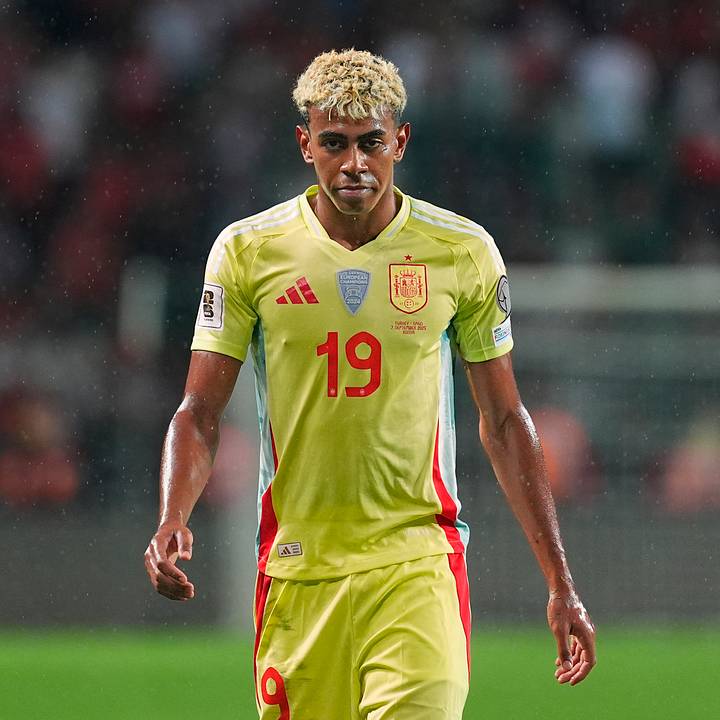
Vast as the palette might be, for all the emotions that athletes experience in the course of competition, pity isn’t one that tends to stand out. But there was Lamine Yamal in Brussels last November, feeling genuinely sorry for the opponents he had just cooked.
In the 61st minute of a Champions League match, Yamal, the 18-year-old Barcelona winger, took a pass 20 or so yards in front of the goal. In a jag resembling a bit of slapstick comedy, he dribbled around, past and through a half dozen defenders, leaving them flat-footed in the grass, like garden gnomes. When only the goalkeeper remained as the final line of defense, Yamal garnished this run with a final dash of sorcery, using the outside of his left foot to guide the ball with power and precision into the back of the net.
It was a mismatch of skill, Yamal’s sumptuous talent pitted against athletes who were merely world class, not generationally elite. It was also a mismatch of age. Yamal celebrated by flashing his signature hand gesture (more on that later) and an incandescent smile, revealing his signature braces, a reminder that Yamal is often closer in age to his opponents’ kids than to the opponents themselves.

For Yamal, it recalled the goal he’d scored earlier in his career in a preseason game against FC Seoul. That one, too, triggered in Yamal pride for his feat, but also genuine compassion for the other guys. “In the end, they also have friends, just like I do,” he said. “If I were a fullback, I wouldn’t like it if a player who’s much better than me were to keep getting away from me all the time. I would ask them to please slow down a little, otherwise my friends would make memes about it.”
De La Masia al mundo: Lamine Yamal 🪄 pic.twitter.com/FjhjCw3tWX
— FC Barcelona (@FCBarcelona_es) November 6, 2025
Yamal rehashed this all inside a television studio in Barcelona’s warehouse district. He was there to appear on 60 Minutes, and we spoke for nearly an hour. He was also there to shoot a commercial-slash-music video for Coca-Cola, based on “Jump,” Coke’s anthem for the 2026 World Cup.
Just a few years ago, Yamal’s post-practice afternoons entailed playing FIFA with friends. Now he is FIFA. His Barça jerseys sell more briskly worldwide (reportedly 1.32 million in 2025) than those of any other player in the sport. The equivalent of a VPN, Yamal will be available and easily accessible in the U.S. this summer. (Yamal is currently recovering from a hamstring injury sustained April 23 that caused him to miss the final month of Barcelona’s season. Spain manager Luis de la Fuente says he expects Yamal to be ready their World Cup opener.) Spain ranks among the World Cup favorites and will kick off its campaign in Atlanta on June 15. And its swollen hopes rest largely on a star more than two years short of the cohost nation’s legal drinking age.
The story of Spain’s best young soccer player begins not in Iberia but in Africa. In 1990, Fatima Nasraoui snuck onto a bus in Morocco and crossed into Spain in the hope of building a better life. When she had put enough money together, she sent for her boys, and soon Mounir and Abdul Nasraoui emigrated from Morocco to Spain, as well. Mounir was still a teenager when he met Sheila Ebana, a recent arrival from Equatorial Guinea, who was working at a local McDonald’s. Bonded by their immigrant experience, they married, and in July 2007 had a son, whom they named Lamine Yamal, in honor of two friends who helped the couple financially.
A fine player in his day, Mounir had early designs of rearing his son as a soccer star. The young couple raised their boy in the town of Mataró (pop. 130,000) in the neighborhood of Rocafonda, a North African enclave a few blocks from the Mediterranean, a 45-minute drive north of Barcelona. Soon the sight of Mounir putting Lamine through dribbling and passing drills became a fixture on the asphalt pitch of the local park. Sometimes they recruited bigger kids, sometimes they used neighborhood dogs as stand-in defenders. “It was dribbling,” says Yamal. “Since I was afraid the dog could catch me, I’d run away with the ball.”

Mounir and Sheila divorced when their son was 3. (“Lamine Yamal Nasraoui Ebana” became just “Lamine Yamal.”) Both parents were active in his upbringing. Sheila remarried another soccer enthusiast, moved to the town of La Torreta, and played the role of nurturer. Mounir was the soccer equivalent of a Little League dad.
Yamal was also raised by Rocafonda. The neighborhood was once described by the Spanish daily newspaper El País as “forgotten, isolated and stigmatized,” but Yamal remembers it warmly. “I spent more time at the park than I spent at my home.” It was there that he learned to use his gifts—his instincts, his anticipation and an almost subliminally fast first step.
On the other side of town, Lionel Messi was beginning his path to the GOAT pasture. And Yamal was getting noticed as well. First, he played for a team in his mother’s neighborhood, C.F. La Torreta. At age 6, he was spotted by Barça scouts who recruited him for a junior team that played and trained on the pitches of La Masia, “The Farm,” Barcelona’s famed youth academy.
For Yamal, the manicured fields and wide-open spaces made it “soccer heaven.” Albeit with a hellish commute. He and his father would often take two trains from Rocafonda, passing a ball in the aisle if the cars were empty; otherwise, they slept. Eventually, the club arranged for Lamine and Mounir to bunk at the academy. The reduced commute boosted Yamal’s performance. Even playing up in age groups—he played in some U-16 games when he was 11—he scored early and often. More important, he showed a sixth sense for tactics and spacing and anticipation and creativity, the intangibles that augur greatness. Barça’s manager at the time, Xavi, enlisted Yamal, then 15, to train with the first team.
Yamal made his La Liga debut on April 29, 2023. At just 15 years, 291 days old, he was the youngest player ever to represent Barcelona’s first team. It was no novelty act. A boy against men, he more than held his own.
Soccer commentator Ray Hudson—himself a teenage phenom for Newcastle in the ’70s—recalls watching Yamal play an early Champions League game against Inter Milan. “This was against the hairy-chested Italian defenders, who come in with tackles, with a machete down their jockstraps,” he says. “And they couldn’t contain him.”

Barça had the foresight to lock up Yamal after turning down various offers—most notably a €250 million bid from Paris Saint-Germain. But Yamal also drew interest from the Moroccan federation, which recruited him for its national team. Yamal concedes that when Morocco beat Spain in the 2022 World Cup, his loyalties were tugged in both directions.
Aware poachers were circling, the Spanish national team plugged a 16-year-old Yamal into a game against Georgia. Ultimately, he decided to represent Spain, the country of his birth, but his custom boots come adorned with the flags of both Morocco and Equatorial Guinea, a reminder that, as he puts it, “I represent a lot.”
Yamal’s star turn came in the 2024 Euros. In short order, he became the youngest player ever to play in the tournament; to score a goal; to help his country win the event. But the age records shortchange his impact. His side-winding goal against France in the semifinals, a curling, guided missile launched from outside the penalty area, stood as the Goal of the Tournament.
🌟 #EURO2024 Highlights 🌟
— UEFA EURO (@EURO2024DE) July 21, 2024
🪄⚽️ Lamine #Yamal in #ESPFRA. 🤩🥳@SEFutbol | @SpainIsFootball pic.twitter.com/bBkxNtbyJE
The day after his 17th birthday, he played in the biggest game of his young life. Not that he gave any indication: Yamal napped on the bus on the way to the Olympiastadion in Berlin. Against England, he assisted on the first goal of the final, tying the record for most assists (four) in a Euro tournament; changed the defense’s spacing with his playmaking threat; and celebrated mightily when Spain won.
As if eager to show that this was no fluke, back in La Liga Yamal resumed his precocious, ferocious play. Goals came fast and furious, Yamal marking them with a signature hand gesture that creates a 3-0-4, a tribute to the Rocafonda postal code. The month he turned 18, Barça rewarded him with a contract reported to pay him around $30 million a season. (An assortment of brands confer roughly the same amount in endorsements.)

Last fall, he narrowly lost out to PSG’s Ousmane Dembélé for the Ballon d’Or. Yamal took it in stride. “I don’t dream of one Ballon d’Or, I dream of many,” he said. “If I don’t get them, it will be my fault.”
His father, less so. “I think this is the biggest, I won’t say theft, but moral damage done to a human being,” Mounir memorably said. “Because I believe Lamine Yamal is the best player in the world by far, by a huge margin.”
Lofty Comparisons to Lionel Messi
By official soccer rules these days, there comes a time in any discussion of Yamal that there must be a comparison to Messi, who also happens to be the hero of the previous World Cup. We’ve reached that point. Two different players, two different eras, two wildly different personas, Messi’s studied blandness versus Yamal’s irrepressible color. Still, the overlap is both unmistakable and unshakable: two soccer Mozarts, both left-footed wingers, who came of age playing for the same club. Barça hasn’t helped matters either. They may have plied Yamal with hype-defusing talking points—I’m honored to be mentioned in the same breath, but I want to be the first Yamal, not the second Messi—but they have also plied him with jersey No. 10, same as Messi and Diego Maradona before that.
But even before this came an unmatched moment of sports-greatness foreshadowing. When Lamine was barely 3 months old, the family entered a raffle through Barça. A dozen winning entrants would be treated to a family photo session alongside a Barcelona player, with the images compiled for a calendar to benefit UNICEF. Not only was Sheila’s entry chosen—once summoned to Camp Nou for the shoot, she and her infant son were picked to pose alongside the club’s ascending star … Lionel Messi.
Almost two decades later, the photographer that day, Joan Montfort, shows off the fruits of the serendipitous session. In one image, Sheila hands her son over to Messi, himself only 20 and beginning his assault on global soccer. Messi appears game but grips the baby gingerly. “Imagine,” Montfort says, “Michael Jordan holding baby LeBron.”

With the caveat that trajectories change and sports careers are sinuous, let the record reflect: At 17, Messi had played in eight matches, scored a single goal and tallied zero assists. Yamal had played 106 matches, scored 25 goals and amassed 28 assists. You could also make the counterpoint that Messi has won the Ballon d’Or a record eight times. Let Yamal win his first before we start comparing and contrasting.
The starkest differences between the two reside not in their play but in their modes of being. Intensely shy, Messi has been strenuously unknowable off the pitch. Yamal? In the words of Guillem Balagué, a dean of Spanish soccer coverage, “He is closer to a pop star than a traditional footballer.” If Yamal’s play screams look-at-me, so does everything else about him, from his platinum-dyed hair to his social media profile. Asked if he minds being a star, Yamal smiles, nods and laughs before the end of the question. “I don’t. In fact, I like it!”
Para no dejar de verlo. 🌟
— LALIGA (@LaLiga) November 13, 2025
El 𝗴𝗼𝗹 𝗱𝗲 𝗟𝗮𝗺𝗶𝗻𝗲 𝗬𝗮𝗺𝗮𝗹 al Espanyol nominado al Premio Puskas 2025.
LALIGAEASPORTS | LALIGAHighlights pic.twitter.com/wOCTb0IoaA
Yamal admits it can get to be a bit much. “A [conventional] 18-year-old kid gets out of school and goes home. I go out to practice while four paparazzi are at my house asking questions about my life. I turn on the TV, and I’m on TV. I walk down the street, and I see a kid wearing my jersey. Honestly, I believe I’ll never be a normal 18-year-old, because people don’t see me as normal.”
Then again, he’s not normal. FIFA has recognized Yamal as a generational talent—you’ll be seeing a lot more of his braces and platinum locks at the World Cup. Yamal’s image is unavoidable in Rocafonda, where his face has been rendered in graffiti on the asphalt soccer pitch. Even Uncle Abdul has renamed his local restaurant in his nephew’s honor. It’s now Bar Cafeteria LY 304, and a tinfoil replica of the World Cup trophy sits behind the bar.
The World Cup final will be held July 19, six days after Yamal turns 19. He hopes that evening that Spain will hoist the real trophy. But he vows that for all the expectation and change his transcendent skills have already wrought on his life, his relationship to the sport is unalterable. He’ll continue playing soccer for—and from—the soul.
“I’ve never been the type of person who comes to the field thinking, Oh, man, today I want to score four goals and three assists. However, I do think, I want to do what I used to do at the park. I want people to have fun. I want to have fun with my teammates. And if I score lots of goals, that would be even better, but I believe soccer goes beyond that.”
More World Cup from Sports Illustrated
 Add us as a preferred source on Google
Jon Wertheim is a senior writer for Sports Illustrated and has been part of the full-time SI writing staff since 1997, largely focusing on the tennis beat, sports business and social issues, and enterprise journalism. In addition to his work at SI, he is a correspondent for “60 Minutes” and a commentator for The Tennis Channel. He has authored 11 books and has been honored with two Emmys, numerous writing and investigative journalism awards, and the Eugene Scott Award from the International Tennis Hall of Fame. Wertheim is a longtime member of the New York Bar Association (retired), the International Tennis Writers Association and the Writers Guild of America. He has a bachelor’s in history from Yale University and received a law degree from the University of Pennsylvania. He resides in New York City and Paris with his wife, who is a divorce mediator and adjunct law professor. They have two children.
Follow jon_wertheim