%20%20--%3E%0A%3Csvg%20version%3D%221.1%22%20id%3D%22Layer_1%22%20xmlns%3D%22http%3A%2F%2Fwww.w3.org%2F2000%2Fsvg%22%20xmlns%3Axlink%3D%22http%3A%2F%2Fwww.w3.org%2F1999%2Fxlink%22%20x%3D%220px%22%20y%3D%220px%22%0A%09%20width%3D%2239px%22%20height%3D%2240px%22%20viewBox%3D%220%200%2039%2040%22%20enable-background%3D%22new%200%200%2039%2040%22%20xml%3Aspace%3D%22preserve%22%3E%0A%3Cpath%20fill%3D%22%23FFFFFF%22%20d%3D%22M38.5%2C7H28.2v26h10.3V7z%22%2F%3E%0A%3Cpath%20fill-rule%3D%22evenodd%22%20clip-rule%3D%22evenodd%22%20fill%3D%22%23FFFFFF%22%20d%3D%22M26.1%2C25.5c0%2C5.8-4.1%2C7.5-12.9%2C7.5C3.9%2C33%2C0%2C31.2%2C0%2C25.2v-1.1h11.6%0A%09v2.4c0%2C0.7%2C0.1%2C1.4%2C1.2%2C1.4c1%2C0%2C1.2-0.4%2C1.2-1.3v-0.9c0-1.6-0.9-1.6-3.5-2.2C2.2%2C21.7%2C0%2C19.7%2C0%2C15.3v-0.9C0%2C9.3%2C5.5%2C7%2C12.9%2C7%0A%09c10.2%2C0%2C12.8%2C2.6%2C12.8%2C7.4v1.8h-11v-2.9c0-0.6-0.4-1.1-1.2-1.1c-0.6%2C0-1.2%2C0.4-1.2%2C1.1v0.9c0%2C1.5%2C0.9%2C2%2C3.3%2C2.5%0A%09c8%2C1.6%2C10.5%2C3.3%2C10.5%2C7.5V25.5z%22%2F%3E%0A%3C%2Fsvg%3E%0A)
March Madness Rankings: Every Men’s NCAA Tournament Team From No. 1 to 68
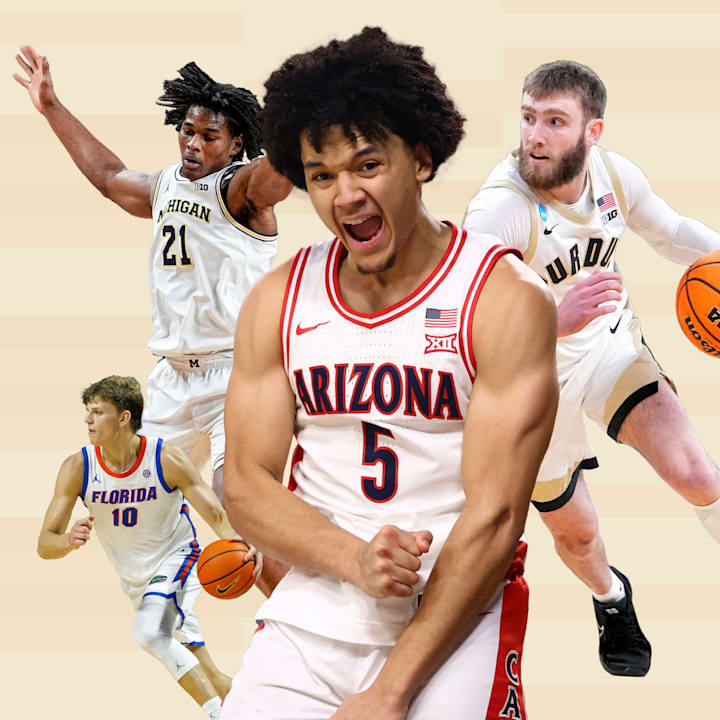
The men’s NCAA tournament selection committee had its say, now it’s our turn. The annual rite of mid-March has returned: rearranging the seeding and ranking for all 68 teams in this year’s field. Last year, the NCAA had Auburn as the overall No. 1 and Florida No. 4, while Sports Illustrated correctly identified the Gators as the team to beat and eventual national champion. Stick with us as we Bear Down with Arizona this year.
1. Arizona
NCAA seed: 2
For the first time since the Lute Olson days, the Wildcats legitimately have the goods to win it all—NBA talent, quality guards, imposing size, veteran depth and coaching. They are in the top five of KenPom’s metrics both offensively and defensively. The tournament broadcast partners gave them a 10:35 a.m. local (and body clock) tip time for their first game, but that might be their toughest obstacle through two rounds in San Diego. After that looms a potential Sweet 16 doozy against Arkansas or Wisconsin, a tough draw at that stage, but Zona is up to that challenge. We’ll see the Wildcats in Indy, site of their only other national championship, and history will repeat.

2. Duke
NCAA seed: 1
The top overall seed persevered through significant injuries in the ACC tournament, showcasing its resilience and underappreciated depth. The Other Boozer, Cayden, stepped up in Charlotte, as did frontcourt reserve Nikolas Khamenia. With big man Patrick Ngongba II expected back, the Blue Devils should again be a giant defensive terror. But the main cog is Cameron Boozer, whose all-around play has made him the runaway choice for national player of the year. The draw is interesting, with Jon Scheyer matching wits against Gerry McNamara in the first round—have two key players on national championship teams ever faced off as NCAA tournament coaches? Beyond that lies a potential Sweet 16 game against either Kansas or St. John’s, which would be on a jet-lagged journey from San Diego to Washington, D.C. UConn, an old Duke tournament nemesis, could be the last impediment to a repeat Final Four. Once there, Scheyer just needs to nail the ending.

3. Michigan
NCAA seed: 3
The Wolverines didn’t exactly go through the motions in the Big Ten tourney, but they weren’t very sharp there—barely getting past Ohio State and Wisconsin before being thumped by Purdue. They looked like a team with eyes on the next prize, this one, and they have the team to get to Indy. Yaxel Lendeborg is relentless at both ends of the floor, 7' 3" center Aday Mara is a towering impediment defensively and Elliot Cadeau is a creative and fearless point guard. The x-factor is forward Morez Johnson Jr., a major talent who wasn’t much of a factor in Chicago. Guard depth is an issue after the injury to L.J. Cason, which is why Michigan is third on this list and not first.
4. Houston
NCAA seed: 5
The Cougars weren’t giving off great vibes at the end of the regular season, but that changed at the Big 12 tournament in Kansas City. That looked more like a Kelvin Sampson team, turning every defensive possession into a mission and every rebound into a barroom brawl. Point guard Kingston Flemings is an elite player with the right mindset to handle his demanding coach. Fellow freshman Chris Cenac Jr. is wildly talented as well. Joseph Tugler is the latest havoc-inducing big man, who just needs to avoid chronic foul trouble. But the easiest Cougar to root for is guard Emanuel Sharp, veteran of 142 games in a Houston uniform, who had the most unfortunate moment of the 2025 national title game when he didn’t take the final shot. Get that guy back to the Final Four and let him write a better ending.

5. Florida
NCAA seed: 4
The defending champions have a shot, a solid shot, at repeating. It will require them to make shots, which has been the season-long issue. The nation’s No. 324 team in three-point accuracy had a brief flurry of competence—even excellence—from outside the arc, making 43% of their threes in the final five games of the regular season. Then they went to Nashville for the SEC tourney and relapsed, connecting on 8 of 37 attempts in two games. Even without shooting great, the Gators are an imposing team—huge and aggressive on the front line, willing and able to rebound all their missed shots. The guards do several things well, even if shooting isn’t one of those things. Todd Golden proved he’s a championship-level coach last year, which can go a long way. A doomsday scenario is lurking in the regional final: a Florida-Houston rematch of the 2025 title game—this time in Houston.
6. Iowa State
NCAA seed: 7
Nobody last week was more impressive in defeat than the Cyclones against Arizona, in an instant classic in Kansas City. As T.J. Otzelberger’s program has evolved offensively, while still maintaining a fierce level of physical defense, it has raised Iowa State’s ceiling. Now it just needs a breakthrough Final Four. The core group is terrific: forward Joshua Jefferson fills the stat sheet (16.9 points, 7.6 rebounds, 4.9 assists); point guard Tamin Lipsey is the head of the snake both offensively (5.0 assists per game) and defensively (2.2 steals); wing Milan Momcilovic is the most dangerous shooter in the tournament (49.6% from three). Depth is not great, but the Cyclones loom as a serious challenge to Michigan in the Midwest Region.
7. Purdue
NCAA seed: 8
Faith in the Boilermakers was restored at the Big Ten tourney, which they won rather convincingly over Michigan. It’s possible that Purdue’s late-season malaise was the product of a senior core group that has essentially started together for four years simply being over it all and hitting a February lull in anticipation of the last postseason roundup. Suddenly, Braden Smith was back to his pick-and-roll mastery (46 assists in four games, closing in on Bobby Hurley’s NCAA career record); Fletcher Loyer was making shots; and Trey Kaufman-Renn was doing work inside. It’s also possible that the Chicago emergence of big man Oscar Cluff, a transfer from South Dakota State, has raised Purdue’s ceiling—he averaged 17.3 points and 9.5 rebounds in that tourney. But here is the other possibility: The Boilers remain vulnerable enough defensively that they’re knocked out early.
8. Illinois
NCAA seed: 10
The existential question with the Illini is whether they can play defense at a level their offense can be proud of. Because the offense is Final Four quality. Freshman guard Keaton Wagler went from relatively unknown to a Top 10 NBA draft pick this season, and should benefit from getting outside the Big Ten as that league started to figure him out late in the season. Brad Underwood’s legion of Eastern Europeans—Andrej Stojaković, David Mirković and the Ivišić brothers (Zvonimir and Tomislav)—all can go. Veteran point guard Kylan Boswell still needs to fully get his swagger back after missing nearly a month with injury. Underwood has gotten as far as an elite eight before, but he’s had some ugly elimination games as well. Potentially facing Houston in the Cougars’ backyard in the Sweet 16 is not a favor.

9. Arkansas
NCAA seed: 16
The Razorbacks will have to outscore the world to make a run—and they’re capable of it. This is not a great defensive team, but it is one of John Calipari’s best offensive units, averaging 89.9 points per game. The Hogs have the nation’s best point guard in freshman Darius Acuff Jr. (22.9 points, 6.5 assists, deadly anywhere on the court) and a capable supporting cast (Meleek Thomas, Trevon Brazile and Billy Richmond combine for nearly 40 points per game). Acuff is Calipari’s best scorer since he underutilized Shai Gilgeous-Alexander and Devin Booker at Kentucky. Arkansas’s SEC tournament title was a microcosm of this season—a parade of big shots and fearless plays, interspersed with just enough defensive lapses and key missed free throws to keep every game interesting. The draw is difficult—after playing Sunday in Nashville, Arkansas was dispatched to Portland for a Thursday first-round game against Hawai’i. Then what could be the best of all second-round games awaits against Wisconsin, with Arizona as a potential Sweet 16 roadblock.
10. UConn
NCAA seed: 6
Heading into February, when UConn was 21–1 and had beaten Florida, Kansas, Illinois and BYU, the Beast of the East appeared to be back. Since then the Huskies have gone 8–4, with two losses to St. John’s and two to teams that aren’t in this tournament. Dan Hurley has a good nucleus of veteran players, but he has no great players. There might not be enough high-level bucket-getters when times are tight, and UConn lacks its recent championship-level defensive presence to make opponents abandon all hope in the paint. Being routed by the Red Storm in the Big East title game could be a warning sign of an impending early exit—or it could be a wake-up call in which an elite coach concocts another run. Playing in a historically soft Big East probably did the Huskies no favors.
11. Michigan State
NCAA seed: 9
The Spartans’ statistical profile is pretty similar to last year, when they went to the Elite Eight as a No. 2 seed. The strengths are classic Tom Izzo: vicious rebounding, vigilant defense and a point guard with verve—as long as combustible Jeremy Fears Jr. (15.7 points, 9.2 assists per game) keeps his feet to himself. Player development has turned Jaxon Kohler and Carson Cooper into capable big men, and wing Coen Carr is a dazzling midair player. Michigan State can be turnover prone, but it has more capable shooters than last season. That presents the opportunity for yet another deep Izzo run. Does he have an eighth Final Four in his bag?
12. St. John’s
NCAA seed: 18
The selection committee was so impressed by the Red Storm winning both the Big East regular-season and tournament titles that they gave them a No. 5 seed—just the second time in league history that a double Big East champion didn’t land in the top 16 overall seeds (Villanova was a No. 6 in 2019). Not only that, they shipped the Johnnies across the country to San Diego, matched them up with a root-canal first-round opponent (Northern Iowa) and a potential second-round game against Kansas. I’m sure Rick Pitino is overjoyed. St. John’s doesn’t pack much punch in terms of perimeter scoring, but it does have length, depth, experience, a bellcow star in Zuby Ejiofor and Pitino orchestrating. The Red Storm has lost once since Jan. 3, and while that might be partly a function of a weak Big East, this is also a team accustomed to winning and averse to elimination.
13. Vanderbilt
NCAA seed: 17
The Commodores join St. John’s on the perplexingly underseeded list with a No. 5. Vandy has 10 wins over teams in the field, is the only team to beat Florida since January (in a blowout, too) and has strong predictive metrics. It is vulnerable on the defensive glass and prone to fouling, but Mark Byington’s team runs excellent offense and can score almost at will. Sophomore guard Tyler Tanner’s explosion from a role player (5.7 points, 1.9 assists per game) to a star (19.1 points, 5.1 assists per game) is one of the biggest year-over-year improvements in recent times. As long as the Dores don’t get caught flat-footed in the opening-round against a more rested McNeese State squad, they could zoom into the Sweet 16 and a rubber match with the Gators.
14. Wisconsin
NCAA seed: 20
Tired: The No. 5 seeds are vulnerable to upset by the No. 12s. Wired: The No. 5 seeds have been disrespected and are primed for a run. The Badgers belong to that group, coming off a strong closing stretch that includes victories over Purdue and Illinois and an overtime loss to Michigan. Greg Gard has two dynamic, sassy guards in Nick Boyd and John Blackwell, who combine for 39.6 points, 8.7 rebounds and 6.5 assists per game. If Wisconsin’s pick-and-pop big men continue to rain down three-pointers like they have in March, look out—Australian Austin Rapp and Lithuanian Aleksas Bieliauskas are a combined 25 for 56 from deep this month. The Badgers are a bit indifferent defensively, which could be a bad thing in a second-round game against Arkansas, but they are also capable of being a legitimate upset threat against No. 1 Arizona if they make it that far.
15. Virginia
NCAA seed: 12
The breaking of the Tony Bennett mold and remaking under Ryan Odom has been one of the most impressive elements of this season, as the Cavaliers quickly revamped their roster and have won 29 games. The New Hoos are large and physical, with the same defensive intensity of the Bennett era and a much better offensive flow than recent editions. Virginia shoots threes and crashes the glass with their European big men. Defensively, center Ugonna Onyenso is the nation’s best shot blocker. The Cavaliers don’t produce a lot of easy baskets off turnovers or get to the foul line regularly, but nobody other than Duke has beaten them since January. Prepare for them to win their first NCAA tournament game since the 2019 championship.
16. Gonzaga
NCAA seed: 10
This is one of the oldest teams in the tournament, with a center (Graham Ike) who has played 152 college games and a guard (Adam Miller) who has played 150. Then there is 26-year-old wing Tyon Grant-Foster. It’s a classic Mark Few team, with a wide effective field goal percentage disparity over its opponents (shooting 56.3% while holding opponents to 46.2%). It isn’t one of Gonzaga’s great offensive machines of recent years, taking and making fewer threes than usual, but the Zags are stout defensively. Teams that don’t lose tend to continue not losing, and at 30–3 Gonzaga has not lost much. But a second-round matchup with AJ Dybantsa and BYU presents a serious threat to making the second weekend.

17. Kansas
NCAA seed: 15
The Darryn Peterson Thing remains A Thing, even with him back in the lineup on a permanent basis. Because here is The Thing, in broad strokes: The Jayhawks are 9–2 when the presumptive No. 1 pick in the draft did not play, including victories over Arizona and Tennessee; and the Jayhawks are 14–8 when Peterson does play, including five losses in the last nine games. He is an abundant talent, but is Kansas tangibly better when he’s on the floor? Common sense says the Jayhawks have a higher ceiling in this tourney with him, since he is one of three players who can fracture any defense (Acuff and Dybantsa are the others), and Bill Self is a master at exploiting his advantages. But this team doesn’t hammer the glass and score easily inside like his best teams. The wheels have come off the Jayhawks several times recently, with four losses of 15 points or more in the last month. Whenever the end comes—perhaps in the first weekend against St. John’s, perhaps not—it might be ugly.
18. BYU
NCAA seed: 24
The Cougars looked like a classic one-and-done target for most of the last month of the regular season, losing guard Richie Saunders to injury and losing nine of 13 games in one stretch. But then came a restorative Big 12 tournament, in which BYU rediscovered defense—if not being great at that end of the court, at least no longer being awful. Dybantsa is an electrifying talent who relishes the big stage, bright lights and toughest competition—he could be one of the stars of the tournament if BYU moves into the second weekend. Robert Wright III also is a gamer at guard, and Kennard Davis Jr. made big strides in Kansas City as a third scoring option. Chiseled center Keba Keita could use some more help inside for the Cougars to defeat Gonzaga in a potential second-round matchup.

19. Tennessee
NCAA seed: 21
The Volunteers didn’t finish well, going 7–5 since January and just 1–5 against NCAA tournament teams. But they have two powerful tournament weapons: defense and a kamikaze rebounding mentality. They’re hard to score against and impossible to keep off the offensive glass—especially if the game isn’t officiated tightly. (Rick Barnes’s preferred methodology is to turn every game into an MMA fight.) Tennessee has some star power in freshman wing Nate Ament and guard Ja’Kobi Gillespie, who combine for 35.5 points per game. The question is where the rest of the points come from. There are no other viable perimeter shooters. The Vols don’t have the same ceiling as past years, but they could brawl their way into the Sweet 16.
20. UCLA
NCAA seed: 28
Remember way back in February, when Mick Cronin was ejecting his own players and people wanted him fired? Things are better now in Westwood—not perfect, but improved enough to have optimism about the No. 7-seeded Bruins’ ceiling. For one thing, the Midwest-averse team left the West Coast and won two games in the Big Ten tourney, a definite sign of progress. They will need dynamic guard Donovan Dent and forward Tyler Bilodeau back to full strength after injuries in Chicago, which could happen—especially for Dent. (UCLA doesn’t play its first game until Friday night, so that extends the recovery window.) If healthy, the Bruins could present a vexing second-round matchup for UConn in Philadelphia.
21. Nebraska
NCAA seed: 13
One of the best stories of the season became a bit of a slog come February, as a 20–0 start became a 26–6 record on Selection Sunday. The Cornhuskers’ record against tournament teams during that closing stretch: 1–6, including decisive losses to UCLA and Purdue. Thus Nebraska’s No. 4 seed feels a bit dated, like it belongs to a January version of this team. The Huskers don’t get many easy points, since they’re a deficient offensive rebounding team and don’t get to the foul line much. But when the threes are falling—they shoot them in bulk—Nebraska is dangerous. Among players in the tournament, Pryce Sandfort ranks third in threes made per game at 3.5. The Huskers are very good defensively across the board, particularly in covering the three-point line and. Avoiding fouling. They will have to be ready early, with a Thursday morning tip-off against a tricky Troy team in Oklahoma City.
22. Texas Tech
NCAA seed: 19
Nobody in the tournament suffered worse injury luck than the Red Raiders, who lost do-everything guy JT Toppin (21.8 points, 10.8 rebounds, 1.4 steals, 1.7 blocks per game) in mid-February. After a defiant flurry of three straight victories post-Toppin, the gravity of the loss has come home to roost in the form of three straight defeats. Tech is light on length and interior scoring without him. Grant McCasland does have an NBA-level point guard in Christian Anderson (18.9 points, 7.6 assists per game) and the most avid three-point hunter in the tourney in Donovan Atwell (3.9 made per game).
23. Ohio State
NCAA seed: 31
Putting the Buckeyes this high on the list requires belief in two things: they really did hit a different gear in the final month, and Bruce Thornton really is a player capable of putting a team on his back. Ohio State surged off the bubble and into the main bracket with a No. 8 seed thanks to wins over Wisconsin, Purdue and Iowa, plus a blowout of Indiana that eliminated the Hoosiers from NCAA contention and a highly competitive loss to Michigan in the Big Ten tourney. Thornton became Ohio State’s all-time leading scorer along the way, averaging 20.2 points per game this season. The Buckeyes aren’t very disruptive defensively, producing few turnovers or blocked shots and allowing opponents to make 52.4% of their shots inside the arc. A potential second-round matchup with Duke could be interesting for a while if Thornton goes off.

24. Alabama
NCAA seed: 14
There are better ways to start March Madness than having your second-best player arrested on felony drug charges, but here the Crimson Tide are. If Aden Holloway (16.8 points per game) does not play Friday against Hofstra, Alabama’s considerable firepower takes a hit—and given how shaky the Crimson Tide are defensively, they need all the points they can get. But beware a coach who knows what he’s doing and has an ability to impose his preferred style of play—ultra-fast—on opponents. Nate Oats is 13–8 in the NCAA tournament, with three straight trips to the Sweet 16 or farther.
25. South Florida
NCAA seed: 46
Say hello to what might be the best Cinderella candidate in this tournament. The No. 11 seed Bulls have won 11 straight games, most of them easily, in storming to both the regular-season and tournament titles in the American Conference. Their only three losses in 2026 are by a total of five points. Former Oats assistant Bryan Hodgson is on the fast track to a power conference—maybe as soon as this spring, with Syracuse and Providence both showing interest in him. But his first and possibly last South Florida team is a good one that could make a move in this tourney behind five double-digit scorers. The Bulls prefer to play fast, but they need to crash the glass because plenty of their shots don’t go in.
26. Louisville
NCAA seed: 23
The No. 6 seed Cardinals are the most three-dependent team in this tournament not named Alabama, which means they could win multiple games if hot and lose the first one if not. The task becomes easier if delicate star freshman guard Mikel Brown Jr. is available, which remains unknown as of Monday. (Louisville is 16–5 with him in the lineup and 7–5 without him.) With or without Brown, fellow perimeter bombers Ryan Conwell and Isaac McKneely are key—they’ve combined to hit 191 treys. The Cardinals play hard at both ends of the floor, but their lack of interior presence is a hindrance. For second-year coach Pat Kelsey, just winning any Big Dance game is the elusive goal—he’s 0–5 in first-rounders.
27. Kentucky
NCAA seed: 25
Big Blue Nation is prone to wild mood swings anyway, and this team exacerbates that condition. The Wildcats have had great wins (Arkansas, St. John’s and Tennessee away from home) and also been blown out of the gym multiple times. They’ve been beset by injuries but also by fits of offensive dysfunction—and that hits at the problem with this high-priced roster. Mark Pope assembled a team to fix last year’s defensive weaknesses but not one that retained enough of last year’s offensive strengths. Pope salvaged a mildly disappointing first season by making the Sweet 16 last year. This season is a bigger disappointment, and the seeding is worse as a No. 7. The former Pitino-era Kentucky player will face former Pitino-era Kentucky assistant Herb Sendek and Santa Clara in a difficult first-round matchup.
28. Miami
NCAA seed: 27
If any good team has flown under the radar this year, it’s the Hurricanes in their first season under Jai Lucas. Their nonconference schedule was empty calories, with losses to Florida and BYU and victories over nobody. But the Canes finished well, winning eight of their last 11, including an ACC tourney win over Louisville. With a mix of transfers and freshmen, Lucas pulled this team together in a hurry—they are proficient inside the arc but not proficient from three and one of the worst foul-shooting teams in the tourney. Seniors Malik Reneau, Tre Donaldson and Ernest Udeh Jr. are the anchors. The committee did not do the No. 7 seed any favors matching them with No. 10 Missouri in St. Louis, a de facto road game.
29. North Carolina
NCAA seed: 22
The high ceiling came crashing down on the Tar Heels when star freshman big man Caleb Wilson was lost for the season due to injury. For long-in-the-tooth fans of a program that has had some bad late-season injury luck over the decades (Phil Ford, Tom LaGarde, Kendall Marshall), this was an unwelcome flashback. They dug in their Heels with a four-game winning streak shortly thereafter, but lost their last two to Clemson and Duke. They arrive in the Big Dance still working on a reboot, with a shortened rotation and new go-to players in center Henri Veesaar and guard Seth Trimble. Carolina’s path forward as a No. 6 seed probably depends on some hot shooting and a star turn from an unexpected source.
30. VCU
NCAA seed: 45
The Rams are consistently good no matter who coaches them, but they’ve also become a consistent sucker pick as a Cinderella. They’ve lost their last four first-round appearances and are 3–9 in the tournament since that fabled Final Four run of 2011. This team, under first-year coach Phil Martelli Jr., has been very good, going 16–1 since Jan. 10. It’s been an any-given-night group effort, with seven players averaging between 22 and 27 minutes and between 7.2 and 14.4 points per game. (Guard Terrence Hill Jr., who does not start, was the MVP of the Atlantic 10 tournament.) Many of the traditional VCU Havoc Ball elements remain, but the current team is better at getting fouled without fouling (157 more free throws attempted than their opponents).
31. Utah State
NCAA seed: 33
You’ve got to admire the durability of the Aggie brand, which persists despite changing hands like a rental car—current coach Jerrod Calhoun is the fourth coach in the last six years, and he appears ticketed elsewhere when this season ends. Yet Utah State has missed only one NCAA tournament since 2018, with Craig Smith, Danny Sprinkle, Ryan Odom and now Calhoun taking their teams dancing in that time. This might be the best Utah State team in that run, a No. 9 seed that has been made a slim favorite over No. 8 Villanova in San Diego. They have a bunch of old guys, led by guards Mason Falslev and MJ Collins Jr. (a combined 33.7 points per game, as the only Aggies who play more than 30 minutes per outing). Drake Allen is a savvy point guard, and the frontcourt is manned by committee. Utah State gets good shots and makes them, but is susceptible on the defensive glass and prone to fouling.
32. Saint Louis
NCAA seed: 35
The Big Dance is better with senior point center Robbie Avila—aka Cream Abdul-Jabbar, aka Steph Blurry, aka College Jokić—in it for the first time. Avila (12.9 points, 4.5 rebounds, 4.1 assists per game and 42% from three) became something of a cult hero playing for Josh Schertz at Indiana State on a team that was robbed of a bid two years ago, and now the two of them have gotten it done at Saint Louis. The Billikens had to steer through some late turbulence to land an at-large bid and No. 9 seed, going 4–4 over the final eight games—and 1–4 away from home—after a dazzling 24–1 start. When it’s going well, it’s art—Saint Louis has a 14.9% effective field goal differential, shooting 40.5% from three and 58.9% from two. When it bogs down, it can be a struggle. Georgia is a good first-round draw, because the Bulldogs will want to play fast as well. First one to 90 wins that game.

33. Saint Mary’s
NCAA seed: 26
There aren’t many things as consistent in college basketball as the Gaels and their style of play. They are patient, they are large, they have international flavor, they are good offensively, they are very good defensively, they make the tournament, they are gone after the first weekend. Could that last element change this time, as a No. 7 seed? Seems unlikely, but let the games play out. This is Randy Bennett’s best shooting team in a while, ranking 13th nationally in three-point accuracy (38.6%) and first in free throw accuracy (81.1%). But the Gaels still don’t shoot a lot of threes and are less effective than usual inside the arc. As usual, the size of Saint Mary’s makes them very difficult to score on. If styles make fights, the first-round pace war with No. 10 Texas A&M should be fascinating.
34. Georgia
NCAA seed: 32
Mike White’s return to the up-tempo flock has been a sight to behold—after his teams became painfully plodding for a couple of years at Florida, he’s back to the run-and-gun style he coached at Louisiana Tech more than a decade ago. These Bulldogs are fifth nationally in scoring at 89.8 points per game and ninth in offensive tempo, with possessions lasting just 15.4 seconds. White maximizes the style by playing nobody more than 27.9 minutes per game, going as deep into the bench as anyone in the tourney. Georgia hasn’t won an NCAA tournament game in 24 years, but will have a chance against Saint Louis.
35. Iowa
NCAA seed: 36
Jovial Fran McCaffery has earned a bounce-back NCAA bid at Penn, but he’s not missed in Iowa City after the first-year work done by Ben McCollum and his call-ups from Drake and Division II. The Hawkeyes are riding the same formula as the Bulldogs and Northwest Missouri—force turnovers, gang rebound, control tempo and let slo-mo savant Bennett Stirtz cook. The senior was a complete D-II steal who became the best guard in the Missouri Valley last season and one of the best in the Big Ten this season, averaging 20.0 points and 4.5 assists per game while shouldering a huge offensive load. McCollum and Drake took out Missouri last year and look like they can win a game this year against hobbled Clemson. Florida in the round of 32 would be an entirely different deal.
36. Villanova
NCAA seed: 30
Kevin Willard immediately improved the product at ’Nova, but the Wildcats will have to dial it back to pre-Christmas form to make any noise in this tournament. Victories over Wisconsin, Penn and Queens in November and December mark the last time ’Nova beat teams that are in the field of 68. Since then: 0–5, plus a dismal upset loss to Georgetown in the Big East tournament. The Wildcats have solid shooters from the perimeter, and freshman guard Acaden Lewis is a talent (12.3 points, 5.3 assists per game). Duke Brennan is a double-double guy but needs more help inside, especially on the defensive glass. Should they get past Utah State—iffy—next up is a date with Arizona.
37. Santa Clara
NCAA seed: 37
Herb Sendek is a great coach, and in his 10th season at Santa Clara he finally got close enough to the West Coast Conference power duo of Gonzaga and Saint Mary’s to earn an at-large NCAA bid and No. 10 seed. In a six degrees of Pitino matchup, the former Kentucky assistant takes on the former Kentucky player Mark Pope—and the Broncos should have a shot, if they can handle the 9:15 a.m. body clock tip-off. Scoring balance? They’ve had five different leading scorers in their last six games. Offensive efficiency? Among the top 20 teams in the field. Defensive disruption? In the top 10 in the field in turnovers forced and steal percentage. The rest of the defensive profile is a bit suspect, especially in the paint. That could be a problem in the first round, and the Broncos would be at a physical disadvantage if they get to the second round and run up against Iowa State.
38. TCU
NCAA seed: 34
It can be argued that nobody had a wider performance variance this season than the Horned Frogs, who in October alone lost at home to New Orleans and beat Florida on a neutral court. The Frogs also lost to Notre Dame at home and last-place Big 12 finisher Utah, but beat Iowa State and Texas Tech, the latter on the road. So what do we expect here? Who knows. But TCU has played well over the last month, overcoming a lack of shooting with defense and offensive rebounding. Powerful post player David Punch was strong at the league tournament, averaging 25.0 points, 8.5 rebounds and 3.0 blocks in two games. Their defense on Ohio State guard Bruce Thornton will be key.
39. Clemson
NCAA seed: 29
On the one hand, losing No. 2 scorer and leading rebounder Carter Welling to an ACL tear in the ACC tournament is a brutal blow. On the other hand, Clemson might be built better to absorb such a loss than anyone else in the field, given that nobody averages more than 11.9 points and it has seven other players averaging 20 or more minutes. The Tigers do everything by committee, most importantly guarding with great zeal. They have to, since they don’t shoot particularly well and don’t rebound their misses. But no matter what happens, Clemson seems sure to perform better in its first-round game against Iowa than it did in last year’s opening flop against McNeese State.
40. Missouri
NCAA seed: 39
You could argue that no team got a better draw than the Tigers, who not only avoided the Dayton play-in round with a No. 10 seed, but were also gifted a backyard game in St. Louis. Rarely has a team done less to earn a home court advantage than Mizzou, which lost its last three games and also did little in the nonconference slate. But in between those things, Mizzou posted several big SEC victories: Florida and Tennessee at home, Kentucky and Texas A&M on the road. Forward Mark Mitchell and guard T.O. Barrett make the Tigers go, with the latter picking up his play dramatically in the second half of the season. Mizzou is average at best defensively, commits too many turnovers and misses too many free throws—but the committee gave the Tigers an opportunity. We’ll see if they seize it.

41. Miami (Ohio)
NCAA seed: 44
The most cussed and discussed team of the last three weeks has a chance to reset after a 31–1 season launched a million takes, all of them hot and many of them shallow. The RedHawks got their deserving at-large bid. They were shuffled off to Dayton for a play-in game, which might seem a tad disrespectful but allows for a major home court advantage against SMU onWednesday night. (Miami’s campus is 55 miles away.) Beyond that, Miami should benefit from escaping what became a target-on-the-back gauntlet at the end of the MAC season. The RedHawks looked spent, and could be reinvigorated now. If the national leader in scoring and No. 2 team in field goal percentage gets its flow back, they’ll be in this past the First Four. Keep an eye on Peter Suder, a feisty and versatile senior guard.
42. Akron
NCAA seed: 48
If you’re drawing up an archetypal Cinderella, here’s what you’d want: athletic senior guards with no fear; an underrated big man who can hold his own inside; and a coach who has been through the March cauldron many times. Say hello to the No. 12 seed Zips, winners of 29 games, who check all boxes. Tavari Johnson (20.1 points, 5.0 assists per game) is the leader of a backcourt trio that includes double-digit scorers Shammah Scott and Evan Mahaffey. Amani Lyles (14.6 points, 8.0 rebounds per game) is the battler inside. John Groce is the coach, making his seventh NCAA trip at three different schools. Can his team, which surrenders a high shooting percentage from three, guard well enough to hang with the accomplished shooters of Texas Tech? That’s the great unknown.
43. Central Florida
NCAA seed: 38
The Knights try hard, which is certainly a fine attribute. It helps wallpaper over several deficiencies, particularly on defense, where opponents make 53% of their shots inside the arc. Guard Themus Fulks, who fills the stat sheet in ways positive and negative, needs to get back to his high-usage roots after being unusually passive offensively in two Big 12 tournament games. When UCF has hit the high notes—like beating BYU in Provo, Utah, and Texas Tech in Orlando—Fulks has been very productive scoring and distributing. One question mark is the health of 7' 2" John Bol, who collapsed during the Big 12 quarterfinal game against Arizona. Coach Johnny Dawkins said after the game that Bol was “day-to-day.” Keep an eye on the availability report the night before UCF plays Friday against UCLA.
44. Texas A&M
NCAA seed: 40
Aggies coach Bucky McMillan is a renowned poker player, and it feels like he’s bluffed the Aggies into the tournament with a queen-high hand. Unfortunately for McMillan, it’s now time to lay the cards on the table. This is another hard-trying bunch that lacks the length and width to match up with most elite teams inside. Forward Rashaun Agee is a battler at 6' 8", but he has little help—which is why the Aggies give up too many offensive rebounds and interior baskets. A&M does have three perimeter players capable of big performances from three-point range—Rylan Griffen (41.7%), Rubén Dominguez (40.4%) and Pop Isaacs (39.7%)—which means a magical shooting game is possible. More than one might be asking too much, given the likelihood of facing Houston in the second round.
45. Texas
NCAA seed: 42
The Longhorns fired Rodney Terry after a First Four season last year, replacing him with Sean Miller at considerable cost … and now return to the First Four. Not a great initial return on investment, although maybe Miller can ride versatile forward Dailyn Swain (17.8 points, 7.6 rebounds, 3.4 assists, 1.7 steals per game) to a run out of Dayton that makes an impact in the main bracket. Texas lost five of its last six games, playing very poorly defensively. The Horns apply little ball pressure, foul too often and give up 36% shooting from deep. But they do already own a Maui Invitational victory over their Dayton opponent, NC State—and if there is one at-large team coming into this tournament playing worse than Texas, it’s the Wolfpack.
46. NC State
NCAA seed: 41
Speak of the devil, here’s Will Wade’s team. NC State has lost seven of its last nine games, three of them by at least 29 points, plummeting from what looked like solid positioning in the middle of the field to very nearly out of it. The Wolfpack’s range of performance is vast, from five losses to teams not in the NCAA field—including to ACC last-place team Georgia Tech, at home—to beating North Carolina by 24. Wade spent good money bringing in four transfers from high-major programs that played in the 2025 NCAA tournament, and the return on investment has been paltry. But hope springs eternal in Dayton, and clever-passing guard Quadir Copeland can be worth the price of admission alone. He is, shall we say, expressive on the court.
47. High Point
NCAA seed: 50
The Panthers have one of my favorite players in the field in sixth-year reserve guard Chase Johnston—he is the ultimate specialist. Johnston has yet to make a two-point shot this season, attempting just four, but has launched 114 threes, making 54 of them. With 1,033 career three-point attempts, Johnston is tied for the most among players in the tourney with Chris Ashby of Queens, who has at least made multiple two-pointers this season. The Panthers like to let it fly and play fast offensively, but still take care of the ball while forcing a lot of turnovers. The No. 12 seed High Point is short and vulnerable defensively, which could be a problem against Wisconsin’s offense, but the Panthers also aren’t accustomed to losing—they’ve dropped just one game since Dec. 14. First-year coach Flynn Clayman, promoted to replace Alan Huss, has kept the program humming.
48. McNeese State
NCAA seed: 47
If it’s not nailed down, the Cowboys will take it—they lead the nation in steal percentage and turnovers forced, and rank fourth in blocked shot percentage. Pressure and disruption is the Cowboy way, helping camouflage an offense that can’t shoot, especially from outside. Bill Armstrong, a former assistant to Will Wade at LSU during the strong ass offer days, was imported from Baylor’s bench to replace Wade. He’s kept the operation humming along, despite retaining just two primary players from last year’s round of 32 team. Freshman guard Larry Johnson has been the biggest addition, leading the team in scoring (17.5 points per game) and rebounds (5.5 per game). McNeese showed its mettle by enduring a triple-overtime Southland semifinal game and then coming back the next afternoon to blow out Stephen F. Austin for its third straight NCAA bid.
49. SMU
NCAA seed: 43
The Mustangs had a losing ACC record at 8–10, including defeats against four non-NCAA tournament teams. They’ve lost five of their last six games. And it’s very much unclear whether injured guard B.J. Edwards (12.7 points, 5.9 rebounds, 4.9 assists, 2.3 steals per game) is going to play anymore this season. Yet here SMU is, beneficiary of a bubble in shambles, backing into the Big Dance. On the plus side, they do have a player named Boopie—guard Kevin “Boopie” Miller averages 19.2 points per game and is a certified spree scorer. SMU has bucket-getters, but not a surplus of bucket-stoppers. That could make the game against high-octane Miami very entertaining.

50. Hofstra
NCAA seed: 52
The Pride have a 7-foot, 282-pound center named Silas Sunday who was born in Milan and raised in Ireland, which qualifies him as very interesting. It will also be interesting—and perhaps excruciating—to see how the big man handles the absolute breakneck pace at which first-round opponent Alabama always plays. This might not be a game for Silas. But it could be a game for Hofstra’s excellent guards, Cruz Davis and Preston Edmead, neither of whom leave the floor without a court order. (Davis has played 40 or more minutes 19 times, and Edmead has done so in three out of four March games.) If Holloway is indeed out for the Crimson Tide, Hofstra might actually have an advantage in the backcourt. (Then again, Bama’s Labaron Philon Jr. might be better than any two mid-major guards combined.)
51. Northern Iowa
NCAA seed: 49
There are few things you can count on in this world, but Ben Jacobson coaching sound defense and methodical offense at Northern Iowa is one of them. This is Year 20 for Jacobson as the head coach, and his fifth NCAA bid in that time is his most improbable. The Panthers were a No. 6 seed in the Missouri Valley tournament and benefited from 20-loss Drake taking out dominant regular-season champion Belmont. But Northern Iowa did the work from there, beat the Nos. 2, 3, and 4 seeds to make the Big Dance. The Panthers guard well without fouling, clamping down on three-point shooters and forcing turnovers. Offensively, Northern Iowa has to hope its hot three-point shooting at Arch Madness carries over—the Panthers were 26 of 51 in their final three games, a 17% jump from their regular-season accuracy.
52. Troy
NCAA seed: 53
The Trojans are an extreme outlier in 2026, with a homegrown roster almost devoid of transfers. Only one rotation player has spent a season elsewhere, showcasing coach Scott Cross’s ability to identify the right players, retain them and build with them. That philosophy has resulted in back-to-back NCAA bids for the first time in school history—and Troy has to like its draw this time around. The No. 13 seed gets a Nebraska squad that labored through most of the final six weeks of the season after a fast start, and the teams’ strengths and weaknesses largely mirror each other. Troy is a bit shaky at guard, which is never a good thing in March, but it has a puncher’s chance at being a first-round Cinderella.
53. Hawai’i
NCAA seed: 54
The Big West annually ranks in the top half of Division I conferences according to KenPom’s numbers, and this season is no exception—it is 11th out of 31 leagues. But the Big West’s tourney team hasn’t won a game since 2019, and hasn’t had a team win more than one since 2005. Hawai’i might not be the team to break that losing streak, given its standing as the second-worst three-point shooting team in the field (just 31.6%) and third-worst at taking care of the ball (an 18.9% turnover rate). Making matters worse is the first-round opponent: red-hot Arkansas and its lottery pick guard, Darius Acuff Jr. The No. 13 seed Rainbow Warriors do have a few things going for them—they’re tall, they’re good defensively and they caught an ideal travel situation. Playing in Portland is about as easy a commute as they can get, and the Razorbacks have to turn around from a Sunday afternoon SEC title game for a Thursday lid-lifter on the West Coast.
54. Wright State
NCAA seed: 57
It’s a big March for mid-majors from Ohio, with the Raiders joining Akron and Miami (Ohio) in the field. Wright State made a smart choice to promote Clint Sargent to replace Scott Nagy in 2024, with a 23–11 record and NCAA berth as the payoff in Year 2. Wright State is a good offensive team that relies on scoring balance, with nobody averaging more than 13.4 points per game (that’s guard Michael Cooper, one of two key freshmen in the rotation). The Raiders don’t have a lot of frontcourt size and depth, which is a daunting reality when the opening opponent is long and physical Virginia. They will probably still be seeking the first main-bracket victory in school history after this season.
55. North Dakota State
NCAA seed: 55
The Bison go to Buffalo, which is at least a good climate fit when coming from Fargo, N.D. But their reward for winning the Summit League regular-season race by two games and cruising through the conference tournament is a No. 14 seed and a date with Michigan State, which is unfortunate. At least the Bison have some strengths that should come in handy against the Spartans—they are stout on the defensive glass, they don’t foul a lot and they create turnovers. (Big men Noah Feddersen and Treyson Anderson will likely have to play much more than their season averages of 21 and 18 minutes per game, respectively.) The Bison are strong and sharpshooting, 39.1% outside the arc in league play; they’ll need to do at least that well to have a chance Thursday.
56. California Baptist
NCAA seed: 51
The Lancers have a legitimate bucket-getter in Compton, Calif., product Dominique Daniels Jr., the No. 2 scorer in the tournament behind AJ Dybantsa at 23.2 points per game. Daniels is the volume-shooting, undersized guard at 5' 10" (maybe) that Cinderella dreams are made of. He has had games of 47 and 41 points this season, the latter coming in the WAC tournament last week. Whether he can get shots off against the size of Kansas remains to be seen. But California Baptist has size of its own, with three rotation players standing 6' 10" or taller—they key a defense that ranks 10th in the tournament in field goal percentage allowed.
57. Penn
NCAA seed: 56
Here’s to successful second acts, for coach and player. Fran McCaffery’s bounce-back job after being fired at Iowa has produced the Quakers’ first NCAA bid since 2018 by winning two Ivy tourney games in overtime. TJ Power, a highly touted recruit who played little at Duke and Virginia the past two seasons, has found his niche—he’s averaging 35.3 minutes, 16.8 points and 7.9 rebounds per game. Power turned in one of the greatest performances in Ivy history in the championship against Yale, scoring 44 points and getting that game into overtime with a pair of dramatic three-pointers in the final eight seconds. Penn’s only chance against No. 3 seed Illinois is to keep hitting threes at the same rate it did in the upset of Yale (14 of 28). Dare to dream, Quakers.
58. Kennesaw State
NCAA seed: 58
It’s quite possible that no coach made a better in-season adjustment than the Owls’ Antoine Pettway after losing 20-point-per-game guard Simeon Cottle in mid-January to, um, off-court events. Cottle was charged by the feds in the game-fixing scandal that rocked the mid-major and low-major levels of the sport, for alleged activity dating back to the 2023–24 season. After losing five of their first eight without Cottle, Kennesaw State regrouped and ultimately dashed through the Conference USA tournament, averaging 82 points in three games. The Owls’ preferred style of play is fast and physical, attacking the glass and getting to the foul line, which might not work against a Gonzaga team that is built to deter those things.
59. Tennessee State
NCAA seed: 59
The Ohio Valley Conference will never be confused for a high-major league, but the Tigers’ stretch run was about as impressive as anyone’s against the competition at hand. They won their final six games by an average margin of 18 points and made more than 50% of their threes in the OVC tournament—a massive jump up from their season accuracy mark of 33.7%. Nolan Smith’s debut season as a head coach was a huge success, with several holdover players from the previous coaching staff and a couple of key transfers. Tennessee State is not tall, not deep and susceptible defensively, but if the Tigers keep shooting like they did in Evansville, Ind., they could at least keep things interesting for a while against Iowa State.
60. Furman
NCAA seed: 61
It is the Paladins’ great good fortune that Bob Richey is still their coach. He’s never had a losing season in nine years on the job, and this is the seventh time he’s won more than 20 games. This NCAA team might not be as good as the one that shocked Virginia and made the second round in 2023, but Furman is proficient inside the arc (59%) while spreading the floor with a lot of threes (923 attempts, or 27 per game). Freshman guard Alex Wilkins is capable of big scoring outbursts, putting up 34 points in the Southern Conference tourney semifinals and 33 in a February game. Furman is one of the tallest teams in the country, with every starter 6' 5" or taller and two at 6' 11", which should be helpful in a first-round matchup against UConn.
61. Siena
NCAA seed: 63
It seems wrong for one of the most renowned shooters in NCAA history to have the worst three-point shooting team in the tournament—by a wide margin—but Gerry McNamara is making it work. The Saints make only 30.4% of their threes, so they don’t take that many, finding other ways to score and focusing on defense. Siena got a heroic effort from lanky sophomore Gavin Doty in the MAAC tournament, averaging 21.7 points and 6.7 rebounds per game while making 27-of-29 free throws. In his second season, McNamara didn’t build Siena with quick-fix transfers—most of the key players were recruited out of high school by McNamara or retained from the previous staff. Matched up against overall No. 1 seed Duke, Siena doesn’t figure to be around for long—then we’ll see whether McNamara is still around as the head coach.
62. Queens
NCAA seed: 62
The No. 15 seed Royals’ first NCAA tournament appearance might not last long, given their standing as the worst defensive team in the field by far. But they figure to go down with YOLO gusto, playing fast and firing threes and hoping to drag Purdue into a scorefest. Guard Chris Ashby is one of the great chuckers in the field, with 291 attempts on the season and 1,033 in his high-volume career. Carson Schwieger has also launched more than 200 threes this season. Queens is also effective inside the arc, making 59% of its two-point shots. Literally everything is a problem at the other end, which suggests that the Royals could be in big trouble against the most efficient offense in the country unless Purdue again contracts Fairleigh Dickinson Fever.
63. Howard
NCAA seed: 65
The Kenny Blakeney–Bryce Harris marriage is a rare one at the low-major level, with the coach retaining the standout player for five seasons in an era when Harris could have transferred to any number of programs. The payoff has been three NCAA bids in the last four years, with the Bison entering this year’s First Four game with eight straight wins and a full head of steam. Howard is a disruptive defensive team that shoots haphazardly and turns the ball over, but it’s also an older group that knows how to win. The Dayton matchup with UMBC should be a good one.
64. UMBC
NCAA seed: 66
The patron saint of No. 16 seeds is back for the first time since planting the flag on March Mount Everest with the upset of No. 1 Virginia in 2018. Much has changed since then, but the social media snark remains strong from the sassy Retrievers. UMBC rolls into Dayton on a 12-game winning streak, all but one of those victories by a dozen points or more. The Retrievers are a balanced team, with several players capable of going off at any given time—most recently it was guard DJ Armstrong Jr., who had one of the most efficient 33-point games possible in the America East title game. Armstrong was 2 of 2 from two-point range, 7 of 9 from three and 8 of 9 at the foul line. UMBC also has a sixth-year guard named Cougar Downing, who has played three years of junior college ball, one year of Division II and two years of Division I at two different schools.
65. Long Island
NCAA seed: 64
Thirty-eight years after his last NCAA appearance as a player at DePaul, Rod Strickland is back as the head coach of the Sharks. In his first season at LIU, Strickland went 3–26, with two of those wins over non-D-I opponents. The climb up has been gradual but consistent, to 7–22 and then 17–16 and now 24–10. Long Island essentially plays six guys, none of them taller than 6' 8", which makes the first-round task of facing huge and deep Arizona a major problem. But this is what the champion of the Northeast Conference signs up for. Keeping it respectable and enjoying the weather in San Diego will be the squad goals.
66. Idaho
NCAA seed: 60
Here’s to persistence: The Vandals had never won more than two games in a row all season until the Big Sky tournament, where they proceeded to win four straight and earn the school’s first bid since 1990. Current coach Alex Pribble was 4 years old when the last Idaho appearance happened. Four different players led the Vandals in scoring in the Big Sky tourney, which is fitting for a balanced team that lost arguably its best player, Kristian Gonzalez, after scoring 18 points in the first game of the season. Idaho might not last long against Houston in Oklahoma City, but at least they get to make the trip.
67. Lehigh
NCAA seed: 67
This is how tournament serendipity works: On Feb. 18, the Mountain Hawks were 12–16 and coming off a 23-point loss. On March 5, they were 16–16 and in a tie game in the Patriot League quarterfinals against Holy Cross before Nasir Whitlock threw one in from half court to advance. On March 8, dominant league champion Navy was shocked on a 40-foot shot, opening the bracket. On March 11, Lehigh romped past Boston University for its first NCAA bid in 14 seasons. The last Lehigh team to make the dance beat Duke in an all-time upset; this team will probably settle for beating Prairie View A&M and making the main bracket.
68. Prairie View A&M
NCAA seed: 68
Nobody wants to be No. 68 on this list. But you know what you really don’t want to be? No. 69 and uninvited. Byron Smith’s team takes a seven-game streak into Dayton, with guard Dontae Horne going off in that time—he averaged 23.4 points per game. (Horn also averaged 20.1 shots over those seven games; the senior was not going to go out without emptying the clip.) Prairie View A&M is the fourth different SWAC representative in the last four seasons, with the previous two both winning First Four games. We’ll see whether the Panthers can keep the Dayton winning streak alive.
More March Madness from Sports Illustrated
Listen to SI’s college sports podcast, Others Receiving Votes, below or on Apple and Spotify. Watch the show on SI’s YouTube channel.
 Add us as a preferred source on Google
Pat Forde is a senior writer for Sports Illustrated who covers college football and college basketball as well as the Olympics and horse racing. He cohosts the Others Receiving Votes podcast for SI and is a regular contributor to the Tony Kornheiser Show podcast. He previously worked for Yahoo Sports, ESPN and The (Louisville) Courier-Journal. Forde has won 28 Associated Press Sports Editors writing contest awards, has been published three times in the Best American Sports Writing book series, and was nominated for the 1990 Pulitzer Prize. A past president of the U.S. Basketball Writers Association and member of the Football Writers Association of America, he lives in Louisville with his wife. They have three children, all of whom were collegiate swimmers.
Follow ByPatForde