%20%20--%3E%0A%3Csvg%20version%3D%221.1%22%20id%3D%22Layer_1%22%20xmlns%3D%22http%3A%2F%2Fwww.w3.org%2F2000%2Fsvg%22%20xmlns%3Axlink%3D%22http%3A%2F%2Fwww.w3.org%2F1999%2Fxlink%22%20x%3D%220px%22%20y%3D%220px%22%0A%09%20width%3D%2239px%22%20height%3D%2240px%22%20viewBox%3D%220%200%2039%2040%22%20enable-background%3D%22new%200%200%2039%2040%22%20xml%3Aspace%3D%22preserve%22%3E%0A%3Cpath%20fill%3D%22%23FFFFFF%22%20d%3D%22M38.5%2C7H28.2v26h10.3V7z%22%2F%3E%0A%3Cpath%20fill-rule%3D%22evenodd%22%20clip-rule%3D%22evenodd%22%20fill%3D%22%23FFFFFF%22%20d%3D%22M26.1%2C25.5c0%2C5.8-4.1%2C7.5-12.9%2C7.5C3.9%2C33%2C0%2C31.2%2C0%2C25.2v-1.1h11.6%0A%09v2.4c0%2C0.7%2C0.1%2C1.4%2C1.2%2C1.4c1%2C0%2C1.2-0.4%2C1.2-1.3v-0.9c0-1.6-0.9-1.6-3.5-2.2C2.2%2C21.7%2C0%2C19.7%2C0%2C15.3v-0.9C0%2C9.3%2C5.5%2C7%2C12.9%2C7%0A%09c10.2%2C0%2C12.8%2C2.6%2C12.8%2C7.4v1.8h-11v-2.9c0-0.6-0.4-1.1-1.2-1.1c-0.6%2C0-1.2%2C0.4-1.2%2C1.1v0.9c0%2C1.5%2C0.9%2C2%2C3.3%2C2.5%0A%09c8%2C1.6%2C10.5%2C3.3%2C10.5%2C7.5V25.5z%22%2F%3E%0A%3C%2Fsvg%3E%0A)
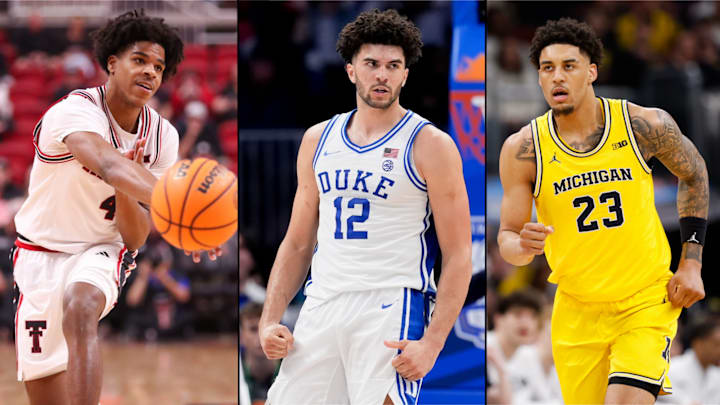
Ranking the Best 68 Men’s Basketball Players in the March Madness Field
In this story:
This is college basketball’s most talented season of the 21st century.
The freshman class is absolutely loaded, and could produce the most one-and-done lottery picks in NBA draft history this summer. Experienced stars are staying in college longer thanks to seven-figure NIL deals. And top European talent that never considered college before are now the faces of some high-profile teams that are dancing this March.
All that sets the stage for an NCAA tournament with the potential to be epic. If the grind-it-out, sometimes-ugly games of the 2010s weren’t your speed, don’t fear. Scoring and efficiency is up all season, and you can expect that trend to continue into the Big Dance, thanks in large part to all this impressive star power.
With that in mind, Sports Illustrated set out to rank the top 68 players in this year’s Big Dance. It’s a laborious task with lots of details to consider: Talent, production, team impact and the chance to make a run were all weighed. But the end product gives a comprehensive look at the potential stars of March, from top draft prospects to mid-major stars and everyone in between.
SI’s Kevin Sweeney drove the rankings process, with Patrick Andres, Tim Capurso, Zach Koons, Mike McDaniel and Blake Silverman contributing as well.
1. Cameron Boozer, Duke
Boozer is a shoo-in All-American for the NCAA tournament’s top overall seed and has performed as advertised as one of the NBA’s top prospects in the draft later this summer. In the meantime, Boozer is trying to will his team to a national title after averaging a double-double and doing it all on both ends for Jon Scheyer’s best team to-date.
2. AJ Dybantsa, BYU
BYU has struggled significantly on both ends of the floor since the season-ending ACL tear to star wing Richie Saunders, but future top-three pick Dybantsa has done his best to keep the program afloat. Much like Boozer, Dybantsa has lived up to the hype this season, averaging over 25 points per game on 52% shooting. He’s a special player.
3. Yaxel Lendeborg, Michigan
The UAB transfer didn’t skip a beat in his move up to the high-major level, earning Big Ten Player of the Year honors with the dominant Wolverines. Michigan’s remarkable depth prevents Lendeborg from putting up gaudy numbers, but his efficiency and lockdown defensive ability make him one of the most well-rounded players in the NCAA tournament field.
4. Darius Acuff Jr., Arkansas
Acuff, averaging over 20 points and six assists per game, is on pace to become the first player since Pete Maravich to lead the SEC in scoring and assists in the same season. The uber-efficient Arkansas star guard, who has made countless clutch shots for the Razorbacks this season, has a game meant for the bright lights of March Madness.
5. Christian Anderson, Texas Tech
A standout at last year’s FIBA U19 World Cup, Anderson’s had a breakout sophomore season for the Red Raiders. He’s one of the best three-point shooters in the nation, connecting on his eight attempts per game at a 42.7% clip. If that’s not enough, Anderson is even better as a creator. He’s third in the nation with 7.8 dimes per game as the straw that stirs the drink for Texas Tech.
6. Keaton Wagler, Illinois
The fast-rising Wagler was not expected to have this kind of impact as a freshman, but he’s been one of the best players in college basketball this season for the Illini. Wagler’s defense has been better than anticipated, and he's been Illinois’s best playmaker on the offensive end this season, where he is averaging 18/4/4 on 45% shooting.
7. Darryn Peterson, Kansas
When he’s healthy, few players in the country are better—ask Kansas State, which allowed Peterson 27 points in the Jayhawks’ regular-season finale. However, ‘when’ is the operative word here, as he’s been shuttled in and out of the Kansas lineup all season due to various injuries.
8. Jeremy Fears Jr., Michigan State
Hysteria over Fears’s alleged dirty play overshadowed a breakout season for the Joliet, Ill., native. Through March 8, his 9.1 assists per game led the country, and he’s assisted on more of his team’s buckets percentage-wise than any player in the history of Division I men’s college basketball.
9. Braden Smith, Purdue
Smith continues to chase the NCAA’s all-time assist record of 1,076 held by Bobby Hurley, and he will likely break the mark in the first round of the NCAA tournament. He’s an All-American point guard for good reason, and the most important piece of a deep Purdue run.
10. Thomas Haugh, Florida
Haugh, a junior, stepped into a full-time starting role this season for the reigning national champions and has not disappointed. In 33.4 minutes per game, Haugh is averaging a career-high 17.2 points to go along with 6.1 rebounds on greater than 47% shooting from the floor. The 6' 9" junior is converting on just 34% of his three-point attempts, but can get hot from beyond the arc, which will be something to keep an eye on if the Gators are going to reach their offensive ceiling this postseason.
11. Labaron Philon Jr., Alabama
The wiry sophomore guard has been one of the SEC’s premier offensive players this season, averaging over 21 points per game on 50% shooting from the floor. Philon is also converting nearly 40% of his three-point attempts, which is a significant jump in his game from a year ago. His sophomore leap both offensively and defensively, where he has proven to be a perimeter disruptor, has made Alabama one of the SEC’s top threats to make a Final Four.
12. Joshua Jefferson, Iowa State
Iowa State’s Mr. Do-It-All, Jefferson is a stat-sheet stuffer, as he became the first player in Big 12 and Cyclones program history to log multiple games with a triple-double this season. But Jefferson’s most important superpower is his ability to guard every position on the floor, an invaluable piece of Iowa State’s elite defense.
13. Bennett Stirtz, Iowa
Jumping from Drake to the Hawkeyes this offseason, Stirtz made a seamless transition to the Big Ten alongside coach Ben McCollum. His 20.2 points per game are actually an improvement year over year despite jumping from MVC to Big Ten opposition, and he may have played his way into the first round of the NBA draft.
14. Zuby Ejiofor, St. John’s
Ejiofor has been so good during his three years at St. John’s that legendary coach Rick Pitino joked that the fourth-year senior is “going to make me retire” when he graduates. Just the eighth player in Big East history to win Player of the Year and Defensive Player of the Year in the same season, Ejiofor is the beating heart of the Red Storm’s defense and also its leading scorer.
15. Kingston Flemings, Houston
Rim protectors around the country are on constant alert when the explosive and quick Flemings is coming downhill with the ball. An All-Big 12 first-team selection, deadly three-level scorer and creative facilitator, the Cougars will go as far as Flemings can take them in March.

16. Brayden Burries, Arizona
Burries has come a long way after a slow start to the year, with 11 games of 20-plus points after failing to eclipse 10 points in four of his first five regular-season games. Burries’s inside-out scoring approach and ability to play on and off the ball have opened things up for the Arizona offense, while his solid on-ball defensive skills have been valuable to one of the nation’s most analytically efficient defenses.
17. Morez Johnson Jr., Michigan
The Illinois transfer has leveled up in his sophomore season, nearly doubling his scoring average from his freshman year while leading Michigan in rebounding. But Johnson makes perhaps his biggest impact on the Wolverines with his defense, as he has the ability to guard opposing bigs using his 7' 2" wingspan while also being able to switch onto the perimeter and guard wings.
18. Graham Ike, Gonzaga
Ike is a walking bucket, having scored more than 15 points in every game since the start of the New Year—and eclipsing the 20-point mark in 11 of those 15 outings. Listed at 6' 9", 250 pounds, the WCC Player of the Year is punishing on both ends of the floor for a Gonzaga team that has deep-run potential.
19. Tyler Tanner, Vanderbilt
After coming off the bench as a reserve in 33 games a year ago, Tanner stepped into a starting role this year and has performed perhaps even better than anticipated. The sophomore has been dominant defensively, averaging nearly 2.5 steals per game, while showing a bit of everything on offense. Entering the SEC tournament, Tanner was averaging 19.2 points per game and 5.2 assists on 49.5% shooting from the floor and nearly 38% shooting from three.
20. Jaden Bradley, Arizona
There are very few backcourt players you’d rather have this time of year than Bradley. The senior guard is one of the best two-way players in college basketball, combining his elite perimeter defense with a shooting percentage north of 46% for the third consecutive season. He’s one of the best guards in the country.
21. Alex Condon, Florida
Condon, one of just four players nationally averaging at least 14.0 points, 7.5 rebounds and 3.5 assists per game, is a key cog in the Gators’ elite rebounding machine, as well as an energetic and versatile defender capable of protecting the rim. If Florida is to repeat in 2026, the do-it-all Condon’s fingerprints will be all over the championship run.
22. Milan Momcilovic, Iowa State
Momcilovic is the best shooter in the country, full stop. He leads the nation having connected on 50% of his threes this season and done so while taking 7.4 attempts per game—absurd efficiency at a high clip. His long frame makes him extremely difficult to guard when he’s in rhythm, and it doesn’t take much for him to get hot.
23. Alex Karaban, UConn
The only two-time champion on this list, Karaban is the heart and soul of Dan Hurley’s UConn program, as evidenced by the emotional senior day for both player and coach. Flanked this season by skilled guards, the four-year starter has gotten back to what he does best—working off the ball and knocking down threes at a 40% clip.
24. Nick Boyd, Wisconsin
Wisconsin will go as far in the NCAA tournament as Boyd and fellow guard John Blackwell can take them. And Boyd, a strong on-ball defender, capable three-point shooter and a big-time clutch scorer, could help the Badgers enjoy a deep run having already helped one team—2022–23 Florida Atlantic—to the Final Four in his collegiate career.
25. Motiejus Krivas, Arizona
There’s a case to be made for Krivas as the defender who has the most impact in the country. Arizona’s defense was more than 15 points per 100 possessions better with him in the game during the regular season, and teams shot an NCAA-low 39.6% from two in those minutes. He could make a Donovan Clingan–like impact on the Big Dance.

26. Aday Mara, Michigan
Michigan’s defense ranks third in adjusted defensive efficiency and first in effective field goal percentage allowed—and Mara is arguably the biggest reason why. The 7' 3" Mara, Michigan’s first Big Ten Defensive Player of the Year since 1988, forces teams into taking long twos and threes thanks to his sheer size, wingspan and shot-blocking ability (2.6 blocks per game).
27. Bruce Thornton, Ohio State
The picture of consistency is riding a tidal wave of goodwill into the Big Dance, having broken the Buckeyes’ scoring record in a season-ending victory over Indiana. Thornton—the conference’s leader in win shares—and Ohio State appear to be peaking at the right time after an up-and-down regular season.
28. Mark Mitchell, Missouri
Mitchell started his career as a role player at Duke but has turned into a star at Mizzou, emerging as a point forward of sorts who leads the Tigers in points, rebounds and assists. He lives at the free throw line, attempting eight shots from the charity stripe per game, and is a matchup nightmare for opposing defenses with his strength and physicality.
29. Nate Ament, Tennessee
After starting slow in nonleague play, Ament averaged 19 points and six rebounds per game in SEC play for Tennessee to reestablish himself as a premier draft prospect in this class. A strong March could further boost his stock and help the Vols toward that elusive Final Four.
30. Tarris Reed Jr., UConn
The senior center has been monumental in the middle of the Huskies’ defense, and will be key to a deep tournament run for UConn. Reed is a walking double-double, having notched double figures in points and rebounds in four of the last five regular-season games entering the Big East tournament. Reed averages 14 points and eight rebounds per game and is averaging a career-best in blocks with over two per contest.
31. Silas Demary Jr., UConn
A Naismith Defensive Player of the Year finalist, Demary has helped UConn field one of the best defenses in the country and has been an incredibly efficient scorer and passer on the offensive end. Entering March Madness, Demary gives the Huskies what they had during their back-to-back title runs—and what they lacked last year: elite point guard play.
32. Ja’Kobi Gillespie, Tennessee
At a time of year where having veteran guard play is paramount, there are few better than Gillespie, a Maryland transfer who has gotten better each season he’s played college basketball. Gillespie is averaging 18.0 points and 5.6 assists per game, to go along with 2.1 steals per contest. He’s also a 40% shooter from the floor while taking over 15 shots per game. The Volunteers offense runs through the senior.
33. Mikel Brown Jr., Louisville
Brown has fought injuries all season, but when healthy, he’s flashed the offensive game to show why he’s a projected lottery pick. Brown missed the ACC tournament due to a back injury, one that coach Pat Kelsey hopes will heal in time for the NCAA tournament. If Brown is anywhere near full health, he could be a star of March. He’s averaging 18.2 points per game this season and has nine games of 20 points or more (including a season-high 45-point effort against NC State on Feb. 9).
34. Henri Veesaar, North Carolina
The role of Veesaar for North Carolina’s NCAA tournament run gained even more importance when it was announced that Caleb Wilson would miss the rest of the season due to surgery on a fractured thumb. Veesaar has been an anchor both offensively and defensively in the Tar Heels’ frontcourt, but his perimeter shooting is where he’s taken the biggest step forward since transferring from Arizona. The 7-footer is taking nearly three shots per game from beyond the arc (a career high), and is converting those threes at over a 41% clip.
35. Flory Bidunga, Kansas
Kansas is a markedly better offensive and defensive team when the rim-rattling and shot-blocking Bidunga, who ranked inside the top 10 in field goal percentage and blocked shots this season, is on the court. Thanks to his elite rim protection and switchability, Bidunga could have a massive defensive impact in March.

36. Pryce Sandfort, Nebraska
Few shooters in the sport strike fear into defenses like Sandfort, who’s now well north of 100 made triples on the season. He can take over games at times, like when he scored 26 points on 10-of-13 shooting in the first half alone of a road win at Illinois.
37. Tyler Bilodeau, UCLA
Bilodeau is the prototypical stretch four, throwing in triples at a blistering 46% clip in the regular season and leading UCLA in scoring at 18 points per game. He’s a model of consistency for the Bruins this season, a big reason they won four of five down the stretch in Big Ten play to clinch a spot in the field.
38. Thijs De Ridder, Virginia
Arriving at Virginia after years of professional basketball in Europe, and on Belgium’s national team, the 23-year-old is perhaps the most poised freshman in the college game. Capable of scoring at all three levels, De Ridder is well-rounded and versatile, and led the Cavaliers to their best season since winning the 2019 national championship.
39. Rueben Chinyelu, Florida
Haugh and Condon get much of the praise in the loaded Florida frontcourt, but you could argue its MVP is Chinyelu. He’s an absolute force on the glass and a game-changing defender that can switch onto guards, battle with bigs and protect the rim.

40. Emanuel Sharp, Houston
Sharp provided the lasting image of heartbreak from the 2025 national championship game, when he crouched with his head in his hands after failing to get off a shot in the closing seconds of Houston’s loss to Florida. But redemption has been on the senior guard’s mind, as he averaged a career-high 15.8 points while providing the Cougars with stable leadership throughout a dominant regular season.
41. Isaiah Evans, Duke
The 6' 6" sophomore has been Duke’s second-best offensive player behind Boozer this season, and has become indispensable for Scheyer’s No. 1-seeded Blue Devils. Evans has made a leap in his second season at Duke, flashing an excellent offensive game with play on the defensive end that has improved as the season has gone on. Evans is averaging 14.5 points per game on nearly 43% shooting.
42. Malik Reneau, Miami
Reneau’s homecoming at Miami after three years at Indiana has been as good as anyone could have asked for. He blossomed into a first-team All-ACC selection this season under Jai Lucas’s tutelage, finally putting it all together after some frustrating moments while with the Hoosiers. He’s perhaps the biggest reason for the Canes’ remarkable Year 1 turnaround under Lucas.
43. Koa Peat, Arizona
The five-star recruit stayed home in Arizona and immediately made his mark for the Wildcats with 30 points in his debut, a win over defending champion Florida. He then bookended his regular season with a 25-point explosion against Colorado, showing he’s capable of scoring in bunches—and supporting the rest of Arizona’s loaded roster from the shadows.
44. John Blackwell, Wisconsin
The other star in Wisconsin’s elite backcourt, Blackwell enters the Big Dance just shy of 1,500 career points in three seasons with the Badgers. Both he and Boyd are more than capable of taking over a game in the tournament.
45. Donovan Dent, UCLA
Dent arrived in Westwood with tons of hype and struggled much of the way, but of late there have been very few point guards playing better than he has. He posted an incredible 78 assists to just six turnovers in his final seven-plus games before leaving early against Purdue in the Big Ten semifinals with a calf strain.

46. Rienk Mast, Nebraska
Mast’s tenure in Lincoln has been transformational. He transferred into the Huskers program with Fred Hoiberg on the hot seat and took them dancing in the 2023–24 season, then came back off serious knee surgery this year to lead the charge for Nebraska’s best season ever. His shooting ability as a big man opens the floor up big time.
47. Otega Oweh, Kentucky
The 6' 4", 220-pound Oweh is a constant threat to score in the paint thanks to his combination of athleticism and strength, and his disruptive defense—1.8 steals per game—is key to kickstarting Kentucky’s strong transition offense. Oweh’s ability to impact the game on both ends of the floor will give the Wildcats an edge late in close games in the NCAA tournament.
48. Boopie Miller, SMU
The best sobriquet in college basketball (real name: Kevin) dazzled on Jan. 14 with a stunning buzzer beater against Virginia Tech, and closed the regular season with 32 against Florida State on Sunday. The Mustangs faded to close the regular season, but the Chicago native remains dangerous in his breakthrough fifth campaign.
49. Tamin Lipsey, Iowa State
One of the best floor generals at the high-major level, Lipsey is capable of getting his own shot or setting the table for his teammates—as evidenced by career-highs in points (13.2) and assists (5.0) per game this season. Though his shooting has taken a dip, particularly in Iowa State’s recent string of losses, the senior has a knack for making the right play in close games.
50. Mason Falslev, Utah State
If Utah State makes a Cinderella run, Falslev will likely have his fingerprints all over it. He’s a stud in the Aggies’ backcourt, shooting better than 50% from the floor and 40% from three. He’s also the consummate winner: 28 wins in 2023–24, 26 in 2024–25, and 28 in 2025–26 entering the dance.
51. Dailyn Swain, Texas
Swain willed Texas to the NCAA tournament after following coach Sean Miller from Xavier to the Longhorns, blossoming into a star as a junior. Good luck stopping him when he gets a head of steam going to the rim.
52. Paulius Murauskas, Saint Mary’s
The Lithuanian forward has been a standout for Saint Mary’s the last two seasons after transferring in from Arizona. He’s a versatile piece that can punish smaller defenders around the rim, pull bigger ones away from the hoop and rebound at a very high level.

53. Melvin Council Jr., Kansas
The St. Bonaventure transfer’s move up has paid off in a big way. While Council doesn’t put up scoring numbers like Darryn Peterson, he’s integral to the Jayhawks’ offense. He keeps the ball moving and tends to make the smart play, with 5.2 assists per game when no other Kansas player averages even two. Council has scoring pop when the Jayhawks need it too, which has been valuable with Peterson in and out of the lineup. In Kansas’s overtime win over NC State on Dec. 13, Council went off for 36 points, draining nine threes in the close call.
54. Ryan Conwell, Louisville
Conwell can be streaky as a shooter but when he gets hot—particularly from three-point range—look out. Conwell, who tied for seventh in the nation in triples made this season, has helped turn Louisville into one of the better three-point shooting teams in the country, a big improvement from last year’s team that bowed out in the first round of the NCAA tournament.
55. Patrick Ngongba, Duke
The 6' 11" sophomore has been banged up down the stretch of the season, missing several regular season games and the ACC tournament with a sore foot. But when he’s in the lineup, Ngongba is a rim-running big who has been key to Duke’s success. He’s averaging 10.7 points and 6.0 rebounds per game entering the NCAA tournament to go along with 1.1 blocks per contest.
56. Trey Kaufman-Renn, Purdue
After his junior year explosion in 2024–25, Kaufman-Renn projected to be one of the best players in the country this season, but that hasn’t quite come to fruition. Still, his crafty post footwork and tenacious rebounding ability (8.7 boards per game) make him a lethal roll man and running mate alongside point guard Braden Smith.
57. Robbie Avila, Saint Louis
The bespectacled big man is the nexus point for the Saint Louis offense, now in its second year under former Indiana State coach Josh Schertz. The Sycamores’ success first thrust Avila into the spotlight in 2024, but he’s grown into an even better passer and shooter (42.3% from beyond the arc) as a senior. He played just 25 minutes per game this season—and still was named Atlantic-10 Player of the Year.

58. Kylan Boswell, Illinois
Boswell is the heart and soul of Illinois, a Champaign native who transferred home after two years at Arizona. He’s among the nation’s best and most versatile on-ball defenders and an essential piece of the puzzle for the Illini offensively as a guy who can consistently touch the paint.
59. Peter Suder, Miami (Ohio)
Suder, the Redhawks' leading scorer, is the nerve center of one of the most surprising teams in the history of the sport. His 37-point outing against Buffalo on Jan. 17—capped by a game-winning three-pointer—kept Miami (Ohio) undefeated, and he's in the top 10 of the MAC in both offensive and defensive win shares.
60. David Punch, TCU
A major catalyst for TCU’s late-season surge into the Big Dance, Punch is among the nation’s top power forwards. He’s a game-changing defender that stacks up steals and blocks with the best of them, and has risen to the challenge offensively in some of TCU’s top matchups like his 19-point, nine-rebound explosion in a November upset of Florida.
61. Allen Graves, Santa Clara
Analytical models love this redshirt freshman so much he has started popping up on draft boards despite coming off the bench for the Broncos. His game might remind some fans of a mid-major Cameron Boozer, stuffing the stat sheet as a forward with impressive feel for the game and an improving jump shot.
62. Quadir Copeland, NC State
Copeland, a senior guard, followed Will Wade from McNeese State to NC State this season and has put together his best season to-date. The senior spent his first two seasons at Syracuse before transferring to McNeese, and his comfortability against ACC competition has been apparent. Copeland is averaging 14.0 points and nearly seven assists per game on 50% shooting from the floor and better than a 40% mark from three. He’s the Wolfpack’s best offensive player, and has made an impact defensively as well, averaging nearly two steals per night.
63. Tavari Johnson, Akron
Only two players in this tournament average at least 20 points and five assists per game: Darius Acuff and Johnson. The diminutive Chicago native is an absolute bucket capable of taking over a game with his shot-making or distribution skills.
64. Cruz Davis, Hofstra
Davis started his career playing for Rick Pitino at Iona and St. John’s but has turned into a star playing for Speedy Claxton at Hofstra. The lefty scored a combined 58 points in two wins over Syracuse and Pittsburgh, signs he could light it up against high-major competition in the tournament.

65. Alex Wilkins, Furman
Few mid-major freshmen got handed the keys the way Wilkins did this season at Furman, and coach Bob Richey’s confidence in the Massachusetts native clearly paid off. Wilkins averaged nearly 18 points per game, topped 25 seven times and showcased impressive shot-making upside.
66. Dominique Daniels, California Baptist
Daniels was one of the best mid-major players last spring to not hit the portal, so it's cool to see him get rewarded with a trip to the Big Dance. His performance down the stretch of the WAC title game vs. Utah Valley was epic, drilling three triples in the final two minutes to flip a six-point deficit into a two-point win.
67. Izaiyah Nelson, South Florida
A double-double machine, Nelson followed Bryan Hodgson from Arkansas State to South Florida and became one of the best players in the American. He's an athletic big man who dominates around the rim and on the offensive glass.
68. TJ Power, Penn
Power delivered the performance of a lifetime in the Ivy League title game, scoring 44 points and grabbing 14 rebounds in an overtime win over favorite Yale, including two threes in the final 10 seconds to force overtime. Once an elite recruit who struggled at Duke and Virginia, Power has found his footing playing for Fran McCaffery and the Quakers.
More March Madness from Sports Illustrated
Listen to SI’s college sports podcast, Others Receiving Votes, below or on Apple and Spotify. Watch the show on SI’s YouTube channel.
 Add us as a preferred source on Google