%20%20--%3E%0A%3Csvg%20version%3D%221.1%22%20id%3D%22Layer_1%22%20xmlns%3D%22http%3A%2F%2Fwww.w3.org%2F2000%2Fsvg%22%20xmlns%3Axlink%3D%22http%3A%2F%2Fwww.w3.org%2F1999%2Fxlink%22%20x%3D%220px%22%20y%3D%220px%22%0A%09%20width%3D%2239px%22%20height%3D%2240px%22%20viewBox%3D%220%200%2039%2040%22%20enable-background%3D%22new%200%200%2039%2040%22%20xml%3Aspace%3D%22preserve%22%3E%0A%3Cpath%20fill%3D%22%23FFFFFF%22%20d%3D%22M38.5%2C7H28.2v26h10.3V7z%22%2F%3E%0A%3Cpath%20fill-rule%3D%22evenodd%22%20clip-rule%3D%22evenodd%22%20fill%3D%22%23FFFFFF%22%20d%3D%22M26.1%2C25.5c0%2C5.8-4.1%2C7.5-12.9%2C7.5C3.9%2C33%2C0%2C31.2%2C0%2C25.2v-1.1h11.6%0A%09v2.4c0%2C0.7%2C0.1%2C1.4%2C1.2%2C1.4c1%2C0%2C1.2-0.4%2C1.2-1.3v-0.9c0-1.6-0.9-1.6-3.5-2.2C2.2%2C21.7%2C0%2C19.7%2C0%2C15.3v-0.9C0%2C9.3%2C5.5%2C7%2C12.9%2C7%0A%09c10.2%2C0%2C12.8%2C2.6%2C12.8%2C7.4v1.8h-11v-2.9c0-0.6-0.4-1.1-1.2-1.1c-0.6%2C0-1.2%2C0.4-1.2%2C1.1v0.9c0%2C1.5%2C0.9%2C2%2C3.3%2C2.5%0A%09c8%2C1.6%2C10.5%2C3.3%2C10.5%2C7.5V25.5z%22%2F%3E%0A%3C%2Fsvg%3E%0A)
Pat Forde: Brett Yormark Stabilized the Big 12 Amid Realignment. His Successor’s Job May Be More Difficult.
In this story:
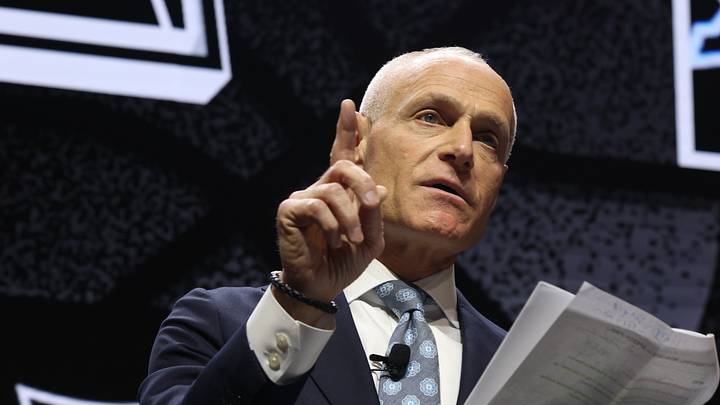
Brett Yormark took over the No. 4 conference in college athletics in 2022 and will leave with the Big 12 as the No. 4 conference. But that certainly doesn’t mean he and the league simply stood still for four years.
Stepping into a fragile league at a fraught moment in the evolution of the industry, Yormark hustled and maneuvered to stabilize the Big 12—expansion to add Colorado, Utah, Arizona and Arizona State, then quickly landing a combo-platter media rights deal. After establishing his marketing and business chops, Yormark showed his leadership ability last spring by forcing Texas Tech to abandon any pretense of playing quarterback Brendan Sorsby.
Nobody believed the 60-year-old was in it for the long haul, and that proved to be true. But he didn’t just cash checks and stand on the sideline while waiting for the next gig (which remains undisclosed, after his sudden announcement that he’s departing the Big 12 on Jan. 31, 2027). Yormark had an impact, and a largely positive one at that.
The future remains murky, but that has less to do with the Big 12 than the rest of its power-conference peers. At least the league still has a place at the table, which was in peril five years ago.
In the wake of the potentially devastating defections of Texas and Oklahoma to the SEC, credit the Big 12 with a self-awareness that led to self-preservation. The remaining schools were relative equals who needed each other to survive as a power conference, so they stuck together under Bob Bowlsby. They smartly added BYU, Houston, Cincinnati and Central Florida to remain viable.
Then Bowlsby retired, and Yormark was the mold-breaking reset for the next phase in life after the Longhorns and Sooners.
Adding the so-called Four Corners Schools as the Pac-12 collapsed made immediate sense. They fit the profile of the rest of the league while offering some growing TV markets (particularly Phoenix and Salt Lake City). Then jumping the media-rights renegotiating line to get a deal done—primarily with ESPN and Fox—was a smart play that avoided being last into a saturated and complicated market. What could have ended badly instead ended safely, if not spectacularly, in terms of incoming revenue.
From there, Yormark has not been afraid to take outside-the-box swings. Some were hits, some were whiffs.
League membership wasn’t shy about pushing back on his Connecticut expansion gambit, which was a basketball-centric ambition for a league that is already flush with basketball powers. International competition—primarily in Mexico—never took off. The light-up, glass court at last year’s Big 12 tournament was a debacle, and Yormark wasn’t too prideful to admit it and replace the floor for the end of the men’s tourney. The Monster Energy agreement yielded a gaudy logo but not commensurate gaudy revenue.

The gimmickry gave way to substance during l’affair Sorsby, as league disruptor Texas Tech tried to finagle a big-dollar transfer quarterback into uniform despite breaking nearly every NCAA gambling rule on the books. This was a serious hot potato, with the Big 12’s most ambitious—and reckless—football program pushing too far. With the backing of 15 other schools, Yormark and the league filed a federal lawsuit that checkmated Sorsby and removed him from college football.
That was a tough thing to do to a program that had been to the 2025 College Football Playoff and looked like it would be the favorite to repeat with Sorsby. But it was the right thing to do, and it was necessary for conference solidarity.
Without Sorsby, the Big 12 still has multiple playoff contenders as of now, including one-loss Texas Tech, heading into a big home game Saturday against one-loss Arizona. BYU (6–1) boosted the league’s reputation and power ratings by taking down Notre Dame. Utah remains undefeated going to Cincinnati. The football product is in good shape.
The question is whether it can ever elevate to great shape. The ceiling remains—much lower than the Big Ten and SEC, and slightly lower than the ACC, which at least has No. 1-ranked Miami and a pair of other programs with national championships in the last 13 years. But the ACC also is dealing with ongoing destabilization, with Florida State, Clemson, North Carolina and Miami among those who are positioning themselves to eventually go elsewhere. (Their political fight against the expansion-limiting provisions in the Protect College Sports Act makes clear their future intentions.)
“Elsewhere,” of course, is either the Big Ten or SEC. Not the Big 12. Which leads to the great unknown of what college sports will look like in five to 10 years.
If the Big Ten and SEC annihilate everyone else, they’ll divide what few spoils remain—with North Carolina and Virginia probably topping that list, but Miami, Clemson and Florida State could factor in. The Big 12 might have no poachable assets—which cuts both ways. Good for stability but essentially guaranteed second-tier status.
If there is a 36-to-40 school super league, the rest of the ACC could well align with the Big 12 in a survivors’ second tier of roughly 30 schools. Throw that group in with some or all of the rest of FBS and you have … something. It would be the final fracturing of college sports, and there will only be a finite number of winners in that scenario.
In looking ahead at that potential landscape, Yormark’s successor at the Big 12 needs to be someone more like him and less like the traditional commissioner. The old guard has been on the way out in recent years anyway, with the SEC’s Greg Sankey and the ACC’s Jim Phillips the last of that breed at the power-conference level. (Both have been adaptable to the modern realities of college sports, which has kept them viable.)
The next Big 12 commissioner might not be Yormark 2.0, but he or she needs to be someone who can creatively try to keep the league viable for what comes next. For much of the conference, there is only so much that can be done in terms of upgrading their marketability. But all options must be explored.
The Big 12 hasn’t transformed under Brett Yormark, but it has survived and improved. That’s a job well done in a tumultuous four-year period. What happens next is the scary part.
PODCAST: Listen to Sports Illustrated’s college sports podcast, Others Receiving Votes, hosted by Pat Forde, on Apple and Spotify. Watch the show on SI’s college YouTube channel or on SI TV.
 Add us as a preferred source on Google

Pat Forde is a senior writer for Sports Illustrated who covers college football and college basketball as well as the Olympics and horse racing. He cohosts the Others Receiving Votes podcast for SI and is a regular contributor to the Tony Kornheiser Show podcast. He previously worked for Yahoo Sports, ESPN and The (Louisville) Courier-Journal. Forde has won 28 Associated Press Sports Editors writing contest awards, has been published three times in the Best American Sports Writing book series, and was nominated for the 1990 Pulitzer Prize. A past president of the U.S. Basketball Writers Association and member of the Football Writers Association of America, he lives in Louisville with his wife. They have three children, all of whom were collegiate swimmers.
Follow ByPatForde