%20%20--%3E%0A%3Csvg%20version%3D%221.1%22%20id%3D%22Layer_1%22%20xmlns%3D%22http%3A%2F%2Fwww.w3.org%2F2000%2Fsvg%22%20xmlns%3Axlink%3D%22http%3A%2F%2Fwww.w3.org%2F1999%2Fxlink%22%20x%3D%220px%22%20y%3D%220px%22%0A%09%20width%3D%2239px%22%20height%3D%2240px%22%20viewBox%3D%220%200%2039%2040%22%20enable-background%3D%22new%200%200%2039%2040%22%20xml%3Aspace%3D%22preserve%22%3E%0A%3Cpath%20fill%3D%22%23FFFFFF%22%20d%3D%22M38.5%2C7H28.2v26h10.3V7z%22%2F%3E%0A%3Cpath%20fill-rule%3D%22evenodd%22%20clip-rule%3D%22evenodd%22%20fill%3D%22%23FFFFFF%22%20d%3D%22M26.1%2C25.5c0%2C5.8-4.1%2C7.5-12.9%2C7.5C3.9%2C33%2C0%2C31.2%2C0%2C25.2v-1.1h11.6%0A%09v2.4c0%2C0.7%2C0.1%2C1.4%2C1.2%2C1.4c1%2C0%2C1.2-0.4%2C1.2-1.3v-0.9c0-1.6-0.9-1.6-3.5-2.2C2.2%2C21.7%2C0%2C19.7%2C0%2C15.3v-0.9C0%2C9.3%2C5.5%2C7%2C12.9%2C7%0A%09c10.2%2C0%2C12.8%2C2.6%2C12.8%2C7.4v1.8h-11v-2.9c0-0.6-0.4-1.1-1.2-1.1c-0.6%2C0-1.2%2C0.4-1.2%2C1.1v0.9c0%2C1.5%2C0.9%2C2%2C3.3%2C2.5%0A%09c8%2C1.6%2C10.5%2C3.3%2C10.5%2C7.5V25.5z%22%2F%3E%0A%3C%2Fsvg%3E%0A)
Football School or Basketball School? The NIL Era Redefines One of the Greatest Questions in College Sports
In this story:
In the age of NIL and revenue sharing, programs across Division I college athletics have had to make a decision.
Do we fund football or do we fund men’s basketball?
Of course, there are a few exceptions where a program can fund both. However, for the vast majority, a decision has been made between the two highest-generating revenue sports in major college athletics.
With the spring transfer portal closing for basketball, and in the absence of a post-spring transfer portal for football in 2026, we now have a clear view of what rosters will look like for schools next fall when football kicks off and basketball season nears.
Sports Illustrated took a look at a handful of schools for this exercise, and based on transfer portal hauls in both sports, made a determination on whether the university should be considered a football school or basketball school.
Read ’em and weep.
Indiana Hoosiers

The case for football:
This one should be quite simple in Bloomington. Curt Cignetti just led Indiana to its first-ever national championship in football in January. The Hoosiers’ historic run to an undefeated season capped a phenomenal two-year start to the Coach Cig era at Indiana, where he has gone 27–2 with two College Football Playoff appearances and a title.
Led by Heisman-winning quarterback and No. 1 NFL draft pick Fernando Mendoza, IU went 16–0. The Hoosiers will look to continue their unprecedented football success this fall, with TCU transfer quarterback Josh Hoover the prized commitment in the portal this offseason. But he is just one of the 17 commitments that Indiana earned for its ninth-ranked portal class in college football, per 247Sports. Other key commitments include interior offensive lineman Joe Brunner from Wisconsin, cornerback A.J. Harris from Penn State and wide receivers Nick Marsh from Michigan State and Shazz Preston from Tulane.
The Hoosiers should once again be considered one of the Big Ten favorites heading into the fall.
The case for basketball:
Indiana’s portal haul for football can only be outdone by its portal recruiting in basketball, where the Hoosiers are determined to contend in the Big Ten next season and on paper, be a shoo-in for an NCAA tournament bid.
The Hoosiers added point guard Bryce Lindsay from Villanova and power forward Aiden Sherrell from Alabama. Indiana also added size with former SMU center Samet Yigitoglu, and a versatile playmaker in Markus Burton from Notre Dame. To top it off, the Hoosiers also secured commitments from Duke wing Darren Harris and Georgia Tech shooting guard Jaeden Mustaf.
The rotation has been totally overhauled for a program that missed the tournament in a disappointing first year under Darian DeVries. Indiana appears poised to contend in a loaded Big Ten next season and is going back to its roots with a commitment to hoops for a program with a rich basketball history.
The verdict: Football School
In most informed minds, Indiana is and always will be a basketball school. But all of that goes out the window when the basketball program hasn’t contended in a while, and the football program has reached unprecedented heights.
Basketball’s portal haul can make the argument to be even better than a strong portal class for Cignetti’s third season on the gridiron, but it’s hard to view Indiana as anything other than a football school until further notice. It’s now on DeVries to help the basketball program reach its potential in his second season in Bloomington—otherwise, he could have a short coaching stint.
BYU Cougars

The case for football:
BYU’s strongest case as a football school stems from the program’s ability to retain coach Kalani Sitake, who was squarely in the mix for the Penn State opening last fall after James Franklin was fired. The Nittany Lions put on a full court press to land Sitake, who ultimately landed a contract extension that came with a stronger financial commitment to continue building the football program.
The Cougars have always been viewed as a developmental football program, doing its best work in landing who they can at the high school level and developing prospects into contributors deep into their careers in Provo. But BYU added some key pieces in the football portal this offseason, with former Stanford quarterback Bear Bachmeier chief among them. Bachmeier is expected to start this fall.
BYU’s transfer class is rated No. 83 in the FBS per 247, a testament to the program’s continued commitment to development.
The case for basketball:
BYU earned the commitment of one of the nation’s top basketball prospects last cycle in A.J. Dybantsa, who lived up to every bit of the hype in his only season with the Cougars. The All-American averaged better than 25 points per game and declared for the NBA draft, where he is expected to be a top-three pick.
How did BYU replace him? By signing blue-chip prospect Bruce Branch III. He will take on the brunt of the responsibility for the Cougars as a freshman next season, but Kevin Young’s staff also added Clemson forward Jake Wahlin, Syracuse forward Tyler Betsey and Kentucky guard Collin Chandler to fortify the roster.
The verdict: Basketball School
As long as BYU keeps ponying up money for high school prospects with NBA lottery potential, it should be viewed as a basketball school. The Cougars have also spent plenty of money in the transfer portal to add to their roster. It feels like only a matter of time before Young sees similar success to Sitake on the hardwood.
Football is taking a developmental approach, while basketball is swinging for the fences with elite star power. Football has a longer track record of success in contending in the Big 12, but has yet to win a conference title under Sitake. BYU seems poised to win a conference title on the hardwood in the near future with the stars it continues to add. Slight nod to basketball while we wait to see what Sitake does with a greater financial football commitment.
Kentucky Wildcats

The case for football:
Kentucky paid the buyout that it didn’t want to actually pay, and got out from under the contract of former longtime head football coach Mark Stoops. It’s a new era on the gridiron under Kentucky native Will Stein, and the program has committed to flipping the football roster quickly.
The Wildcats have the No. 11 transfer portal class in 2026 per 247, and have plenty of star power entering the program for Stein’s first year. Former Notre Dame quarterback Kenny Minchey committed to Kentucky this offseason, along with Texas running back CJ Baxter. Kentucky also improved its offensive line play, securing commitments from Coleton Price from Baylor, Max Anderson from Tennessee, Olaus Alinen from Alabama, and Tegra Tshabola from Ohio State. Those are just a handful of the 29 commitments that the Wildcats landed out of the transfer portal.
No guarantees that the Wildcats will contend in the gauntlet of the SEC anytime soon, but this program should improve quickly under Stein.
The case for basketball:
Kentucky ended last season with a listless performance in a 19-point loss to Iowa State in the round of 32, leading to plenty of questions about Mark Pope and his staying power in Lexington. The offseason portal has been a mess, as Kentucky has been in play for multiple top portal players, but thus far has only added guards Alex Wilkins from Furman and Zoom Diallo from Washington. A make-or-break year for Pope is turning into a wait-and-see year as the Wildcats should enter next season with tempered expectations.
The verdict: Football School
The football program is trending up, and the basketball program is trending down. We have no choice but to label the longtime basketball school as a football school until further notice.
Louisville Cardinals

The case for football:
Louisville has long been determined to compete on the gridiron despite a more established track record of success on the hardwood. The Cardinals have won 28 games over the past three seasons under former star quarterback Jeff Brohm, who inked a contract extension after being pursued by Penn State to replace James Franklin. Louisville is serious about putting together a winning roster for football, with the No. 34-ranked recruiting class overall for 2026, and the No. 18 transfer portal class in college football. In total, the Cardinals secured commitments from 33 players in the portal, highlighted by Tulsa tight end Brody Foley and former Vanderbilt wide receiver Tre Richardson.
The case for basketball:
Louisville has loaded up on star power in the transfer portal for basketball, looking to improve upon Pat Kelsey’s first two seasons leading the program out of the heinous Kenny Payne era. Kelsey is 51–19 with two NCAA tournament appearances thus far at Louisville, with next season shaping up to be his best roster yet.
Louisville has four players committed to the program in the portal: Iowa forward Alvaro Folgueiras, Arkansas forward Karter Knox, Oregon guard Jackson Shelstad and Kansas center Flory Bidunga. That is a great core.
The verdict: Basketball School
Louisville should put together another good season in football, with a roster that is still just short of serious contention in the ACC. Another year in the nine-win range seems likely, but there’s no telling if that will be enough to land the program in the College Football Playoff. The ceiling for the basketball program is higher, as the four additions via the transfer portal is enough for the Cardinals to be considered a serious preseason contender in the ACC.
LSU Tigers

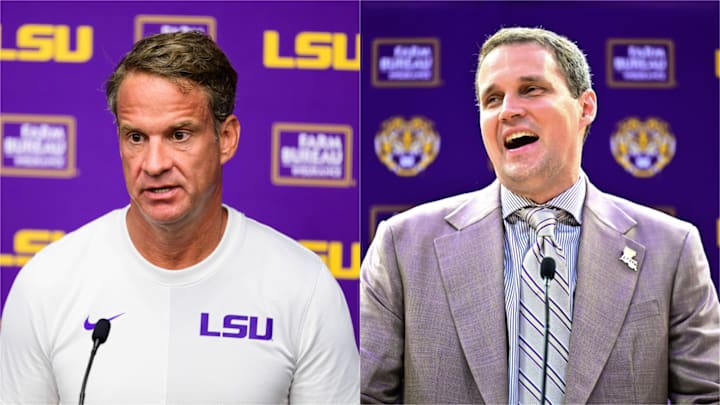
The case for football:
Lane. Kiffin.
Oh, plus his first transfer portal class, which is the best in college football per 247. LSU is leaving no financial stone unturned as the program looks to erase a Brian Kelly era that was average by program standards and never came close to national title contention.
The case for basketball:
Will. Wade.
LSU said to hell with the bad press, it’s a new era with NIL and revenue sharing, so why not hire the disgraced former coach who got himself and the university in hot water for paying players before it was permitted and getting caught red-handed via FBI wiretap?
Wade can coach, and LSU should be taken seriously once again in basketball. But it may take some time for the Tigers to return to contention, as Wade only has the No. 87 transfer class and is in need of a talent upgrade across the board. Consider the basketball program a couple years away from its Final Four potential.
The verdict: Football School
LSU is, and always will be, a football school. It’s averaged a national championship every eight years since 2003 while enjoying relatively consistent relevancy.
USC Trojans

The case for football:
Lincoln Riley said this spring that USC has “opened its championship window” for football, and that it’s taken a long time to rebuild the program to get to this point.
The heat was on Riley to begin with, and now it’s turned up to a 10, as he has put the national title-or-bust expectations on his program beginning this fall. He is 35–18 at USC, and produced a Heisman winner in his first season in Los Angeles with Caleb Williams at quarterback. Since that 11-win campaign, USC has won eight games, seven games and nine games in the three seasons.
USC hired Riley with expectations that he would have the program competing for championships. That has yet to seriously be the case, and we’re heading into year five. But Riley has the financial backing of the university, made clear by the No. 1 class in the 247 composite for 2026, along with a top 30 transfer class. The case for USC as a football school is best made by its high school recruiting class in ’26, but the portal class isn’t shabby either, with the Trojans adding 10 players, including NC State WR Terrell Anderson, Iowa State CB Jontez Williams and Penn State edge rusher Zuriah Fisher.
The Trojans should be competitive in the Big Ten next season, but will they be championship good? The growth of senior starting quarterback Jaiden Maiava may make-or-break the sky-high expectations.
The case for basketball:
Eric Musselman didn’t take the job at USC to play second fiddle to football, and it’s clear that he’s receiving the financial commitment he needs for USC to be competitive. The Trojans added Colgate guard Jalen Cox, Georgetown wing KJ Lewis and UConn center Eric Reibe in the portal for a transfer class ranked in the top 20 nationally. USC also has a blue-chip freshman incoming in St. John Bosco forward Christian Collins and a pair of talented four-star twin bigs in McDonald's All-Americans Adonis and Darius Ratliff.
Next season could be Musselman’s best year yet in Los Angeles.
The verdict: Football School
Riley says USC’s championship window is here. Time to prove it. Otherwise, it’ll be up to Musselman to prove our verdict wrong on the hardwood next winter.
More College Football from Sports Illustrated
 Add us as a preferred source on Google
Mike McDaniel was a staff writer on the Breaking and Trending News team at Sports Illustrated, where he covered college sports. Mike joined Sports Illustrated in January 2022. His work has been featured at InsideTheACC.com, SB Nation, FanSided and more. McDaniel hosts the Hokie Hangover Podcast, covering Virginia Tech athletics, as well as Basketball Conference: The ACC Football Podcast. Outside of work, he is a husband and father, and an avid golfer.
Follow mikemcdanielsi