%20%20--%3E%0A%3Csvg%20version%3D%221.1%22%20id%3D%22Layer_1%22%20xmlns%3D%22http%3A%2F%2Fwww.w3.org%2F2000%2Fsvg%22%20xmlns%3Axlink%3D%22http%3A%2F%2Fwww.w3.org%2F1999%2Fxlink%22%20x%3D%220px%22%20y%3D%220px%22%0A%09%20width%3D%2239px%22%20height%3D%2240px%22%20viewBox%3D%220%200%2039%2040%22%20enable-background%3D%22new%200%200%2039%2040%22%20xml%3Aspace%3D%22preserve%22%3E%0A%3Cpath%20fill%3D%22%23FFFFFF%22%20d%3D%22M38.5%2C7H28.2v26h10.3V7z%22%2F%3E%0A%3Cpath%20fill-rule%3D%22evenodd%22%20clip-rule%3D%22evenodd%22%20fill%3D%22%23FFFFFF%22%20d%3D%22M26.1%2C25.5c0%2C5.8-4.1%2C7.5-12.9%2C7.5C3.9%2C33%2C0%2C31.2%2C0%2C25.2v-1.1h11.6%0A%09v2.4c0%2C0.7%2C0.1%2C1.4%2C1.2%2C1.4c1%2C0%2C1.2-0.4%2C1.2-1.3v-0.9c0-1.6-0.9-1.6-3.5-2.2C2.2%2C21.7%2C0%2C19.7%2C0%2C15.3v-0.9C0%2C9.3%2C5.5%2C7%2C12.9%2C7%0A%09c10.2%2C0%2C12.8%2C2.6%2C12.8%2C7.4v1.8h-11v-2.9c0-0.6-0.4-1.1-1.2-1.1c-0.6%2C0-1.2%2C0.4-1.2%2C1.1v0.9c0%2C1.5%2C0.9%2C2%2C3.3%2C2.5%0A%09c8%2C1.6%2C10.5%2C3.3%2C10.5%2C7.5V25.5z%22%2F%3E%0A%3C%2Fsvg%3E%0A)
Forde-Yard Dash: Seven College Football Teams Whose Seasons Are Dying—or Already Dead
In this story:
Forty names, games, teams and minutiae making news in college football (scapegoats sold separately in Lincoln).
First Quarter: Welcome to the Dead Zone
It’s that time of year when once-budding seasons wither into dry, lifeless husks and fall glumly to the ground, like autumn leaves. Some are worse than others, though. As always, The Dash is keeping a list.
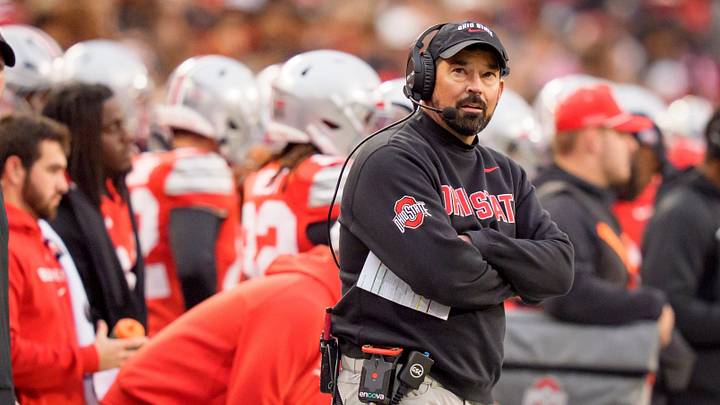
Ohio State (1)
The high point: Ranked No. 1 to start the season and through Week 1. Now: 6–3, 4–2 in the Big Ten and well outside the College Football Playoff bracket.
Oh, this is bad. Really bad, at a place that doesn’t process bad very well. After being thoroughly beaten by USC and Oregon, the Buckeyes have lost two regular-season games in a row for the first time since 2011, when Luke Fickell was the interim coach after Jim Tressel was fired amid an NCAA scandal. But it’s not just that—the Buckeyes have lost two regular-season games in a row by double digits, something that even the 6–6 team of ’11 avoided doing. Last time that happened: Oct. 9–16, 2004.
That was under Tressel, who rebounded to have several more excellent seasons after an 8–4 stumble. Anyone who wants to fire Ryan Day is A. ridiculous and B. should keep that 2004 blip in mind. But it is alarming to see Ohio State fall apart the way it has since the injury to quarterback Julian Sayin—especially since the collapse can be largely attributed to defense and special teams. As was the case in the loss to USC, the Buckeyes were lit up with big plays—Oregon had a 48-yard touchdown run and a 31-yard pass, plus a 30-yard fake punt pass that kept alive its first touchdown drive. Against the Trojans, Ohio State surrendered a 44-yard punt return that set up a TD.
Truth be told, this Ohio State defense hasn’t been good all season at getting off the field on third down. Against Power 4 competition they’re giving up a 45% conversion rate, which is 15th in the Big Ten. That contributed to blowing a 14–0 lead against the Ducks, at home, in front of a Horseshoe crowd that left early as the game unraveled.
The biggest problem for Day: His team has had too many meltdown games. For a few years it was largely confined to playing Michigan, but lately there have been more of them. Losing a 20-point lead to Texas was bad, but it was on the road against a CFP-caliber opponent. Never leading against USC was worse. The collapse against the Ducks was the worst non-Michigan loss of Day’s tenure.
Backdooring into the Big Ten championship game and maintaining a slim playoff chance isn’t completely out of the question, although it would require winning the last three games and losses by Indiana, Oregon and USC (at least). This was not a team built for a Citrus Bowl bid. Keep an eye on the quit factor in Columbus.
LSU (2)
The high point: Ranked No. 7 on Sept. 19. Now: 6–3, 3–3 in the Southeastern Conference and owning zero quality wins.
They didn’t pay Lane Kiffin $13 million to beat nobody, but that’s exactly what he’s done through nine games coaching the Tigers. Best victory to date: over a 5–4 Auburn team. Losing to Mississippi was not greeted warmly, but that was more of an estranged couple spat to which LSU was a third party. Losing to Kentucky definitely played poorly, but that was by a point in overtime on the road against what turned out to be a pretty good team. But a home beatdown against hated Alabama that removes the Tigers from playoff contention (yet again)? LSU fans will turn on a coach in a heartbeat, and they have with Kiffin.
After taking a 13–10 lead late in the third quarter, LSU fell apart. The Tigers gave up a 57-yard pass, a 32-yard punt return, a 25-yard pass and failed three times to convert on fourth down (four times total for the game). One of those was a fourth-and-10 from LSU’s own 25-yard line in a two-score game with eight minutes still to play—a classic Whatever Ball Kiffin move.
LSU still has two prime opportunities to add quality wins, with Texas at home and at Tennessee. But those also could be losses on the way to 7–5. Brian Kelly never did that.

Mississippi (3)
The high point: Ranked No. 4 on Sept. 26. Now: 6–3, with losses by 24 and 35 points.
The Rebels now have two no-show performances on the résumé—one in a hangover game at Florida after the LSU grudge match, but the other was at home Saturday in a complete wipeout against Georgia. The Bulldogs are now the No. 1 team and CFP favorite, capable of making a lot of teams look bad. But Ole Miss’s previously productive offense was completely destroyed. Quarterback Trinidad Chambliss had season lows of 170 yards passing and 158 yards total offense, and for the first time in 2026 did not throw a touchdown pass.
There isn’t much left on the schedule that will help Ole Miss climb back into the CFP race, and earlier victories over LSU and Missouri have been devalued. Outside looking in.
Missouri (4)
High point: Ranked No. 13 on Oct. 17. Now: 6–3, 3–3 in the SEC.
The Tigers missed a prime opportunity for a bracket-busting win at home against Texas on Saturday. While there were multiple officiating calls that outraged Mizzou fans—including an Arch Manning incompletion that was somehow fortuitously ruled a fumble that resulted in a drive-sustaining Texas first down—those are excuses that better teams don’t need to make. The bigger issues against an injury-riddled Longhorns team: a blocked punt, two missed field goals and a secondary that left receivers running free much of the afternoon.
Mizzou could change its trajectory Saturday by winning at Georgia, but that’s a long shot. This looks like an 8–4 or 7–5 team.
Florida (5)
High point: Ranked No. 8 on Oct. 3. Now: 5–4, 3–4 in the SEC, completely out of the playoff picture and trying to have a winning season.
Jon Sumrall has hit some high notes in his first season, shocking Texas in Austin and defrocking Ole Miss in The Swamp. But the reality checks have come in bunches: a 28-point loss to Missouri and a 19-point home loss to South Carolina in consecutive weeks; then losses by 19 to Georgia and 16 at home to Oklahoma. Porous midseason defense has given way to a sagging late-season offense, with starting QB Aaron Philo missing most of the last three games.
Sumrall’s first year is still a success. The fast start engendered some false hope for more. That has been extinguished.
Already Dead, Rigor Mortis Setting in
It was bad. It has gotten worse.
Michigan (5)
Current status: 5–4, bottoming out in a dismal home loss to a very bad Michigan State team. The Wolverines were scoreless for more than 57 minutes. Six times in nine games, Michigan has failed to score 20 points.
Kyle Whittingham is barreling toward a 5–7 first season in Ann Arbor, which will raise legitimate questions about whether there should be a second. Offensive coordinator Jason Beck was not a sustainable option, with multiple highly rated quarterbacks flailing this season in his offense, and was fired Sunday.


Nebraska (6)
Current status: 5–4, losers of four in a row, averaging 13.5 points in that streak. Head coach Matt Rhule scapegoated another assistant coach, this time OC Dana Holgorsen, firing him Saturday. Rhule has run through staff and run out of excuses.
This has been a spectacularly mismanaged program, both in terms of staff and players. Athletic director Troy Dannen extended Rhule in the middle of last season, before another collapse, making him very expensive to fire. This year they announced that quarterback Anthony Colandrea has been signed up for 2027, without compelling evidence that he’s anything more than an unpredictable scrambler. One of the best fan bases in the sport deserves better.

Texas A&M (7)
Current status: 4–5 and 1–5 in the SEC, after starting the season in the top 10. The Aggies are perfecting ways to lose.
The latest: Racking up 457 yards of total offense with no turnovers and still not scoring a touchdown in a 17–9 loss to South Carolina. With a three-year starting quarterback, the Aggies are last in the SEC in pass efficiency. A&M has thrown two TD passes in six SEC games. This is another place that seems destined for an offensive coordinator change.
Back From the Dead
Teams that were written off at varying points but are, improbably, in the playoff hunt.
Oregon (8)
High point: Ranked No. 2 to start the season. Low point: A 4–3 mark on Oct. 24. Currently: 6–3 after consecutive wins over Northwestern and Ohio State. With two losses in Big Ten play, the Ducks are in the hunt for the league championship game.
Since falling behind the Wildcats 20–6 with less than two minutes left in the first half, Oregon has rediscovered itself offensively. The Ducks scored 28 points in the last 31 minutes of that game and then added 41 against the Buckeyes, with backup QB Dylan Raiola regaining his old form. He has five touchdown passes and no interceptions in the last two games.
Oregon should be solidly favored in its final three games. We’ll see if 7–2 is good enough to get to Indianapolis.
USC (9)
High point: Ranked No. 12 after a 4–0 start. Low point: A 6–2 record after being suffocated at Wisconsin on Oct. 24. Currently: 7–2 after beating Ohio State on Halloween, and sitting out the carnage Saturday.
The Trojans can throw the Big Ten race into tumult in the final three games, playing second-place Indiana in Bloomington, Ind., on Saturday and first-place UCLA to close the regular season. It remains to be seen whether they have the internal steel to rise to that occasion, but they certainly do not lack the talent.
South Carolina (10)
High point: Right now. Low point: The Gamecocks were 2–3 and everyone in the world wanted to fire coach Shane Beamer. Currently: 6–3 and perhaps the hottest team not named Utah. Quarterback LaNorris Sellers has rediscovered his verve.
In terms of playoff contention, South Carolina has shoved its way to at or near the top of the SEC’s three-loss teams. The Gamecocks should be solidly favored against Arkansas on Saturday and Clemson to close the regular season. In between: Georgia comes to Columbia, S.C. Win that game, somehow, and it would be hard to keep Carolina out of the playoff.
Dash Playoff Bracket
Each week, The Dash selects and seeds the 12 teams who belong in the College Football Playoff as if today were Selection Sunday. The current Dash bracket:
The Field
- Georgia (8–1)
- Utah (9–0)
- UCLA (9–0)
- Notre Dame (8–1)
- Miami (8–1)
- Texas (7–2)
- Indiana (8–1)
- Tennessee (8–1)
- Alabama (7–2)
- Wake Forest (8–1)
- BYU (7–2)
- Boise State (8–1)
Also Considered
- Texas Tech
- Kentucky
- Oregon
- USC
- Iowa
- South Carolina
- SMU
- Arizona
- Houston
- Duke
- New Mexico
First Round
- No. 12 Boise State at No. 5 Miami
- No. 11 BYU at No. 6 Texas
- No. 10 Wake Forest at No. 7 Indiana
- No. 9 Alabama at No. 8 Tennessee
Quarterfinals
- Peach Bowl: No. 1 Georgia vs. winner of No. 9 Alabama at No. 8 Tennessee
- Fiesta Bowl: No. 2 Utah vs. winner of No. 10 Wake Forest at No. 7 Indiana
- Rose Bowl: No. 3 UCLA vs. winner of No. 11 BYU at No. 6 Texas
- Cotton Bowl: No. 4 Notre Dame vs. winner of No. 12 Boise State at No. 5 Miami
PODCAST: Listen to Sports Illustrated’s college sports podcast, Others Receiving Votes, hosted by Pat Forde, on Apple and Spotify. Watch the show on SI’s college YouTube channel or on SI TV.
 Add us as a preferred source on Google

Pat Forde is a senior writer for Sports Illustrated who covers college football and college basketball as well as the Olympics and horse racing. He cohosts the Others Receiving Votes podcast for SI and is a regular contributor to the Tony Kornheiser Show podcast. He previously worked for Yahoo Sports, ESPN and The (Louisville) Courier-Journal. Forde has won 28 Associated Press Sports Editors writing contest awards, has been published three times in the Best American Sports Writing book series, and was nominated for the 1990 Pulitzer Prize. A past president of the U.S. Basketball Writers Association and member of the Football Writers Association of America, he lives in Louisville with his wife. They have three children, all of whom were collegiate swimmers.
Follow ByPatForde