%20%20--%3E%0A%3Csvg%20version%3D%221.1%22%20id%3D%22Layer_1%22%20xmlns%3D%22http%3A%2F%2Fwww.w3.org%2F2000%2Fsvg%22%20xmlns%3Axlink%3D%22http%3A%2F%2Fwww.w3.org%2F1999%2Fxlink%22%20x%3D%220px%22%20y%3D%220px%22%0A%09%20width%3D%2239px%22%20height%3D%2240px%22%20viewBox%3D%220%200%2039%2040%22%20enable-background%3D%22new%200%200%2039%2040%22%20xml%3Aspace%3D%22preserve%22%3E%0A%3Cpath%20fill%3D%22%23FFFFFF%22%20d%3D%22M38.5%2C7H28.2v26h10.3V7z%22%2F%3E%0A%3Cpath%20fill-rule%3D%22evenodd%22%20clip-rule%3D%22evenodd%22%20fill%3D%22%23FFFFFF%22%20d%3D%22M26.1%2C25.5c0%2C5.8-4.1%2C7.5-12.9%2C7.5C3.9%2C33%2C0%2C31.2%2C0%2C25.2v-1.1h11.6%0A%09v2.4c0%2C0.7%2C0.1%2C1.4%2C1.2%2C1.4c1%2C0%2C1.2-0.4%2C1.2-1.3v-0.9c0-1.6-0.9-1.6-3.5-2.2C2.2%2C21.7%2C0%2C19.7%2C0%2C15.3v-0.9C0%2C9.3%2C5.5%2C7%2C12.9%2C7%0A%09c10.2%2C0%2C12.8%2C2.6%2C12.8%2C7.4v1.8h-11v-2.9c0-0.6-0.4-1.1-1.2-1.1c-0.6%2C0-1.2%2C0.4-1.2%2C1.1v0.9c0%2C1.5%2C0.9%2C2%2C3.3%2C2.5%0A%09c8%2C1.6%2C10.5%2C3.3%2C10.5%2C7.5V25.5z%22%2F%3E%0A%3C%2Fsvg%3E%0A)
The U Is Back on Top, But Miami Football Looks Nothing Like Its Glory Days
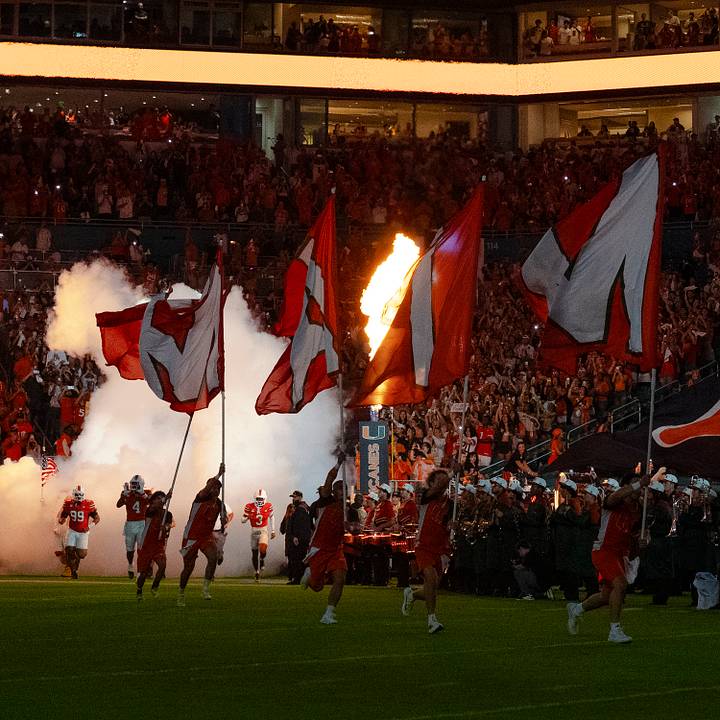
There are times when you can just feel Mario Cristobal’s Cuban-American blood rising to the same temperature as his beloved cafecito, the ultra-caffeinated espresso drink he consumes like a life force and that has become as much a part of the culture of his football program as orange T-shirts and U-shaped hand signals. You can feel it when he becomes animated with officials over a missed call or when a player does not act according to the standards of the team. You can feel it in the moments after a cathartic win, when the former offensive lineman’s already intense eyes widen further and the veins bulge ever so slightly on his forearms as he fist-bumps Hurricanes fans leaving the field.
If ever his pulse would quicken off the field, you would expect it to occur when Cristobal is forced to answer an inquiry he’s heard who knows how often since he was hired five years ago, one which has hovered over the tenures of his four coaching predecessors in a way that makes one of the best jobs in the country also one of the most demanding.
Is “The U” back?

Cristobal was peppered with that question quite a bit after the 2024 season, when Miami won double-digit games and finished in the top 20 for just the third time since joining the ACC two decades prior and produced the No. 1 pick in the NFL draft (quarterback Cam Ward). The question got louder last winter when the Hurricanes went from the last team invited to the College Football Playoff field all the way to the very last drive of the CFP final with a shot at another national championship.
Although there is an occasional expression of annoyance at having to address the topic constantly, Cristobal betrays no adrenaline surge over a subject his fan base obsesses over and pundits love to bring up in jest. The coach is often matter-of-fact in his response. He usually notes that he wants to take the principles, values and ambition that fueled the success of a past era, but is focused much more on what the current team is capable of accomplishing.
“You feel the progress, the momentum of the program and the university, and in our community the excitement that surrounds it,” he said in early October, nearly nine months removed from the six-point loss to Indiana that prevented the school’s sixth national title. “But truly, the focus is so quickly turned to the next step for us as a program.”
Some of that is natural coach-speak, from a mind sharpened over the years to always think about what is ahead in an attempt to get college-aged players to do the same. Some of it stems from Cristobal’s own experience growing up in Miami as the Canes ascended into a national powerhouse in the 1980s and as a member of two of Miami’s title teams.
That idyllic version of The U cannot be recreated today. The raucous old Orange Bowl is long gone. The bad-boy swagger the program took with it everywhere is consigned to documentaries and old footage. Alumni gatherings feature graying Hall of Fame players recalling an era that saw the Hurricanes win 212 games and five national championships over the course of a two-decade span beginning in 1983. It’s been 25 years since the last of those titles.
It has taken two decades for Miami to rebuild a winning culture that’s even close to that previous era. The New U looks significantly different in order for that to be the case.
College football rarely makes sense. It is surprising and shocking on a weekly basis, and assumptions about teams don’t pan out as often as you would think.
Miami was long the epitome of this maddening disconnect. On paper the program has everything one could ask for to build a successful team. The tree-lined boulevards around the Coral Gables campus offer a picturesque respite from the hustle and bustle of South Florida. Football talent is abundant, with the greater Miami-Fort Lauderdale area producing 32 players on Week 1 NFL rosters alone this season. The private university’s alumni base may not be as large as those of some other college football powerhouses, but it features plenty of supporters with deep enough pockets capable of opening any doors. Plus, there’s enough history of success that the Hurricanes are in the same neighborhood as nearly every blueblood when it comes to the trophy cabinet outside the team meeting rooms.

Yet from 2006 through ’24, Miami finished the season ranked just four times. The program that once produced a first-round pick for 14 straight years needed a late seventh-round selection in 2022 to preserve its streak of having at least one player drafted every year since 1975. None of the four coaches who cycled through after Larry Coker was axed in 2006 lasted more than five seasons. Sports Illustrated called for the program to be shuttered amid debilitating NCAA scandals more times (in 1995 and again in 2011) than the Canes have played for the ACC title (once, in 2017).
Many in South Florida point to a 90-second spiel from analyst Kirk Herbstreit during ESPN’s College GameDay on the morning of Sept. 25, 2021, as a moment that helped jolt The U out of its rut.
“You look at the powerhouse programs—Alabama, Clemson, Ohio State—president, AD, coach [have the] same vision. They’re aligned in their vision for what needs to happen. Recruiting, budget, staff. Whatever it needs, that’s what it takes,” Herbstreit said. “Miami doesn’t have that. So I don’t think it matters who the head coach is. Until you get a president and an AD and a coach together on the same page, I guess football doesn’t matter. It matters to the alums and the brotherhood, to The U, but I don’t know if it matters to the people making decisions at Miami.”
The Hurricanes had started that season ranked No. 14 but were blown out by Alabama in the opener and then needed a late field goal to beat Appalachian State. The weekend before Herbstreit’s comments, the team lost by three touchdowns to Michigan State in its worst nonconference home defeat since 1996. It felt like a nadir, but it turned out to be a rallying cry as a number of prominent alumni seized on the negative national attention as an impetus for change. Former school president Julio Frenk wasted little time in tapping longtime adviser Joe Echevarria and trusted confidant Rudy Fernandez to take a deeper dive into the athletic department to see what needed to be done.
The former CEO of consulting powerhouse Deloitte, Echevarria first came to Miami’s campus as an undergrad in 1974, a year after the school introduced its trademark green and orange U logo. A longtime season ticket holder who weathered plenty of down seasons before Howard Schnellenberger arrived in 1979 and made the Canes a national force, Echevarria was keenly aware of what a successful football program could do for the university.

Their first order of business was to examine the athletic department’s books, assess the school’s facilities and take a thorough accounting of the staff. These were benchmarked against schools that had won consistently over the prior decade in sports like football and men’s basketball. The goal was to lay out the gap that Miami had to make up.
“We were not financially committed to being great, but we had this expectation that we should be great because of that 20-year dynasty we had. We missed out on what it took to move into the new landscape,” says Echevarria, who took over as school president in 2024 after Frenk left for UCLA. “We quite frankly didn’t allocate much capital [to athletics], but we expected returns. Then we had to decide, are we going to commit to winning or not? We did the math on what it would take. To be great you have to invest, you have to have alignment, you have to hold yourself accountable to outcomes. It doesn’t work without those three things. That’s what’s changed.”
The school fired athletic director Blake James two months after Herbstreit’s comments and spent the rest of the fall addressing other areas of the department. Amid an up-and-down campaign under then coach Manny Diaz, that largely meant putting enough pieces in place to make a run at a coach who would be worth an expensive investment: Cristobal.
The allure of coming home was obvious for the former Cane, who at the time had the head job at Oregon. He would make the cross-country trek often to recruit the area or to be with his ailing mother, Clara, before her passing. Still, leaving the Ducks for Miami would have been tough for any coach looking at the matter objectively. At Oregon he had some of the best facilities in the country, buy-in from mega-booster Phil Knight, a supportive administration and a roster which he had transformed from a 4–8 team prior to arriving in Eugene into one which made three consecutive Pac-12 title games. The Hurricanes had recently completed an indoor practice facility which didn’t even contain a full 100-yard field, were still several weeks away from plucking Clemson’s Dan Radakovich to become athletic director and had one postseason victory in 15 years.

“The best training ground I ever had was to be part of a process where things weren’t aligned,” noted Cristobal, who led nearby Florida International in his first head coaching job before being fired. “Sometimes there’s casualties that come with that from an employment standpoint. But you learn a ton.
“Miami in the ’80s was so good, I think people fell asleep at the wheel. It’s like, Oh, we don’t need new facilities. We don’t need a budget. We don’t need increased staff. We’re just going to win. You blink an eye and 20 years go by and it’s like, Where’s Miami?”
Fernandez, longtime trustee Manny Kadre and several others made the pitch to Cristobal that things would be different. Miami was ready to do what it takes to return to the top. Cristobal accepted the job in December 2021. His arrival helped create the alignment essential to a successful program. It also helped that the money taps were opened in a way they had not previously been at the school. According to the most recent data submitted to the Department of Education, Miami’s overall athletic budget climbed from $115.2 million in 2019 to $230.5 million in 2024 (the highest in the ACC). Football has been the main beneficiary of that increase, with operating expenses for the program more than doubling in the same time period to within $5 million of what was being spent at Ohio State and Notre Dame.
Donations to the department have seen an uptick as Cristobal has improved the team’s record every year, and an apparel deal with Nike that begins in 2027 is expected to be among the most lucrative in all of college football. Much of the Canes’ newfound financial heft, however, is attributed to the recent success of the University of Miami Health System. Echevarria became CEO of the hospital unit a few months into the COVID-19 pandemic and helped aid its transformation from a money-losing operation less than a decade ago into one of Miami’s crown jewels. He notes that roughly 85% of the university’s overall revenues can be attributed to the system, a considerable sum given that recent tax returns reported revenues rose 66% for the school overall from $4.23 billion in 2019 to $7.04 billion in 2025.
“We invest across the whole enterprise,” Echevarria says, naming academics, athletics and the health system as three key verticals. “Athletics is what carries the brand recognition of the university more than anything else. You know when people throw The U at you, it’s not because of teaching and research and patient care. All that institutional pride and connection is driven by athletics. So for us, athletics is an investment, not a cost. It’s an investment in the brand of the University of Miami. It makes the health system better. It makes the academic core better.”
In modern college football, brand investment is another way of saying you’re willing to pay big for talent. And few teams have been as aggressive as Miami in the NIL era.
According to an SI survey of coaches and personnel executives around college football, Miami is seen as having the most expensive roster in the ACC this season, with a decent margin between them and the chasing pack. Most estimates put the Canes’ payroll north of $40 million, a number that allowed Cristobal to retain 10 starters from last season’s run to the championship game, add a highly rated high school recruiting class and bring on a transfer portal group that 247Sports ranked in the top five in the country. The result is a group which regularly draws NFL scouts and general managers to practices and games and makes Miami one of the favorites for this year’s College Football Playoff.

“I never imagined any of this,” says tailback Mark Fletcher Jr., who flipped to the program from Ohio State in Cristobal’s first recruiting class. “As a little kid I always watched Hurricane players do things, like in the 30 for 30 [documentaries]. Now it’s crazy that I’m one of those guys that little kids can look up to.”
Fletcher and fellow South Florida native Malachi Toney both turned into national stars last year for the program, but the returnees took a backseat early this season to the team’s most prominent transfer acquisition, quarterback Darian Mensah. Landing the former Duke signal-caller was a statement of intent at a position that has held the program back more than any other the past few decades.
“It’s a pro-style program, just all-around professional. If you ask Coach Cristobal, he’ll tell you the same thing. The way he handles business is the way I try to handle mine,” says Mensah. “This isn’t just a transfer to Miami, I definitely thought about it [being] my next step before the NFL.”

The offseason hoops that Mensah needed to jump through—entering the transfer portal in the final hours and needing a lawsuit (later settled) to extricate himself from a $4 million NIL deal with the Blue Devils—may have been a bit messy, but it’s hard to say it hasn’t worked out so far. Through eight games, the QB had posted a passing efficiency rating nearly 20 points better than last year’s Heisman winner, Fernando Mendoza, led the country in completion percentage and was tied for the most touchdown passes.
“This team learns and understands that we can’t really allow anything to get in the way of a 1–0 process,” Cristobal said after beating Clemson in early October. “With all the distractions that surround our players in the modern college football world, there’s nothing more important than being where our feet are—focused on this simple process that we create.”
That’s easy for a coach to say. But each win the program notches raises the temperature around Miami further, especially as they have returned to No. 1 in the polls for the first time since 2002. So, is The U back?
“I believe this as a fan and as a person who has some responsibility for this, that college football is better when the University of Miami is winning and when we’re relevant,” Echevarria says. “It’s different now. It’s not back. It’s a new version of us in a different era.”
PODCAST: Listen to Sports Illustrated’s college sports podcast, Others Receiving Votes, hosted by Pat Forde, on Apple and Spotify. Watch the show on SI’s college YouTube channel or on SI TV.
 Add us as a preferred source on Google

Bryan Fischer is a staff writer at Sports Illustrated covering college sports. He joined the SI staff in October 2024 after spending nearly two decades at outlets such as FOX Sports, NBC Sports and CBS Sports. A member of the Football Writers Association of America’s All-America Selection Committee and a Heisman Trophy voter, Fischer has received awards for investigative journalism from the Associated Press Sports Editors and FWAA. He has a bachelor’s in communication from USC.
Follow bryandfischer