%20%20--%3E%0A%3Csvg%20version%3D%221.1%22%20id%3D%22Layer_1%22%20xmlns%3D%22http%3A%2F%2Fwww.w3.org%2F2000%2Fsvg%22%20xmlns%3Axlink%3D%22http%3A%2F%2Fwww.w3.org%2F1999%2Fxlink%22%20x%3D%220px%22%20y%3D%220px%22%0A%09%20width%3D%2239px%22%20height%3D%2240px%22%20viewBox%3D%220%200%2039%2040%22%20enable-background%3D%22new%200%200%2039%2040%22%20xml%3Aspace%3D%22preserve%22%3E%0A%3Cpath%20fill%3D%22%23FFFFFF%22%20d%3D%22M38.5%2C7H28.2v26h10.3V7z%22%2F%3E%0A%3Cpath%20fill-rule%3D%22evenodd%22%20clip-rule%3D%22evenodd%22%20fill%3D%22%23FFFFFF%22%20d%3D%22M26.1%2C25.5c0%2C5.8-4.1%2C7.5-12.9%2C7.5C3.9%2C33%2C0%2C31.2%2C0%2C25.2v-1.1h11.6%0A%09v2.4c0%2C0.7%2C0.1%2C1.4%2C1.2%2C1.4c1%2C0%2C1.2-0.4%2C1.2-1.3v-0.9c0-1.6-0.9-1.6-3.5-2.2C2.2%2C21.7%2C0%2C19.7%2C0%2C15.3v-0.9C0%2C9.3%2C5.5%2C7%2C12.9%2C7%0A%09c10.2%2C0%2C12.8%2C2.6%2C12.8%2C7.4v1.8h-11v-2.9c0-0.6-0.4-1.1-1.2-1.1c-0.6%2C0-1.2%2C0.4-1.2%2C1.1v0.9c0%2C1.5%2C0.9%2C2%2C3.3%2C2.5%0A%09c8%2C1.6%2C10.5%2C3.3%2C10.5%2C7.5V25.5z%22%2F%3E%0A%3C%2Fsvg%3E%0A)
Sal Stewart Is the Runaway Favorite to Win NL Rookie of the Year. But He Shouldn’t Be.
In this story:
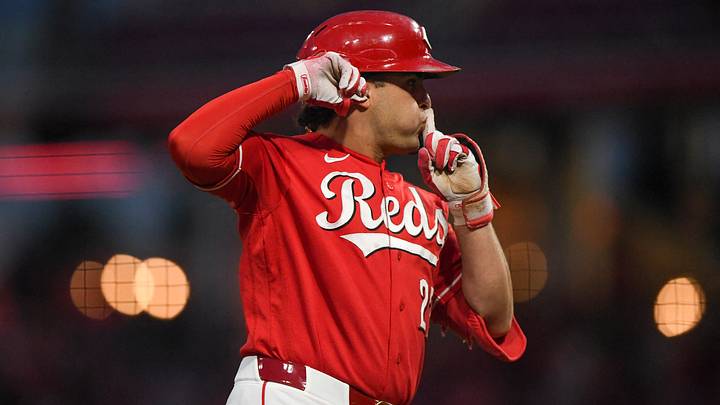
Sal Stewart’s impressive rookie season has him pegged as the runaway favorite to win the National League Rookie of the Year award. The Reds first baseman was impressive at the plate in his first full MLB season. He ranked third league-wide with 113 RBIs behind only Alec Burleson and Pete Alonso and hit 32 home runs, the second-most by a rookie in Reds history.
Among qualified rookies, Stewart led the league in RBIs and was inside the top 10 in home runs, doubles, walks, stolen bases, slugging percentage and OPS. His numbers were eye-opening, so it’s not hard to see why he’s gotten so much attention in the Rookie of the Year race. And he deserves plaudits for what was an impressive rookie campaign, especially for a 22-year-old. But the reality is that Stewart was far from the most valuable newcomer in the NL.
The three finalists for Rookie of the Year are Stewart, Cardinals second baseman JJ Wetherholt and Mets right fielder Carson Benge. While Stewart’s offensive numbers trump both of his competitors, his lackluster production in other facets of the game ultimately diminishes his value.
According to Statcast, Stewart ranked in the 77th percentile in terms of batting run value (+14). However, his baserunning and defensive metrics were far worse. He had -4 baserunning run value, which ranked in the fourth percentile, and -4 fielding run value at one of the least valuable defensive positions, which ranked in the 21st percentile. He was also was below league average in chase rate (32.1%), walk rate (9%) and strikeout rate (22.1%).
In terms of all around production, both Benge and Wetherholt outclassed Stewart. Wetherholt’s 4.6 fWAR ranked third among all rookies and was the highest among NL rookies. In fact, St. Louis’s breakout star was 31st in MLB in terms of fWAR, while Benge was only just behind him in 40th (4.3 fWAR). Stewart, on the other hand, ranked 214th with 2.0 fWAR.
The argument for JJ Wetherholt

Wetherholt was the best defensive infielder in MLB. He ranked in the 100th percentile in terms of fielding run value and was second league-wide in outs above average (25) and runs prevented (19), trailing only Pete Crow-Armstrong in both metrics. Despite that, he was snubbed for the Gold Glove at second base, with the award going to Brice Turang. He committed just two errors all year and had a .996 fielding percentage. He doesn’t have the strongest arm, hence why he’s slotted in at second base as opposed to shortstop, but he has immaculate range in the infield.
Wetherholt’s offensive numbers don’t necessarily jump off the page, at least not in the same fashion as Stewart’s, but that doesn’t mean he wasn’t highly effective at the plate. He has a keen eye in the batter’s box, rarely chasing pitches outside the zone––his 21.2% chase rate ranked in the 94th percentile league-wide. He walked in 10.3% of his plate appearances (65th percentile) and had just a 16.8% strikeout rate (77th percentile). For such a young hitter, those are incredibly encouraging metrics, and he’s also above league average in terms of xwOBA (82nd percentile), hard-hit percentage (76th percentile) and xSLG (68th percentile). Wetherholt also was a highly rated baserunner. While he had one fewer stolen base than Stewart, the Cardinals rookie was successful on 14 of his 15 stolen base attempts.
As brilliant as Stewart was at the plate, Wetherholt was a much more complete player during his rookie season, making contributions across the board while Stewart’s prowess was limited to his production at the plate.
The argument for Carson Benge

Benge looks like a superstar in the making. During his rookie season, he slashed .282/.346/.430 with 20 home runs, 65 RBIs and 22 stolen bases. He became the 18th player in MLB history to record a 20–20 season as a rookie. Benge was particularly good in the second half, when he had a .844 OPS with nine home runs and 28 RBIs over his last 62 games. He had a sluggish start offensively, logging a .525 OPS in his first 28 games, but he found his footing at the highest level after that. Benge had an OPS above .800 and recorded 10-plus RBIs in four of the next five months of the campaign. Benge’s post-April breakout put to bed any concern that he wasn’t ready to handle the leap from the minor leagues.
In addition to his strong offensive showing, Benge was excellent defensively in right field, ranking in the 85th percentile in terms of fielding run value (+8), per Statcast. He was in the 99th percentile in arm strength and 100th percentile in arm value, leading the National League with 10 outfield assists. Similarly to Wetherholt, Benge was masterful defensively at his position and was a five-tool contributor for New York. In a Mets season that was full of disappointment, there was perhaps no brighter spot within the organization than the emergence of Benge.
In all likelihood, Stewart will be named the NL’s Rookie of the Year on Monday night because of his flashy counting stats. But if that’s the case, Benge and Wetherholt will have a right to feel hard done and could enter their sophomore campaigns with a chip on their shoulders.
 Add us as a preferred source on Google

Karl Rasmussen is a staff writer for Sports Illustrated. A University of Oregon alum who joined SI in February 2023, his work has appeared on 12up and ClutchPoints. Rasmussen is a loyal Tottenham, Jets, Yankees and Ducks fan.
Follow Karlras920