
Angels Free Agency: Can Japanese Triple Crown Winner Teruaki Sato Fix Anaheim’s Power Crisis?
In this story:
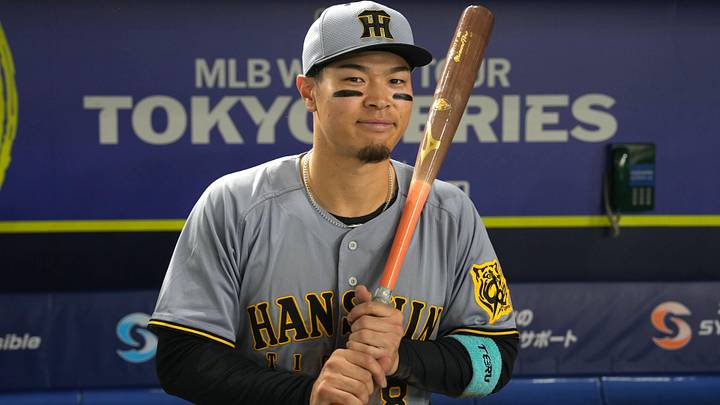
Yesterday the Hanshin Tigers confirmed they will post slugging third baseman Teruaki Sato this off season. Desperately needing to add impact bats and with a clear payroll ledger, the fit between the Angels and Sato is fairly obvious. But should the Angels take a $100 million plus gamble on the NPB standout?
The Allure of Teruaki Sato: Elite Power and a Triple Crown Pedigree
One quick look at Sato's baseline numbers will prove why he is an appealing target. In 2026 he won the NPB triple crown with a .306 batting average, 39 home runs, and 106 RBI. Overall the 29 year old's slash line was a truly impressive .306/.383/.609. Those 39 home runs came along with 40 doubles and 3 triples for a total of 82 extra base hits in 139 games.
This standout platform year follows a 40 home run campaign in 2025. Plus Sato performed well for Team Japan in the World Baseball Classic, going .300/.417/.600 with 3 doubles in 5 games.
Swinging exclusively from the left side, Sato crushes righties has a career .271/.337/.514 slash line with 163 home runs and 185 doubles in 803 games. He is the first winner of the Triple Crown since Muneteka Murakami in 2022. The MVP of the 2025 NPB season, Sato is widely expected to repeat the honor this year.
The Defensive Fit: Can He Solve the Angels' Hot Corner or Outfield Vacancies?

Third base has been a long term problem in Anaheim and the Angels are in need of outside help in 2027. And with the trade of Jo Adell, right field is open as well. In the short term a veteran solution at the hot corner is needed until the Angels Prospect of the Year Jake Munroe is ready for the big time.
Sato's reputation defensively at third base is mixed at best. Most scouts question his ability to stay on the dirt at the Major League level but he did win the Golden Glove there in Japan in 2025. It is notable that the Tigers play on a field with an all dirt infield that is known for ground balls that skip through the infield quickly.
Out on the grass, Sato's defense is universally considered subpar. But he is considered athletic enough to make improvements over time. A move to a
The Red Flag: Navigating the Extreme Swing-and-Miss Profile

Strikeouts are the biggest problem with the Angels offense and there are huge concerns about Sato's contact rate, or lack thereof. While crushing the ball the last two seasons, Sato has also struck out 27.6% of the time which is much higher than NBP norms. And he has done so against pitching that is nowhere near MLB quality most nights.
For comparison's sake, Murakami struck out 28.8% of the time over his last two seasons in Japan. His power translated to MLB with 35 home runs but his K rate increased to 35.4%. Essentially a three true outcomes hitter, Murakami managed an OPS of .805 with a .347 on base percentage thanks to 92 walks but he struck out 196 times in 127 games.
Contact rates tend to drop when Japanese players move stateside and face elite velocity and spin each night. Kazuma Okamoto was a contact machine who struck out a mere 11.3% of the time in his platform year and right around 17% in his NPB career and his K rate jumped to 28.8% his first year in Toronto.
The Verdict: Does a Lucrative Posting Bid Make Sense for Anaheim?

Last year the market for Japanese third basemen was a bit cooler than expected. Murakami's strikeout ratio combined with extreme skepticism he could stick at third base led to him taking a 2 yar $34 million from the White Sox. Sato is a year older but the much better defender at third base and his overall batting lines are a bit better than Murakami's last two seasons in Japan.
Meanwhile, Kuzuma Okamoto landed a 4 year $60 million deal from Toronto. The well regarded third baseman has a much higher floor than Sato but is also 30 years old, nearly three full years older than Sato. Power pays on the free agent market and Sato has far more power than Okamoto, albeit with more swing and miss.
Entering his age-28 season next year, Sato falls right into a desirable sweet spot for free agency. He has more professional experience and physical maturity than Murakami did when he left for MLB, but offers a longer competitive window for a rebuilding franchise than Okamoto. So experts expect his contract to be more lucrative than those two.
A reasonable expectation is for Sato to beat his countrymen in both average value and lenth of years. $20 million per year would handle the former while a 5 or 6 year deal solves the latter. So in all, it is at least a $100 million gamble before adding in the posting fee of $15 to $20 million.
Given the Angels primary weakness is striking out, paying $115 million to $135 million to add about 200 strikeouts per year does not make sense. The team would be better served signing free agent hitters who reduce the team's K rate and shooting for a front of the rotation ace or a completely revamped bullpen if they wish to splurge in free agency.
 Add us as a preferred source on Google

I'm a lifelong Angels fan who majored in journalism at CSU, Bakersfield and has previously covered the team at Halos Heaven and Crashing the Pearly Gates. Life gets no better than a day at the ballpark with family and friends.