
How Dustin May’s $52.5M Contract Reshapes the Angels' Plans for Reid Detmers and Yusei Kikuchi
In this story:
When surprising news broke from the south side of Chicago that the White Sox had signed Dustin May to a three year, $54 million deal that shattered expectations it led to a natural question in baseball circles: is this what back end starting pitching costs now? Considering that is what the White Sox just paid, the answer is "yes." Now come the ripple effects.
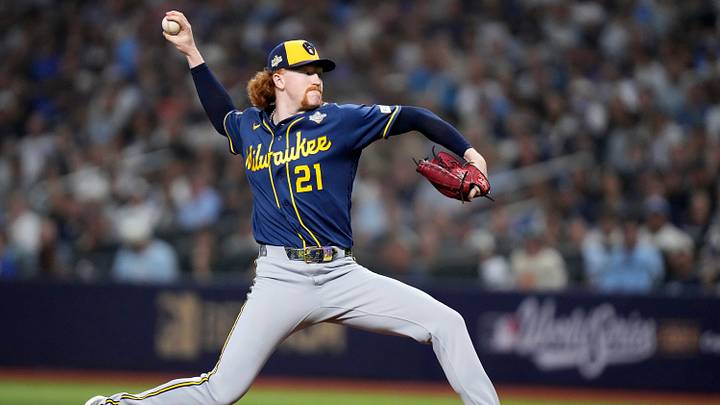
Coming off a 2026 season in which he posted a 4.70 ERA across 31 starts for St. Louis and Milwaukee—producing just 0.4 bWAR while logging a well-below-average 85 ERA+ —May has officially reset the financial floor for back end starting pitchers. If an arm with subpar run prevention and an extensive injury history commands both $17.5 million annually and a three year commitment, the Angels suddenly find themselves with an increased value for the pitchers on their staff. Most specifically, this impacts how the club could proceed with Reid Detmers and Yusei Kikuchi this off season.
Dustin May’s Deal Sets a Steep New Price for Back End Starters
For teams hoping to add reliable innings without breaking the bank on frontline aces like Tarik Skubal or Michael King, May’s contract serves as a sobering reality check. Major League teams are willing to pay premium dollars simply for durability and rotation depth.
When $17.5 million per year becomes the going rate for a pitcher who managed an 85 ERA+ across his last two campaigns and finished 2026 worth less than half a win above replacement, controllable, proven starters immediately skyrocket in value. For the Angels, who have historically struggled to build sustainable pitching depth through free agency, buying arms on the open market is clearly going to be cost-prohibitive. Fortunately, their internal assets just became exponentially more valuable.
Reid Detmers’ Extension Price and Trade Value Just Skyrocketed

Few players across baseball stand to benefit more from the new cost of pitching than Reid Detmers. After rebounding from a bullpen stint in 2025 to deliver a dominant 2026 campaign—posting a 3.36 ERA and 211 strikeouts across 185 innings while finishing sixth in AL Cy Young voting—Detmers is already a legitimate top of the rotation arm who is on the precipice of free agency.
With two years of arbitration control remaining before hitting free agency after the 2028 season, Detmers is projected to earn roughly $7.5 million in 2027. In a world where Dustin May gets $52.5 million for 0.4 bWAR, Detmers is one of the biggest bargains in baseball.
Before free agency even opened, Angels on SI projected a long term extension for Detmers at around five years and $100 million. Now, if the Angels want to lock Detmers up long term before his price tag climbs even higher in his final arbitration year, that $20 million annual baseline looks like the absolute starting point. Detmers’ camp can point directly to May’s $17.5 million AAV as the going rate for a back end starter and request more money for Detmers superior production and injury history.
Conversely, if the Halos listen to trade offers, their asking price should be astronomical. Contenders priced out of the free agent market will view two affordable years of Detmers as a golden ticket, allowing the Angels to demand a massive haul of top prospects. We recently looked at a trade to the Cubs for a trio of talented outfielders, and that package might already not be enough to land Detmers.
Yusei Kikuchi Re-Emerges as an Offseason Trade Chip

While Detmers represents a foundational piece or a blockbuster trade asset, veteran left hander Yusei Kikuchi suddenly looks like an intriguing, movable contract. Kikuchi is entering the final year of his three- year pact and is owed $21.225 million for the 2027 season.
As I previously noted when examining why trading Yusei Kikuchi this offseason makes financial sense, moving the veteran southpaw would clear payroll and open up rotation spots for young, cost-controlled arms like George Klassen and Ryan Johnson. Initially, moving over $21 million for a 35-year-old pitcher coming off an injury shortened 2026 season—where shoulder inflammation limited him to 14 starts and a 4.92 ERA—looked far fetched. However, May’s contract could completely change the math for rival executives.
Instead of committing $52.5 million over three years to a volatile arm coming off an 85 ERA+ stretch, a contending team could view a one year, $21.225 million commitment to Kikuchi as a much safer bet. Kikuchi was an All Star for the Angels as recently as 2025, and because he is on an expiring deal, acquiring him carries zero long term risk.
By eating a part of his 2027 salary or simply dangling him to teams that miss out on the first wave of free agent starters, the Angels might be able to capitalize on the inflated market and flip Kikuchi for young, controllable talent. Even in this market, the amount of contract the Angels are willing to absorb will dictate the talent return, but with more payroll flexibility than MLB prospects there is an opportunity to further the rebuilding effort by paying down some of Kikuchi's final year.
What Comes Next for the Angels' Front Office
The first move, obviously, is to set up a new front office that can execute trades and sign free agents. However, May's contract will give the new regime a solid platform from which to operate. They have a premier trade chip in Reid Detmers and a renewed one in Kikuchi. Of, if the richest owner in baseball wants to keep Detmers in the fold long term he will need to cut a larger check.
With the Angels talent level so far away from that of the upper crust, it would make sense to cash in on Detmers sky high value and see what they can get for Kikuchi. The returns for both will be better now that Dustin May is bringing home over $50 million.
 Add us as a preferred source on Google

I'm a lifelong Angels fan who majored in journalism at CSU, Bakersfield and has previously covered the team at Halos Heaven and Crashing the Pearly Gates. Life gets no better than a day at the ballpark with family and friends.